
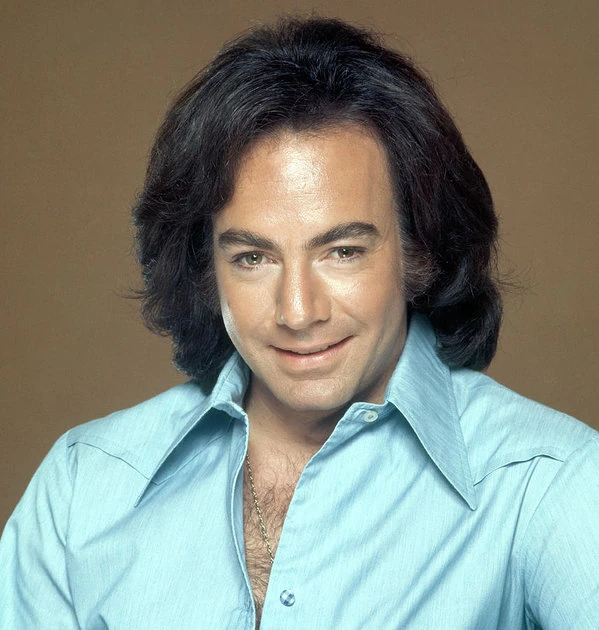
“Smokey Lady” is a snapshot of late-night desire—hazy, intimate, and fleeting—where the room feels small, the air feels warm, and the heart follows a silhouette it can’t quite hold.
In the sprawling arc of Neil Diamond, “Smokey Lady” is not one of the songs that radio crowned with a loud, measurable victory. It didn’t arrive as a headline single with a Billboard peak attached to its name. Instead, it lives where many of Diamond’s most revealing moments live: inside an album, tucked into the flow like a private scene you’re meant to discover. The song appears on Touching You, Touching Me, released November 14, 1969, with Diamond credited as the songwriter for the track.
That album context matters immediately. Touching You, Touching Me was Diamond’s fifth studio album, and it marked a subtle but important shift: it was his first since 1966 to mix his own writing with covers of other writers’ songs, placing his voice in conversation with the wider songwriting world rather than keeping it entirely self-contained. The record also had real commercial weight: it reached No. 30 on the Billboard album chart and was certified Gold in the United States. And while “Smokey Lady” wasn’t the chart driver, the album’s momentum was helped by the major hit “Holly Holy” (peaking at No. 6) and the minor hit “Until It’s Time for You to Go” (peaking at No. 53).
So where does “Smokey Lady” fit inside that picture? Precisely where its title suggests: in the dimmer light. It’s listed as track 3, running 2:40—a compact little film of a song, gone almost as soon as it fully takes shape. The album’s sound world—guided by producers Tom Catalano and Tommy Cogbill, with Lee Holdridge credited as arranger and conductor—leans into a kind of late-’60s pop sophistication: warm, orchestrated, emotionally direct without being melodramatic. In that setting, “Smokey Lady” feels like an interlude of atmosphere, a breath between the bigger, brighter statements.
The “story behind” the song, in the documented sense, is less about a famous anecdote and more about timing. Late 1969 is Diamond standing at a fascinating crossroads: he had already proven he could write a massive sing-along for the world, yet here he is placing a brief, moody portrait right near the top of the album, as if insisting that not every feeling needs a stadium to be valid. The title itself is a little time capsule. “Smokey” evokes clubs, cigarettes, soft-focus glamour—an era when romance could be suggested by the air itself, when the room did half the storytelling. It’s a word that carries both seduction and distance: you can see her, maybe; you can’t fully reach her.
That tension—between closeness and unreachable allure—sits at the heart of “Smokey Lady.” Even without turning the song into a literal plot, the emotional shape is clear: a narrator drawn toward a figure who feels half real, half invented by the night. The “lady” becomes not only a person but a mood—something you follow because it makes you feel alive, even if you know it won’t last. Diamond has always been skilled at writing romance that contains its own shadow, and here the shadow isn’t tragedy; it’s impermanence. The sense that this encounter—this fascination—might dissolve when the lights come up.
And that’s why the song’s meaning can feel strangely grown-up. “Smokey Lady” doesn’t sound like love as destiny. It sounds like love as a moment you’ll remember later with a mixture of sweetness and self-reproach: Why did I want what I couldn’t keep? Why did the haze feel more truthful than daylight? In the best Diamond performances, even the simplest scene carries that double awareness—pleasure now, memory later. A small joy that immediately starts becoming a photograph.
It also says something quietly important about Diamond as an album artist. Touching You, Touching Me is often remembered for its hits and its covers—and rightly so—but songs like “Smokey Lady” reveal his instinct for sequencing emotion. The album moves from familiar standards into his own inner cinema, and “Smokey Lady” is one of those scenes: the quick glance, the leaning-in, the silhouette that stays in your mind longer than it “should.”
So if you’re looking for a chart “ranking at release,” the honest answer is: “Smokey Lady” didn’t have one, because it wasn’t positioned as a hit single. Its success is the quieter kind—the kind measured by whether, years later, it still conjures a room, a scent, a feeling you can’t quite name. And maybe that’s exactly what Diamond intended in 1969: a short song that behaves like smoke itself—curling through the air, catching the light, then disappearing… while leaving you strangely certain it mattered.