
“Love Song” is a gentle act of faith—proof that the simplest words, spoken without disguise, can still feel like the bravest thing a person can offer.
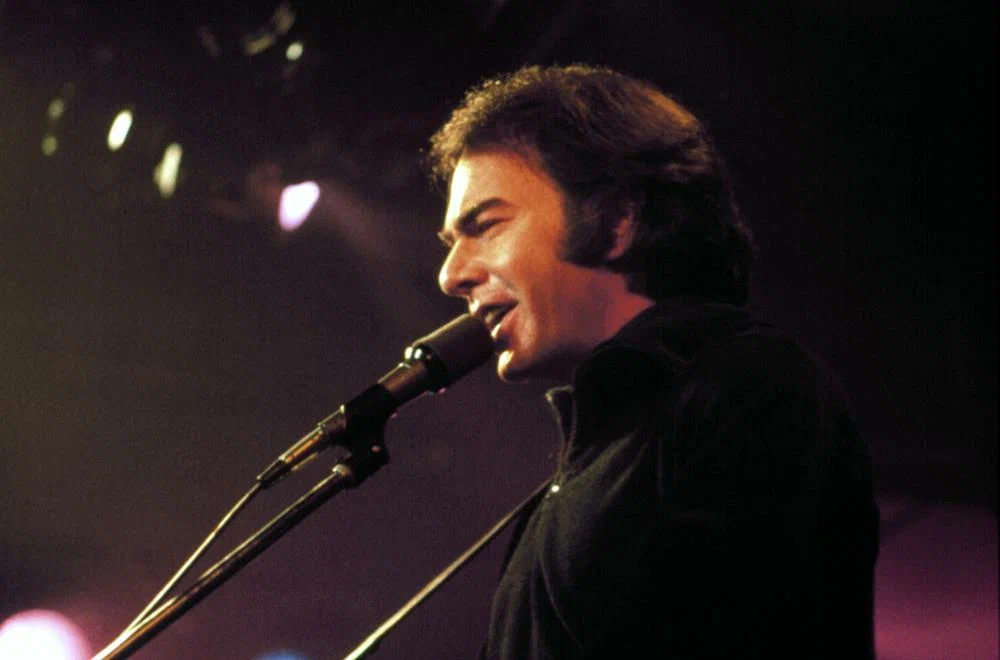
“Love Song” in Neil Diamond’s hands is not a youthful firework; it’s a late-evening lamp. His recording appears on Dreams—the album he released on November 2, 2010, produced by Diamond himself, built as a collection of songs he loved deeply enough to live inside. The album made an immediate statement on release: it debuted and peaked at No. 8 on the Billboard 200 (debut chart date November 20, 2010). In the UK, it reached No. 8 on the Official Albums Chart with a first chart date of November 13, 2010, and an eight-week run—quietly confirming that Diamond’s voice still had an address in people’s lives.
Inside that context, “Love Song” arrives as track 7, running 3:57, and—most crucially—it is not a Diamond original. It was written by Lesley Duncan, one of Britain’s early pioneering female singer-songwriters. That fact changes how you hear Diamond’s performance: he is not confessing so much as bearing witness—choosing another writer’s honesty and delivering it as if it had been sitting in his own chest for years.
There’s a lineage here worth savoring. Duncan’s “Love Song” traveled through the music world like a cherished letter passed hand to hand. Elton John recorded it for Tumbleweed Connection—notably the exception on an album otherwise written by him and Bernie Taupin—and later performed it with Duncan on stage in 1974, a moment preserved on a live release. That long, respectful afterlife is part of what makes Diamond’s version feel so poignant: he isn’t chasing a trend; he’s stepping into a song that already has history on its sleeves.
So what is the “story behind” Diamond recording it in 2010? Dreams was conceived as a personal album of favorites—“pop-canonical evergreens,” as Billboard described it—often delivered in stripped-down, intimate settings. AllMusic’s release information points to recording work in Los Angeles studios (including ArchAngel and EastWest), suggesting the kind of carefully lit studio environment where a seasoned vocalist can choose nuance over volume. And that, ultimately, is the “behind it”: a mature artist deciding that the grand gesture, at this stage, is restraint.
The meaning of “Love Song” is almost disarmingly plain—which is exactly why it can hit so hard. It is built on the idea that love doesn’t need cleverness to be true. The lyric’s power comes from its refusal to decorate itself: these are the words I have to say… maybe they will be simple, but they’re true. Diamond—an artist famed for theatrical lift when he wants it—sings this kind of line like someone setting down a heavy bag after a long walk. His tone doesn’t sparkle; it steadies. And in that steadiness, you hear the deeper promise: love as commitment to clarity, love as the courage to stop performing.
There’s also a subtle tenderness in the way this song sits within Dreams. The album moves through well-known material—songs that already belong to the public imagination. Yet “Love Song” feels unusually personal, perhaps because it’s not about romance as drama; it’s about romance as recognition. It suggests that the greatest gift isn’t intensity, but presence—the decision to speak carefully, to mean what you say, to keep your voice soft enough that the truth can be heard.
If you’re listening with years behind you, Diamond’s “Love Song” can feel like a small reconciliation between the person you were and the person you became: the realization that love, when it lasts, eventually stops trying to impress anyone. It simply tries to remain. And in that sense, this performance is less a cover than a quiet salute—one songwriter’s plainspoken masterpiece, carried gently by another singer who understands that sometimes the most enduring romance in music is not the shout, but the whispered certainty that refuses to fade.