
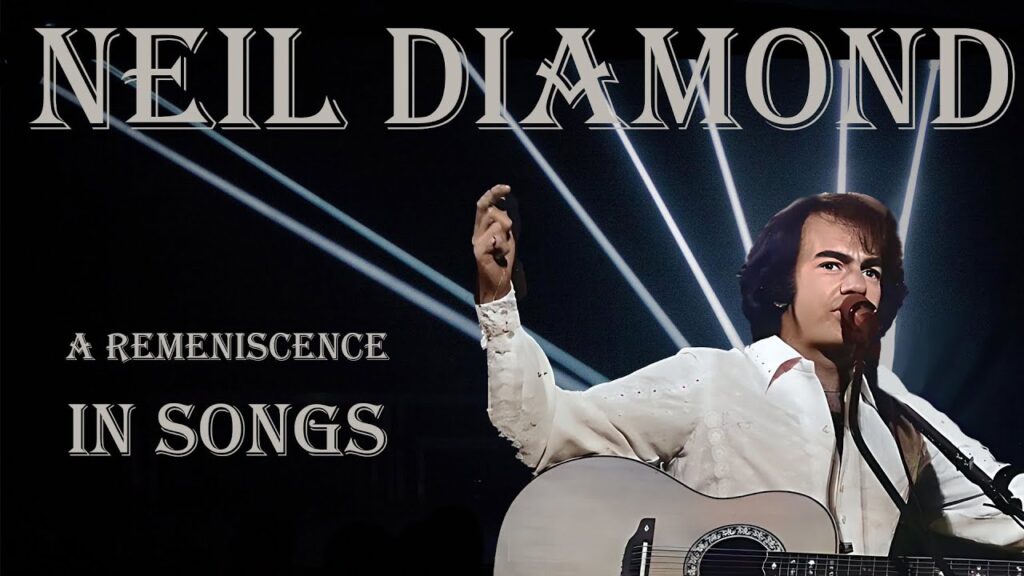
“Play Me (Live)” is the sound of a confident heart stepping into the spotlight—inviting the crowd not just to listen, but to lean in, to remember, to feel.
If you want the most important facts first: “Play Me” was written by Neil Diamond, first released on his 1972 studio album Moods, and it rose to No. 11 on the U.S. charts (Billboard Hot 100 peak). The beloved live performance most listeners have etched into memory comes from Hot August Night, recorded at the Greek Theatre in Los Angeles on August 24, 1972—a concert that helped cement Diamond’s reputation as a commanding live performer. That live album itself reached No. 5 on the U.S. Billboard 200.
But numbers only outline the frame. The true picture lives in the way “Play Me (Live)” breathes.
On the page, “Play Me” is already intimate—less a pop single than a private request dressed in melody. Yet in concert, especially on Hot August Night, it becomes something larger: a moment where a songwriter who once seemed most comfortable behind the curtain steps forward and lets the room carry the emotion with him. Hot August Night was recorded with a sweeping stage setup—band, audience electricity, and orchestral color—turning familiar songs into something almost cinematic. On that record, “Play Me” sits prominently in the flow of the night (it appears on the original track listing as part of “Side three”), surrounded by big crowd-pleasers—yet it doesn’t try to outshout them. It simply holds its ground, like a person who has finally decided they don’t need to raise their voice to be heard.
Part of the song’s spell is in its pulse. “Play Me” moves in a 3/4 waltz feel, and that gentle circular motion matters: it rocks instead of marches, it persuades instead of demands. The acoustic guitar texture—associated with Diamond’s collaborator Richard Bennett—adds to that sense of closeness, like someone speaking to you from the next chair rather than the far end of a stage. In the live setting, that tenderness doesn’t disappear; it’s framed by applause and atmosphere, which makes the vulnerability feel even braver. A studio recording can whisper. A live recording must whisper in public—and be willing to live with the silence between the words.
Lyrically, “Play Me” is built on one of the oldest human bargains: If you touch my life, I’ll let you see my truth. It’s not romance as fireworks—it’s romance as surrender, the kind that comes after a few seasons of learning what it costs to keep your guard up. The song doesn’t pretend love is clean or painless; it suggests that being “played” might be the risk we accept when we“P, t
That’s why this performance endures. Hot Aug is oNe onst When “Play Me” arrives in that set, it feels like the room briefly stops being a crowd and becomes a shared memory—people listening not only to a song, but to the person they used to be when they first heard it.
And maybe that’s the quiet genius of “Play Me (Live)”: it doesn’t chase youth. It doesn’t beg for novelty. It simply opens a door, and—if you’re willing—it lets you walk back into a time when songs weren’t just background noise, but companions.