
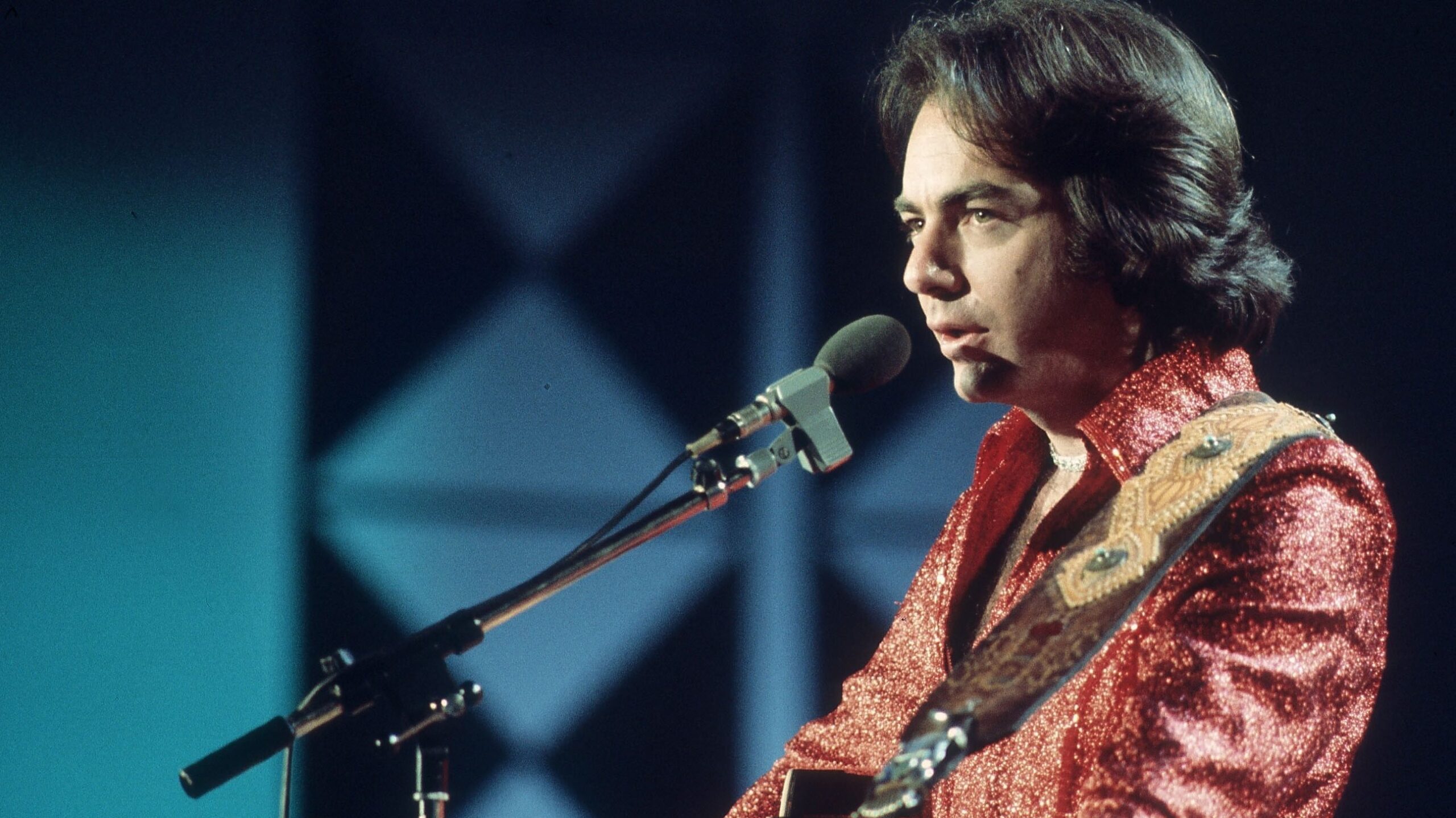
“I’ll Come Running” is early Neil Diamond in its purest form: a youthful vow sung with total conviction, as if love were a door you could sprint through the moment it opened.
Long before the arena anthems and the grand, candlelit choruses, Neil Diamond was carving his name into pop with songs that felt like handwritten promises—direct, urgent, and warmly human. “I’ll Come Running” first surfaced in July 1966 as the B-side to “Cherry, Cherry” on Bang Records, produced by the hitmaking team Jeff Barry and Ellie Greenwich. That pairing matters: “Cherry, Cherry” went on to become Diamond’s first major smash, reaching No. 6 on the Billboard Hot 100, which meant thousands of listeners—flipping the single over, letting the needle fall—found “I’ll Come Running” almost like a secret bonus track, a private confession riding in the wake of a radio hit.
A few weeks later, the song took its place on Diamond’s debut album, The Feel of Neil Diamond, released August 12, 1966. That record captured an artist right at the threshold: still close to the Brill Building’s punchy craft and clean hooks, yet already showing the emotional plainspokenness that would become his signature. The album gathered his early successes—“Solitary Man” (Hot 100 No. 55), “Cherry, Cherry” (Hot 100 No. 6), and “(I Got the Feelin’) Oh No No” (Hot 100 No. 16)—and surrounded them with album cuts like “I’ll Come Running,” songs that didn’t need chart glory to feel essential.
What makes “I’ll Come Running” linger is the way it treats devotion not as poetry to admire from a distance, but as an action—swift, certain, almost physical. Even the title is a heartbeat: no negotiation, no careful pride, no “maybe.” Just motion. In those early Bang-era recordings, Diamond often sounded like a young man learning that sincerity could be a kind of power. “I’ll Come Running” embodies that lesson. It doesn’t dress up its feeling; it commits to it. The lyric’s emotional posture is beautifully old-fashioned: if you call, I will come. If you falter, I will cross the room, the street, the years. There’s something disarming about that simplicity—especially now, when so much modern romance is filtered through irony, distance, or self-protection. This song belongs to a world where you could still believe, at least for three minutes, that love was a straight line and you were brave enough to follow it.
The behind-the-scenes details deepen the nostalgia. Jeff Barry and Ellie Greenwich—architects of so much 1960s pop—helped frame Diamond’s early voice inside a sound that’s crisp and propulsive, yet never cold. The production has that Bang label snap: bright enough for AM radio, sturdy enough to survive decades of listening. And yet the performance remains intimate. You don’t hear a star “performing” romance; you hear a young songwriter leaning forward into the microphone, trying to make a promise feel real.
There’s also an afterlife worth noting, because it confirms the song’s solid bones. Cliff Richard recorded “I’ll Come Runnin’” and released it as a single in June 1967, where it reached No. 26 on the UK Singles Chart—a reminder that Diamond’s early writing was already traveling, already adaptable, already speaking in a language other voices wanted to borrow.
In the end, “I’ll Come Running” isn’t famous because it shouted the loudest. It’s loved because it means what it says. It captures that particular, vanished kind of romantic courage—the kind that doesn’t overthink, doesn’t posture, doesn’t pretend not to care. And when you play it today, you can almost feel the era in the air: the click of a turntable, the glow of a small radio, the sense that a song could be a simple vow—and for the length of the record, you’d believe it.