
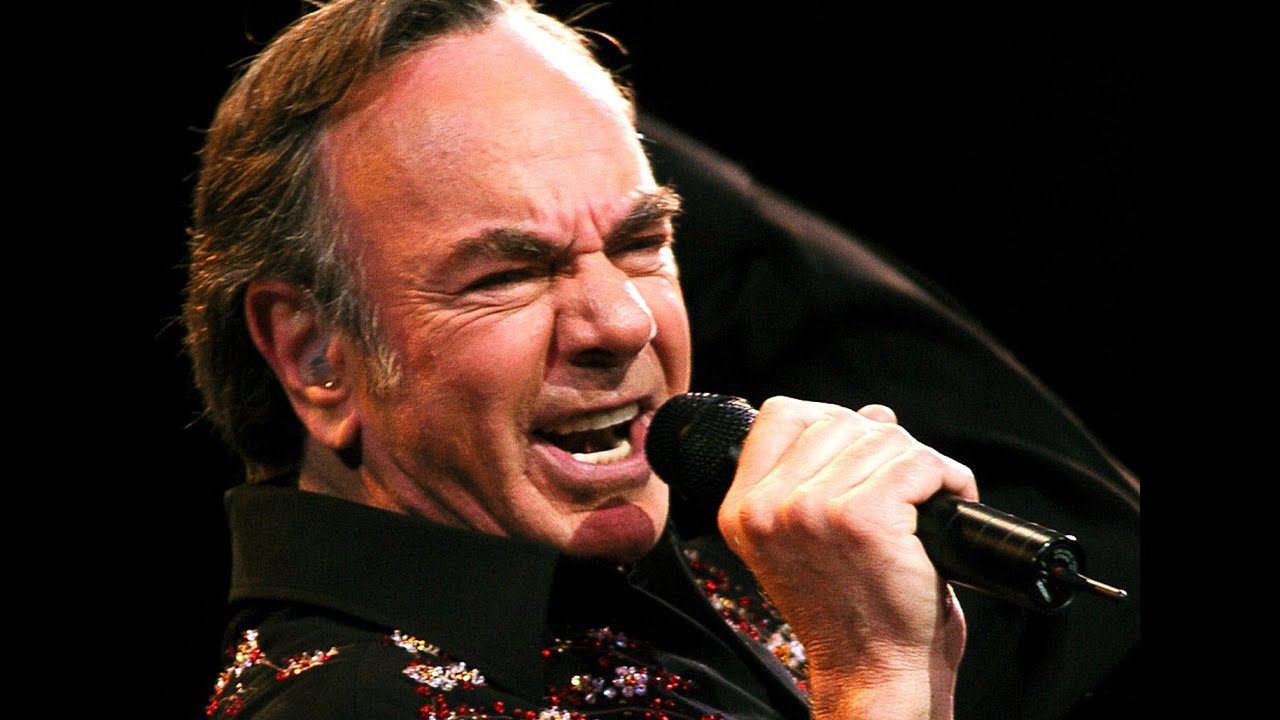
“And the Grass Won’t Pay No Mind” feels like a secret among true Neil Diamond listeners because it is so delicate, so inward, and so quietly wise that it seems to belong less to the charts than to the private places where memory and tenderness still meet.
When Neil Diamond wrote and recorded “And the Grass Won’t Pay No Mind,” he gave the world one of the gentlest songs in his catalog, yet it has never lived in quite the same bright public light as “Sweet Caroline,” “Cracklin’ Rosie,” or “Song Sung Blue.” That is part of its mystery. The song first appeared on Brother Love’s Travelling Salvation Show in 1969, later became part of his celebrated live album Hot August Night, and was even issued as a 1970 single in Australia, where it made only a minor chart appearance at No. 92. In the United States, it was not Neil’s version but Mark Lindsay’s 1970 cover that became the bigger hit, reaching No. 44 on the Billboard Hot 100 and No. 5 on Adult Contemporary. That history matters because it explains why the song still feels half-hidden in Diamond’s own story: admired deeply, covered by others, quietly cherished, but never pushed into the same public space as his most obvious anthems.
And perhaps that is exactly why true fans hold it so close.
There are Neil Diamond songs that arrive with instant grandeur, songs that stride into the room with their collars open and their emotions already burning brightly. “And the Grass Won’t Pay No Mind” does not do that. It drifts in softly, almost shyly. The opening image — listening easy, hearing God calling, walking barefoot by a stream — belongs to a different emotional register than the more theatrical Diamond many casual listeners know best. Here he is not the arena figure, not the great hitmaker reaching outward. He is the quiet poet of stillness, writing about an intimacy so complete that even nature itself seems to step back and leave the two people alone.
That title is one of the loveliest he ever wrote. “And the Grass Won’t Pay No Mind” suggests a kind of absolute privacy, a moment so tender and self-contained that the world neither judges nor interrupts it. The grass does not care. The sky does not interfere. Time itself seems to pause. In a catalog filled with hunger, yearning, and dramatic confession, this song feels different because it is built not on urgency but on hush. It is romantic, yes, but not in the usual pop sense. It feels more like a benediction than a seduction.
The song’s overlooked quality becomes even more striking when placed inside the arc of Diamond’s late-1960s work. He was writing some of the most emotionally vivid material of his career in that period, and yet certain songs naturally rose higher in public memory because they were bigger, more immediate, or more radio-friendly. “And the Grass Won’t Pay No Mind” asks for a slower kind of listening. It does not seize you by the lapels. It waits. That makes it easier to miss at first, but harder to forget once it has found its place in you. Its later inclusion on Hot August Night helped confirm that Diamond himself knew its value; he carried it onto one of his most beloved live statements because the song held something essential about the softer side of his writing.
There is also something especially moving in the fact that other artists heard its beauty so clearly. Elvis Presley recorded it in 1969, and Mark Lindsay turned it into a U.S. hit a year later. Songs get covered for many reasons, but they endure in multiple voices only when the writing contains a truth larger than one arrangement or one moment. In this case, that truth is tenderness without spectacle. Neil Diamond wrote many songs about love, longing, and emotional need, but “And the Grass Won’t Pay No Mind” has a rare serenity to it, as though love here is not a crisis to survive but a brief clearing in the noise of life.
That is why it feels like a secret passed between true fans. Not because it is obscure in any absolute sense, but because it belongs to that inner circle of songs listeners discover for themselves and then keep close. It does not need a giant chart number to validate it. It does not need public consensus. Its power is more intimate than that. The people who love it tend to love it quietly and for a long time.
So yes, “And the Grass Won’t Pay No Mind” remains one of the most delicate and overlooked treasures in Neil Diamond’s catalog. It is a song of stillness, closeness, and unguarded grace. And perhaps its deepest beauty lies in this: it never sounds like it is trying to become a classic. It simply is one, waiting patiently for the right listener to come upon it and understand, almost at once, why some songs are too tender ever to belong entirely to the crowd.