
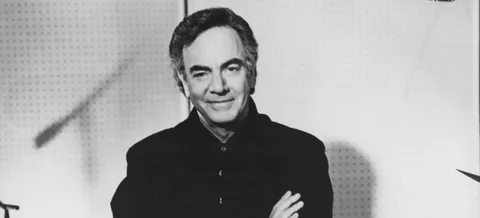
“Act Like a Man” is a late-career mirror held up without mercy—where pride, pain, and old rules about masculinity finally have to answer for the damage they’ve done.
By the time Neil Diamond sang “Act Like a Man,” he wasn’t trying to sound young, fashionable, or “current.” He was doing something rarer: sounding unprotected. The track appears as Track 7 on Home Before Dark—his 2008 studio album produced by Rick Rubin—and it runs a concise 4:04, long enough to bruise, short enough to leave you staring at the wall when it ends.
That album context is not decoration; it’s the frame that makes the song hit harder. Home Before Dark was released May 6, 2008, and it didn’t merely do well—it went straight to the top, reaching No. 1 in the United States, the United Kingdom, and New Zealand. At 67, Diamond became the oldest artist at the time to score a No. 1 album in the U.S.—a fact that reads like industry trivia until you remember what it really means: this was an elder voice, finally given the room to speak plainly, with nothing left to prove.
Rubin’s approach in this era mattered because it changed the emotional lighting. Instead of burying Diamond under gloss, the production culture around Home Before Dark is built to feel close—like the microphone is near enough to catch the grain of breath and the weight behind the words. In that setting, a title like “Act Like a Man” doesn’t sound like a slogan. It sounds like a sentence you’ve heard your whole life—maybe from a father, a coach, an older brother, a world that equated silence with strength—and you’re only now realizing how much that sentence cost you.
The phrase “act like a man” is loaded because it’s supposed to be simple. It’s a command that pretends to be guidance: don’t cry, don’t hesitate, don’t admit you’re scared, don’t ask for tenderness in a language that sounds like need. But the older you get, the more you discover how childish that command can be—how it turns people into locked rooms and calls it character. Diamond doesn’t treat the title as a celebration. He treats it like a confrontation: What did that idea of “manhood” make you swallow? What did it teach you to hide? Who did it keep you from becoming?
And that’s why the song belongs where it sits on the album—after the long, bruised meditations (“Don’t Go There,” “Another Day (That Time Forgot)”) and before the quieter reckonings that follow. “Act Like a Man” feels like the moment the narrator stops performing the part and starts telling the truth. Not with grand speeches—Diamond has never needed them—but with that particular late-night directness he does so well: a voice that can sound both weary and stubbornly alive, like someone who has carried the same private argument for decades and is finally ready to settle it.
There’s a special poignancy, too, in hearing this from a man whose career was built on public emotion—on choruses that became communal property. Here, the emotion is not designed for sing-alongs. It’s shaped like an internal conversation. The title suggests hardness, but the song’s real power is the vulnerability underneath it: the sense that “acting like a man” might have meant acting like someone you weren’t, and that the performance has run out of breath.
In the end, “Act Like a Man” isn’t an anthem about toughness. It’s a small, human document about what toughness has often been mistaken for—and what it can steal. It asks you to reconsider the old teachings, not with anger, but with that deeper, more unsettling feeling: recognition. And once you recognize yourself in it, the song doesn’t really let go. It just grows quieter—like a truth you can’t unhear, walking beside you all the way home.