
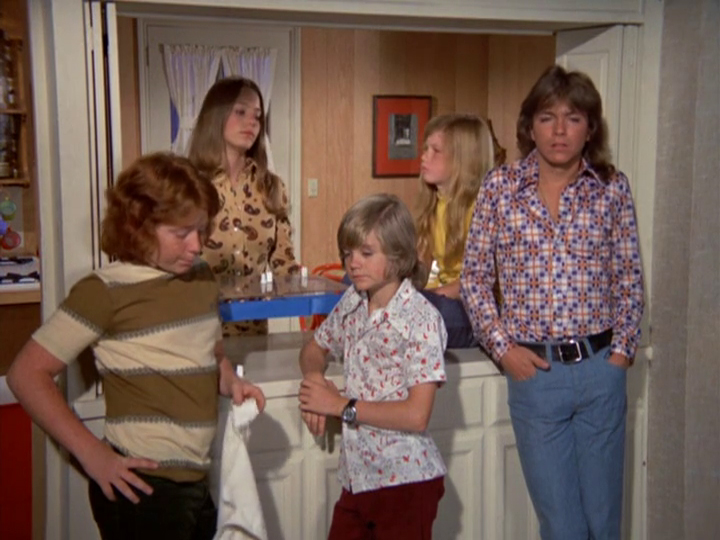
“Frosty the Snowman” becomes more than a holiday standard in the hands of The Partridge Family — it turns into a little burst of Christmas-stage magic, where family warmth, bright pop charm, and pure seasonal joy all seem to meet at once.
There are Christmas songs that arrive like ritual, and there are Christmas songs that arrive like company. “Frosty the Snowman” by The Partridge Family belongs to the second kind. It does not simply revisit a familiar holiday favorite; it freshens it with the kind of easy, bright-hearted charm that made the group so beloved in the early 1970s. Their version was released in November 1971 on the album A Partridge Family Christmas Card, the group’s fourth studio album and their dedicated holiday set. “Frosty the Snowman” was an album track rather than a standalone single, so it did not have its own separate Billboard chart peak. But the album itself was a major seasonal success: it became the best-selling Christmas album in the United States during the 1971 holiday season and held No. 1 on Billboard’s special Christmas Albums chart for all four weeks the chart was published that year. It was issued by Bell Records, produced by Wes Farrell, and recorded in Hollywood in 1971.
That context matters, because it tells us immediately that this was no casual novelty side project. A Partridge Family Christmas Card arrived when the group was at the height of its popularity, and it was received not merely as a television tie-in but as a genuine holiday record that listeners took into their homes. The album’s concept was simple and winning: one original song, “My Christmas Card to You,” surrounded by beloved Christmas standards, with David Cassidy handling most of the lead vocals and Shirley Jones also taking a featured turn on “The Christmas Song.” In other words, “Frosty the Snowman” lived inside exactly the kind of warm, family-centered setting that suited it best.
What makes this recording so easy to love is that The Partridge Family do not overthink the song. They understand something crucial about “Frosty the Snowman”: its magic depends on movement, brightness, and affection. A song like this can easily become either too childish or too stiff when later artists revisit it. But this version stays buoyant. It has the polished pop sheen of early-70s studio craftsmanship, yet it never loses the innocent sparkle the song requires. The performance feels like a holiday special in miniature — cheerful, close-knit, and touched with just enough studio gloss to make the season seem a little shinier than ordinary life.
That family charm was not accidental. The Partridge Family were built around exactly that image: a household that sang together, traveled together, and made music feel like something joyfully communal. Their Christmas album leaned into that identity beautifully. Even if the real recording process depended on top Los Angeles session players and careful production, the emotional effect remains one of togetherness. On “Frosty the Snowman,” that matters enormously. The song is already about shared wonder — a magical figure brought to life by children’s belief — and the Partridge version adds another layer of warmth by making the whole thing feel like a festive gathering rather than a formal performance.
The recording details reinforce that sense of craft beneath the charm. “Frosty the Snowman” was recorded on August 26, 1971, during the sessions for A Partridge Family Christmas Card. The album credits include elite studio musicians such as Hal Blaine on drums, Mike Melvoin on piano, Max Bennett on bass, and guitar work from Dennis Budimir and Louie Shelton. Background vocal arrangements were handled by John Bahler, while Wes Farrell shaped the rhythm arrangements and produced the album. Those names matter because they help explain why the song sounds so smooth and inviting. This was family pop, yes, but made by professionals who knew how to keep everything crisp, melodic, and radio-friendly without draining it of spirit.
And then there is David Cassidy, whose presence is impossible to ignore. His voice was one of the central reasons The Partridge Family records connected so strongly with listeners, and on a song like “Frosty the Snowman” he brings exactly the right quality: youthful warmth without strain, sweetness without syrup. He does not sing the song as though he is aiming for great interpretive depth. He sings it as though delight still deserves to be sung plainly. That restraint is part of the song’s success. Holiday music often suffers when performers try too hard to improve upon what is already beloved. The Partridge Family simply bring it to life.
That, really, is the heart of the song’s appeal. “Frosty the Snowman” is one of those tunes almost no one can resist because it carries such immediate emotional coding: snow, magic, children, laughter, motion, winter transformed into play. In the hands of The Partridge Family, those elements are wrapped in the bright optimism of early-70s pop. The result is not profound in the tragic or philosophical sense. Its greatness is different. It lies in its ability to make a room feel lighter, to make memory feel decorated, to make Christmas seem not merely observed but happily inhabited.
So yes, there is Christmas cheer here, and plenty of it. There is family charm, unmistakably. And there is that one tune nobody can resist, made newly vivid by a group who understood how to turn warmth into performance without losing the feeling underneath. The Partridge Family did not need to reinvent “Frosty the Snowman.” They only needed to welcome him in, dress him in their own bright pop colors, and let him dance again. That is why the recording still works. It does not ask to be judged against solemn masterpieces. It asks only to be loved — and in that humble, festive ambition, it succeeds beautifully.