
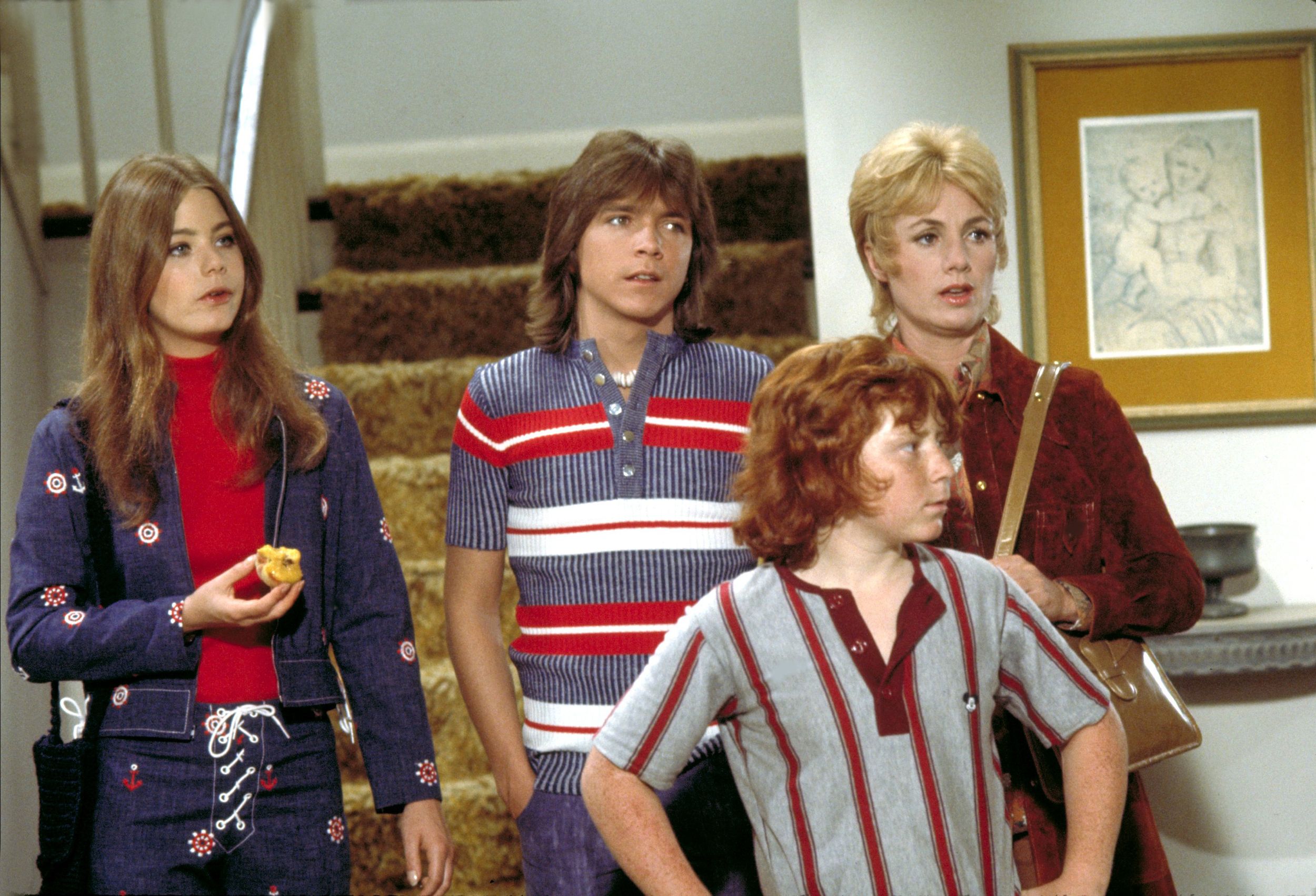
“Walking in the Rain” carries that rare kind of pop melancholy that feels almost physical — and in The Partridge Family’s hands, the longing turns soft, luminous, and unforgettable.
There are songs that arrive as hits, and there are songs that arrive as weather. “Walking in the Rain” belongs to the second kind. By the time The Partridge Family recorded it for The Partridge Family Notebook in November 1972, the song already had a history and a mood all its own. It had been written by Barry Mann, Cynthia Weil, and Phil Spector for The Ronettes, whose original 1964 version reached No. 23 on the Billboard Hot 100 and No. 3 on the R&B chart. That matters, because the Partridge Family were not reviving some anonymous old tune. They were stepping into one of the great early-1960s girl-group laments, a song already soaked in rain, yearning, and dreamlike romantic ache.
What makes the Partridge Family version so memorable is that they do not try to overpower that legacy. They do something subtler, and in some ways more touching. Their recording appeared on The Partridge Family Notebook, released in November 1972, and while it was not released as a single in the United States, it was issued abroad and climbed to No. 10 on the UK Singles Chart in 1973. The parent album itself reached No. 41 on the U.S. album chart and stayed in the Top 200 for 16 weeks. So this was not just a stray cover tucked away in the middle of a fading catalog. It was part of a record that still mattered commercially, and in Britain especially, listeners responded strongly to its wistful pull.
That response makes perfect sense when you hear the song. “Walking in the Rain” is built on one of pop music’s most durable emotional images: longing made visible in weather. Rain in songs can mean comfort, memory, loneliness, cleansing, or all of them at once. Here it becomes the atmosphere of desire itself. The narrator is not just waiting for love; she is wandering inside its absence. That is the reason the melody stays with you for days. It does not merely support the lyric — it seems to drift through it like mist. And when The Partridge Family sing it, that emotional weather becomes a little softer, a little more youthful, and perhaps a little more vulnerable than in the Ronettes’ version.
A great deal of that comes down to David Cassidy. By late 1972, he was far more than the photogenic face of a television phenomenon. He had become one of the defining voices of teen pop in the English-speaking world, and one of his real gifts was that he could make a polished studio record feel emotionally close. On “Walking in the Rain,” he does not oversing the ache. He lets the sadness remain suspended. That restraint is exactly why the performance lingers. It sounds less like a dramatic plea than like a thought you cannot stop repeating to yourself. The title promises melancholy; Cassidy gives it texture.
The recording details help explain why the track feels so smooth and carefully shaded. According to the album documentation, “Walking in the Rain” was recorded on September 22, 1972 at United Western in Hollywood for Bell Records, with Wes Farrell producing. The wider Notebook sessions used some of the finest Los Angeles studio musicians of the era, including players such as Larry Carlton, Tommy Tedesco, Hal Blaine, Joe Osborn, and Mike Melvoin across the album. Even when a Partridge Family record sounded easy and breezy, there was serious craftsmanship underneath it. That craftsmanship matters here: the song floats, but it never feels flimsy.
There is also something especially appealing about where this song sits in the Partridge Family story. Their biggest hits often leaned into bright hookiness, instant singalong appeal, or young-love sparkle. “Walking in the Rain” shows a gentler strength. It proves they could handle material with a deeper emotional tint, and not just coast on TV familiarity. The UK chart success of the single suggests that listeners there heard exactly that. In a market where David Cassidy was a massive star in his own right, this softer, moodier performance still cut through strongly enough to become a Top 10 hit.
What makes the song unforgettable, though, is simpler than chart position. It is the combination of rain, longing, and melody. Some melodies sparkle and disappear. This one seems to settle into the mind. It has that haunted, repetitive grace that mirrors the feeling of walking alone with the same thought circling over and over. The Partridge Family do not reinvent the song radically, but they do make it newly tender. They trade some of the original’s wall-of-sound drama for a more intimate ache, and that change gives the song a different kind of staying power.
So yes, The Partridge Family make “Walking in the Rain” unforgettable. Not because they turn it into a bigger spectacle, and not because nostalgia does the work for them, but because they understand the old pop truth at the center of it: a song about longing works best when it sounds as though the singer is still caught inside the weather. Here, they are. And that is why the melody stays — soft as drizzle, sad as memory, and much harder to shake than first-time listeners ever expect.