
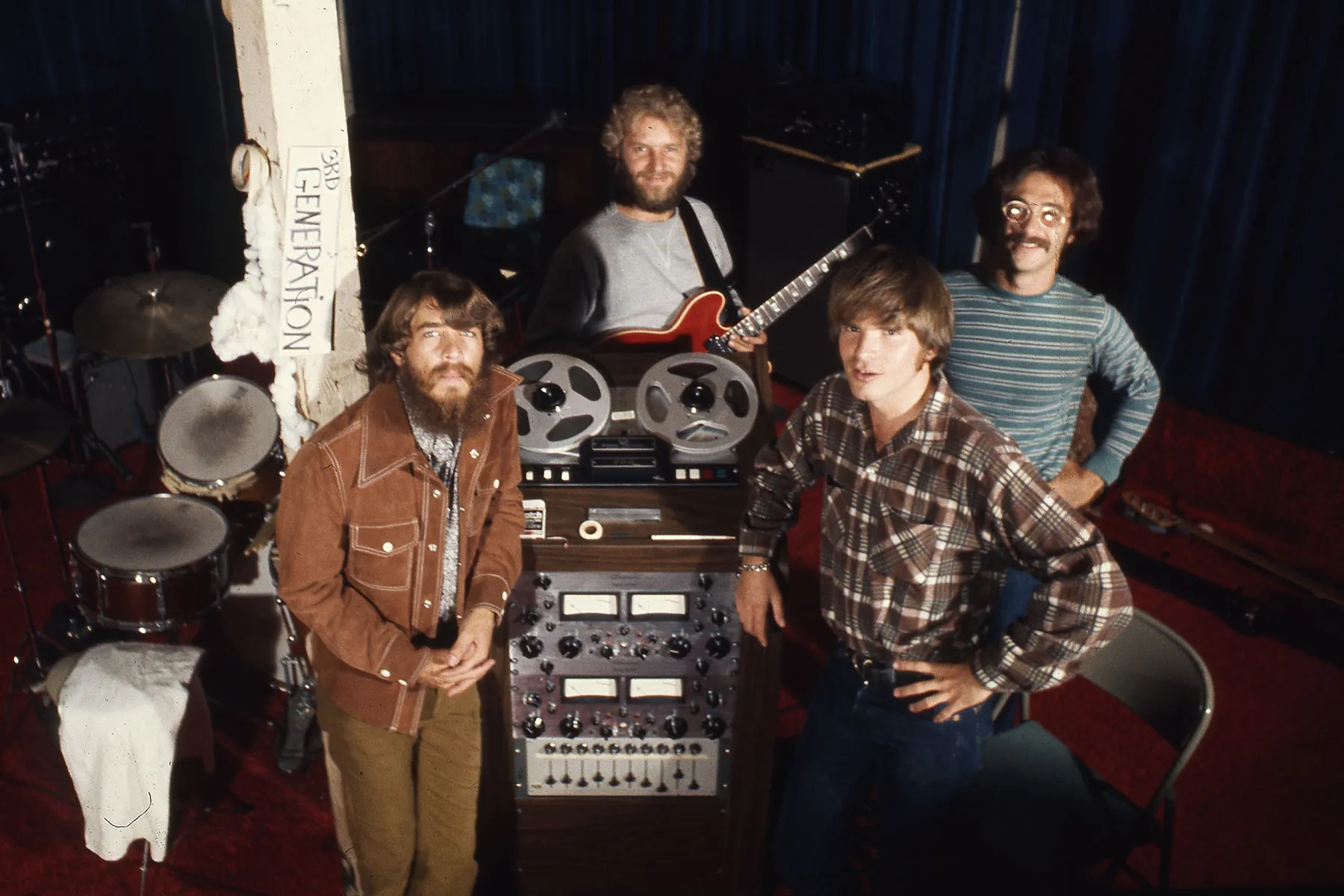
“Green River” made swamp-rock feel like a real place because Creedence Clearwater Revival did not play it like fantasy — they played it like memory, heat, mud, and childhood freedom you could almost step back into.
There are songs that create a mood, and there are songs that build a world. “Green River” belongs to the second kind. Released as a single in July 1969, a month before the album Green River, it climbed to No. 2 on the Billboard Hot 100 and was later ranked by Billboard as the No. 31 song of 1969. That chart run mattered, because it confirmed that CCR were no longer just a band with momentum from “Proud Mary” and “Bad Moon Rising.” They were becoming something larger: a group able to take a deeply specific American atmosphere and make it feel universal.
What made “Green River” so powerful was the way it turned swamp-rock from a style into a setting. Plenty of bands could borrow bits of Southern sound, but John Fogerty did something more vivid here. The song does not merely suggest humid backroads and lazy water — it makes them tactile. You can almost feel the rope swing, the muddy bank, the dragonflies, the sticky summer air. The groove moves like a current, and the lyric is full of remembered detail, which is why the song feels less like invention than recollection. It sounds as though the singer is taking you somewhere he has actually been.
And in an important sense, he was. Fogerty has long explained that “Green River” was inspired not by some mythical Louisiana bayou, but by his own childhood memories of Putah Creek near Winters, California, and by vacations at a cabin belonging to the Sekhon family. The phrase “Green River” itself also came from a soft drink syrup brand he remembered. That backstory is crucial, because it explains why the song’s sense of place is so strong. It is not travel-brochure Southernness. It is California memory filtered through Southern musical language — a personal landscape translated into a broader American myth. That fusion is one of the secrets of CCR’s whole appeal.
This is also why the song changed the meaning of “swamp-rock” for so many listeners. CCR were not from the Deep South; they were an East Bay, California band. Yet on records like “Green River,” they made Southern imagery feel startlingly convincing without sounding like costume. The song’s production helps enormously: recorded between March and June 1969 at Wally Heider Studios in San Francisco, written and produced by John Fogerty, it is compact, sharp, and unpretentious. Nothing is overdecorated. The guitar riff is lean, the rhythm section keeps everything moving, and Fogerty’s voice gives the whole track that half-shouted, half-remembered urgency that made CCR feel both rootsy and immediate.
There is also something quietly beautiful about the way “Green River” sits in CCR’s 1969 run. The Green River album became the band’s first No. 1 album on the Billboard chart, and it arrived in the middle of an extraordinary burst when the group released three studio albums in a single year. In that context, “Green River” was not just another hit. It was part of the moment when CCR’s identity crystallized completely: American, earthy, melodic, and able to make place itself feel like a hook. When listeners heard “Green River,” they were not just hearing a catchy single. They were hearing a band invent a territory of its own.
That is why the song still feels so transportive. “Green River” does not simply describe a place; it invites you into one. It turns memory into geography and geography into music. The water, the fields, the lazy summer drift — all of it becomes so immediate that the song seems to open a door rather than start a track. And that is why CCR became impossible to mistake. With “Green River,” they made swamp-rock feel like somewhere you could actually go, even if that place was part California creek, part Southern dream, and part pure American longing.