
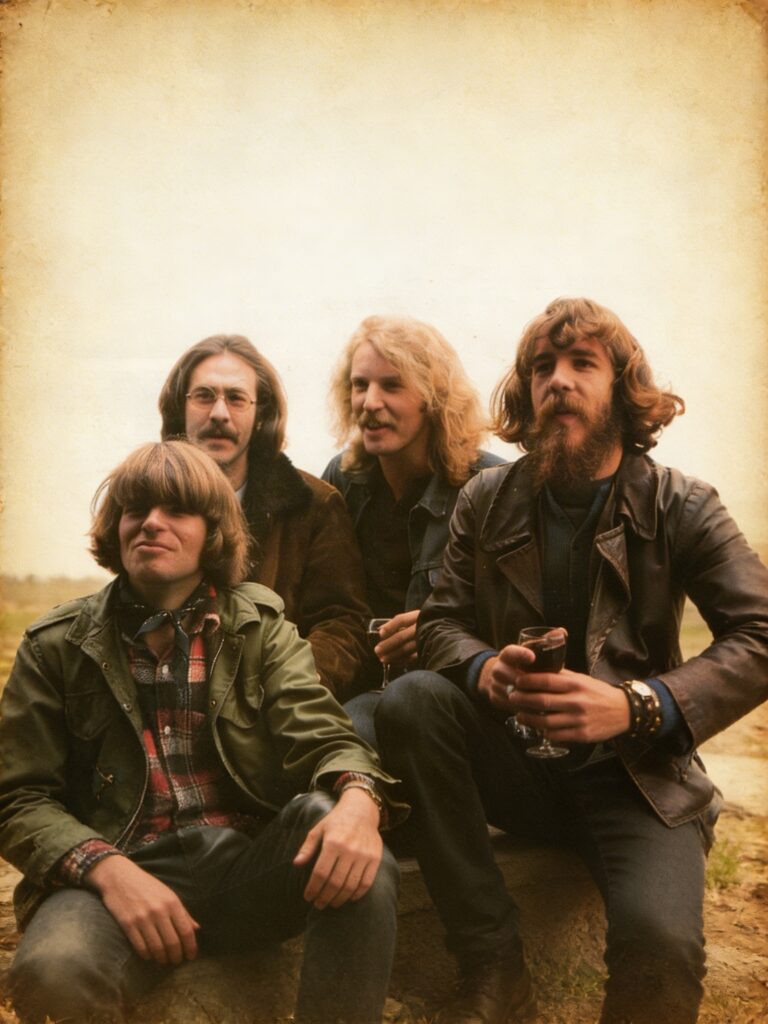
A quiet song about self-deception, longing, and emotional hesitation, Call It Pretending catches Creedence Clearwater Revival at the delicate threshold where one band identity was fading and another was just beginning to bloom.
Released in early 1968 as the flip side of Porterville, Call It Pretending stands as one of the earliest recordings issued under the name Creedence Clearwater Revival. It never became a national chart hit, and the single made no meaningful impact on the Billboard Hot 100. But history has a way of preserving what the charts overlook. Long before Suzie Q announced the band to a wide audience and long before Proud Mary turned them into a defining American group, this small, thoughtful recording was already pointing toward the emotional seriousness that would set them apart.
To understand why the song matters, it helps to remember where the group stood at that moment. John Fogerty, Tommy Fogerty, Stu Cook, and Doug Clifford had spent years recording under other identities, most notably The Golliwogs, while working within the orbit of Fantasy Records. By 1968, the musicians were stepping out of that earlier phase and moving toward something far more personal and enduring. Call It Pretending belongs to that exact in-between space. It does not yet deliver the full swamp-rock authority that later became their signature, but it reveals a band narrowing its focus, finding its emotional center, and learning how to trust understatement.
Written by John Fogerty, the song carries a softer, more introspective mood than many listeners expect when they think of Creedence Clearwater Revival. There is no grand theatrical gesture here, no oversized chorus designed to dominate the radio. Instead, the song leans on restraint. Its melody is gentle, its pacing unhurried, and its atmosphere tinged with the loneliness of someone trying to name a difficult truth without fully confronting it. Even in this early stage, Fogerty shows a gift that would later define so much of his writing: the ability to make ordinary emotional confusion feel vivid, specific, and unforgettable.
The title itself is the key to the song’s power. Call It Pretending is built around a familiar human instinct: if we rename something painful, perhaps we can live with it a little longer. The phrase suggests a relationship or emotional bond that has lost its honesty, yet the speaker cannot let it go cleanly. Rather than dramatizing the moment, the song lingers inside it. That hesitation is what gives the recording its ache. It is not simply about heartbreak; it is about the stories people tell themselves when the heart is trying to keep pace with reality.
Musically, the track is fascinating because it preserves a side of the band that later became less visible. The celebrated Creedence sound would soon be rooted in earthy grooves, clipped guitar lines, Southern imagery, and that unmistakable sense of American motion. Call It Pretending, by contrast, still carries traces of mid-1960s pop, garage rock, and soul-inflected melancholy. You can hear the musicians reaching for clarity. You can hear the discipline tightening. And you can hear John Fogerty beginning to shape the direct vocal presence that would soon become one of the most recognizable sounds in popular music.
What gives the song lasting value is not that it is bigger than the later classics. It is not. Its importance lies elsewhere. It offers a rare glimpse of greatness before the full spotlight arrived. For devoted listeners, that can be even more moving than the hits themselves. The famous records tell us what a band became; a song like Call It Pretending tells us how it felt while that becoming was still uncertain. There is humility in it, and a certain loneliness too. The performance does not sound like a group showing off. It sounds like four musicians quietly crossing a bridge.
That is why the song continues to resonate on archival collections such as The Early CCR. Heard now, it feels less like a discarded curiosity and more like a handwritten page from the opening chapter of a remarkable story. It reminds us that even the most commanding bands do not arrive fully formed. They search, they refine, they shed old skins, and every so often they leave behind a recording that captures that transition with unusual grace.
In the end, Call It Pretending endures because it is honest about uncertainty. It is the sound of Creedence Clearwater Revival before the roar, before the myth, before the radio dominance—still close enough to vulnerability to make it audible. And perhaps that is why the song lingers so deeply once you hear it. It is not just an early track. It is a quiet turning point, preserved on tape.