
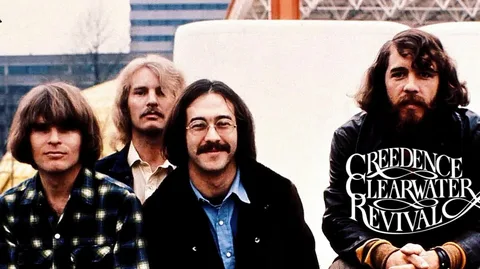
From old folk truth to California swamp-rock charm, “Cotton Fields” carries the feeling of a song that had already lived many lives before Creedence ever laid hands on it.
Some songs come into the world as records. Others arrive as inheritance. “Cotton Fields” belongs to that older, deeper kind of song, the kind that seems to carry dust, labor, memory, and distance in its bones long before a new singer steps up to the microphone. When Creedence Clearwater Revival recorded it for Willy and the Poor Boys, released on October 29, 1969, they did not try to modernize it into something sleek or separate from its past. They gave it their own easy, California-bred swamp-rock charm, certainly, but they left the old grain of the song intact. That is what still makes it so appealing. You can hear movement in it, but you can also hear age.
The history inside the song begins with Huddie Ledbetter — Lead Belly — who made the first recording of “Cotton Fields” in 1940. From there it moved through the folk bloodstream, taken up by voices like Odetta, Harry Belafonte, and The Highwaymen, growing into one of those American songs that seem too sturdy to belong to any one era alone. By the time Creedence touched it, “Cotton Fields” was already carrying the weight of work, home, poverty, and the uneasy promise of return. Even the title sounds older than most pop songs sound. It feels less invented than remembered.
That is why Creedence’s version works so well. John Fogerty understood that the song did not need to be overdecorated. It already had a life. In fact, Fogerty later recalled hearing Lead Belly perform “Cotton Fields” at the Berkeley Folk Festival as a child, which gives the CCR version a lovely sense of continuity. This was not a random cover chosen for convenience. It was a song that had reached him early, stayed with him, and then found a place on a 1969 album that was otherwise full of the band’s own increasingly mythic American imagery. In that setting, “Cotton Fields” feels less like a detour than a quiet acknowledgment of where part of their musical imagination came from.
And what a setting it was. Willy and the Poor Boys arrived during that astonishing CCR run when they seemed incapable of making a false move, their sound already so complete that even a traditional folk-blues number could slide naturally beside songs like “Down on the Corner” and “Fortunate Son.” That alone says something about the band’s gift. They could take a song born far from California, shaped by older American hardship, and make it sound completely at home in their world of rolling rhythm, dry heat, and back-road momentum.
What lingers most is the way history never disappears from the performance. Creedence add brightness, drive, and that unmistakable open-road ease, but they do not bleach out the song’s origins. “Cotton Fields” still carries labor in every phrase. It still sounds tied to a harder America, one built on work and weariness, on longing for home and knowing that home itself may never have been as gentle as memory claims. That tension gives the song its depth. The tune moves lightly enough to charm, yet the story underneath it comes from older, rougher ground.
There is a special beauty in that contrast. Creedence were masters of turning American roots into something immediate and radio-ready, but at their best they never made the past feel disposable. In “Cotton Fields,” they sound like a band who know that old songs survive because they keep telling truths newer songs sometimes forget. This one remembers the land, the labor, the distance between where people are and where they wish they could return. Even with CCR’s relaxed, almost breezy touch, those truths remain.
So the charm of “Cotton Fields” is not only in the performance, though the performance is wonderfully inviting. It is in the feeling that the band are carrying something forward rather than merely covering it. Lead Belly’s shadow is still there. The folk tradition is still there. The long American road between toil and song is still there. And Creedence, with all their California swamp-rock ease, somehow make that whole history sound alive in the present tense. That is why the song still holds up so beautifully. It is cheerful on the surface, but history keeps speaking through every line.