
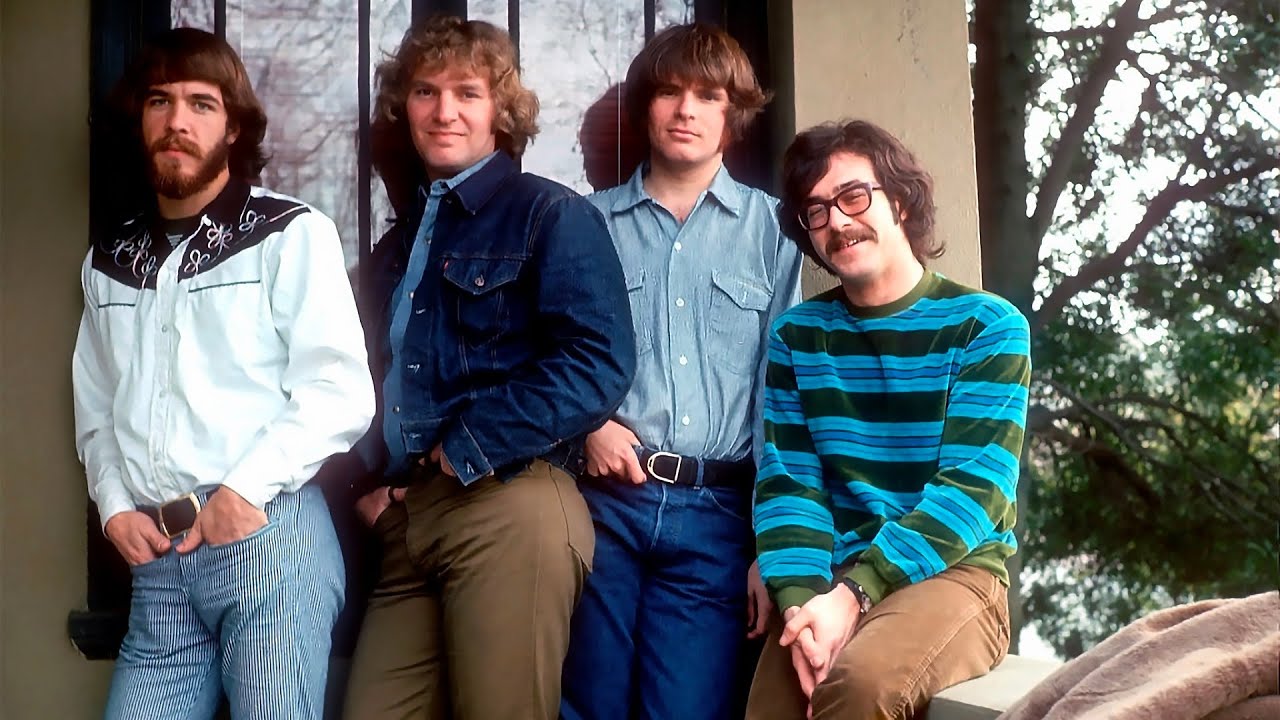
“Susie Q” changed everything because it did not sound like a band asking permission—it sounded like a band already arriving, dragging old rockabilly roots through the mud and turning them into something darker, meaner, and impossible to ignore.
When Creedence Clearwater Revival recorded “Susie Q,” they did more than launch a single. They announced a temperament. Plenty of first hits introduce a group; this one seemed to introduce a landscape. The song came rolling in with that swampy, hypnotic growl and made it clear that CCR were not interested in polished California brightness, even though California was where they came from. They wanted something murkier, more haunted, more primitive. That is why the record still feels so important. It was not only catchy. It was atmospheric. It sounded like heat, darkness, and river water. It sounded like the band had found a mood America did not know it was hungry for until that riff began to move.
The first fact worth putting near the front is the one that gives the whole story its force: “Susie Q” became Creedence Clearwater Revival’s first big hit, reaching No. 11 on the Billboard Hot 100 in 1968. It was issued from their self-titled debut album, and the album version stretched out to more than eight minutes, split across both sides of the single in edited form. That matters because the ambition is already there. This was not a timid debut single trimmed into harmlessness. It was a long, trance-like performance, heavy on groove and repetition, built less like a pop confection than like a spell. And for a brand-new band, that was a bold way to step into public view.
But the hotter, more revealing detail sits even deeper in the song’s history. “Susie Q” was not originally a Creedence song at all. It began as Dale Hawkins’s 1957 rockabilly hit, which reached No. 27 on the Billboard Hot 100 and No. 7 on the Hot R&B Sides chart. That original already carried Louisiana dust and danger in it, and its signature guitar sound became part of rock and roll folklore. Yet when CCR took hold of it, they did not simply revive an old favorite. They thickened it, slowed its pulse just enough, and let John Fogerty’s voice turn the flirtation of the original into something rougher and more elemental. In doing so, they built a bridge between 1950s rockabilly and a late-1960s American rock sound that felt both old and newly ferocious.
That is the emotional key to the song. “Susie Q” is not complicated on paper, but CCR understood that simplicity can become hypnotic if the performance has enough menace in it. The lyric itself is almost bare-bones, yet the band makes it feel obsessive, as though desire has become a kind of chant. The guitars do not merely accompany the singing; they stalk it. The rhythm section does not hurry the song along; it settles into it with confidence, as if this dark little groove could continue all night and never lose its grip. That quality is what made listeners feel that something new had entered the room. CCR were not chasing psychedelic spectacle, though the late 1960s offered plenty of that. They were pulling American roots music into a harder, leaner shape.
There is also something quietly symbolic about the fact that “Susie Q” remains the only Top 40 hit by Creedence Clearwater Revival not written by John Fogerty. That detail gives the song a special place in their story. Their breakthrough did not begin with a grand self-authored manifesto. It began with a cover—a borrowed song transformed so thoroughly that it became a statement of identity anyway. That tells us a great deal about CCR’s gift. They did not need ornate songwriting to reveal themselves. Sometimes all they needed was the right old tune, the right groove, and the nerve to make it sound like their own shadow.
What true fans never forget is that first impression: the sense of a band discovering its own authority in real time. “Susie Q” has swagger, certainly, but it also has hunger. It sounds like musicians who know that style alone is not enough; they must have atmosphere, pressure, personality. And they do. The song leaves behind more than a melody. It leaves behind a texture—the thick, low, humid texture that would soon become inseparable from the name Creedence Clearwater Revival.
So yes, “Susie Q” was the song that changed everything. Not because it was their most profound lyric, and not because it was their biggest chart triumph, but because it revealed the force they were about to become. In that swampy groove, in that raw, relentless pulse, CCR announced themselves as something American rock badly needed: a band that could make the past sound dangerous again. And once listeners heard that growl, they did not forget it.