
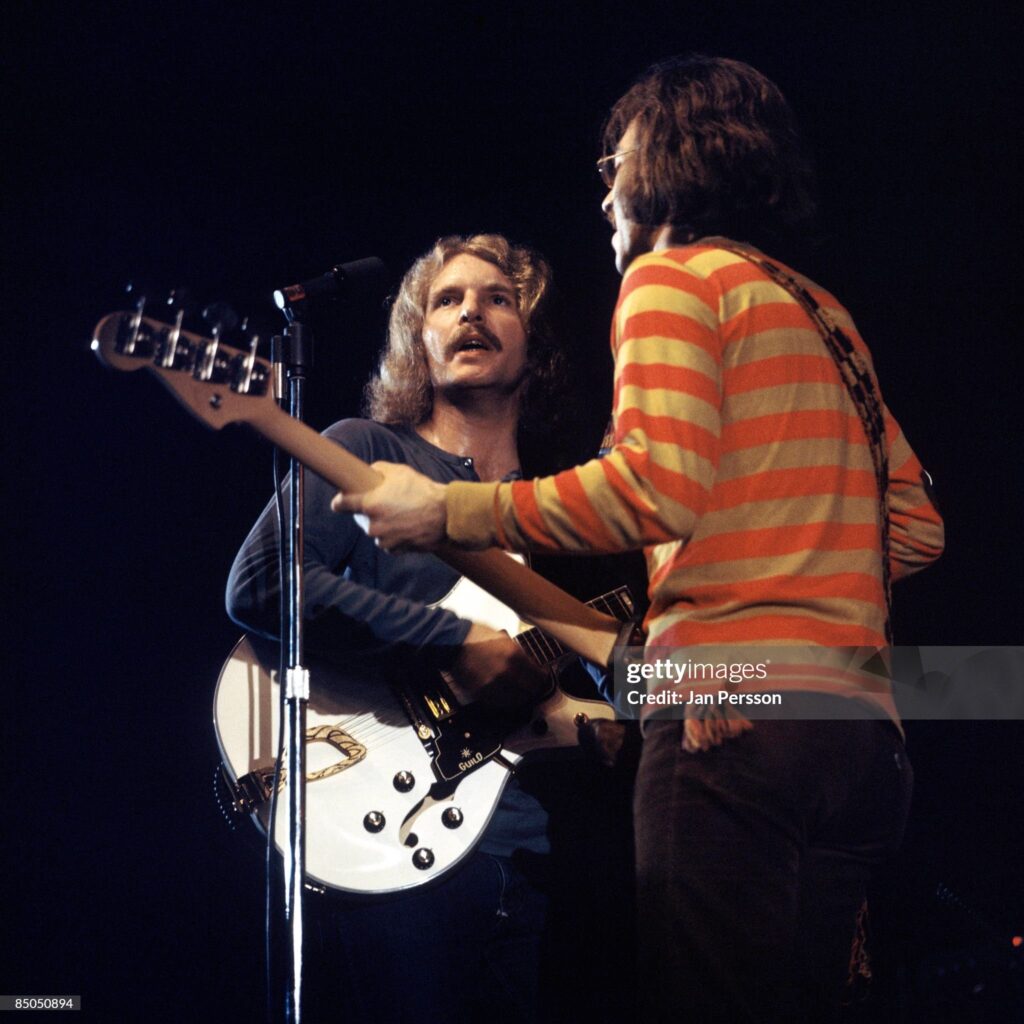
Heartbreak here is not a collapse but an engine revving toward freedom.
When Creedence Clearwater Revival cut “My Baby Left Me” for Cosmo’s Factory in 1970, they did not issue it as one of the album’s major chart singles, yet it arrived inside a record that climbed to No. 1 on the Billboard 200 and confirmed the band’s extraordinary run at the dawn of the decade. That matters, because “My Baby Left Me” feels like more than a stray cover tucked into a blockbuster LP; it feels like a statement of purpose. On an album crowded with immortal CCR performances, “My Baby Left Me” still kicks with a kind of joyous abrasion, reminding us that sorrow in rock and roll does not always come dressed in tears. Sometimes it comes in dust, velocity, and a snarl.
The song itself was born long before John Fogerty and company laid hands on it. Written and first recorded by Arthur “Big Boy” Crudup in 1950, “My Baby Left Me” already carried the elemental materials from which so much of early rock would be built: a blunt lyric, a blues pulse, and the stubborn insistence of repetition. Crudup was one of those foundational figures whose influence often exceeds his fame, a songwriter and performer whose work formed part of the bedrock beneath postwar popular music. In “My Baby Left Me,” he distilled abandonment to its harshest essentials. There is no ornate storytelling, no sentimental architecture, no grand speech of betrayal. The wound is simple: she is gone, and the singer is left in the raw weather of that fact.
That simplicity is exactly what gives the song its staying power. A lesser composition might have tried to explain too much, to dramatize heartbreak until it became theatrical. “My Baby Left Me” does the opposite. It circles the pain until the repetition itself becomes its own form of truth. Heartbreak, after all, rarely unfolds as a polished narrative; it arrives as shock, then fixation, then the relentless return of the same thought. The song understands this intuitively. Its lyric is pared down almost to a nerve.
What Creedence Clearwater Revival understood—perhaps better than almost any American rock band of their era—was that old songs did not need reverence as much as they needed ignition. On Cosmo’s Factory, a record that moves fluently between originals and reimagined material, “My Baby Left Me” becomes less a lament than a machine in motion. Fogerty’s voice does not sink into the loss; it attacks it. There is irritation in the delivery, but also excitement, even something close to defiance. The band does not “deepen” the sadness in a confessional sense. They weaponize it.
That is the great thrill of the CCR version. The grief is real, but it is never inert. Doug Clifford’s drumming keeps the track driving forward with a hard, unembarrassed momentum, while the guitars bite rather than brood. The rhythm section gives the song a muscular, almost physical impatience, as if standing still would be unbearable. In that sense, “My Baby Left Me” is heartbreak translated into movement. It is not a man staring into an empty room. It is a man throwing on his jacket, slamming the screen door, and disappearing into the noise of the night.
There is also something deeply characteristic here about Creedence Clearwater Revival’s place in 1970. While rock music around them often expanded outward—into epic form, studio grandeur, mythic self-importance—CCR remained devoted to compression, force, and the old American vernacular. They knew how to make a performance feel both ancient and immediate, as though the distance between juke joint blues, rockabilly, and contemporary rock had collapsed into one electrified present tense. “My Baby Left Me” is a small masterclass in that gift. It honors the song’s lineage without freezing it in history.
And that is why it still lands with such rude vitality. The song offers no healing, no lesson, no mature reconciliation. It offers rhythm as survival. It offers the primitive wisdom that sometimes the only dignified response to romantic wreckage is to turn the amplifier up and keep moving. In Creedence Clearwater Revival’s hands, “My Baby Left Me” becomes the sound of bad news refusing to become self-pity. It is too wild, too alive, too impatient to sit quietly with its own sadness. Even now, it does what the finest rock and roll always does: it takes private hurt and hurls it into the open road.