
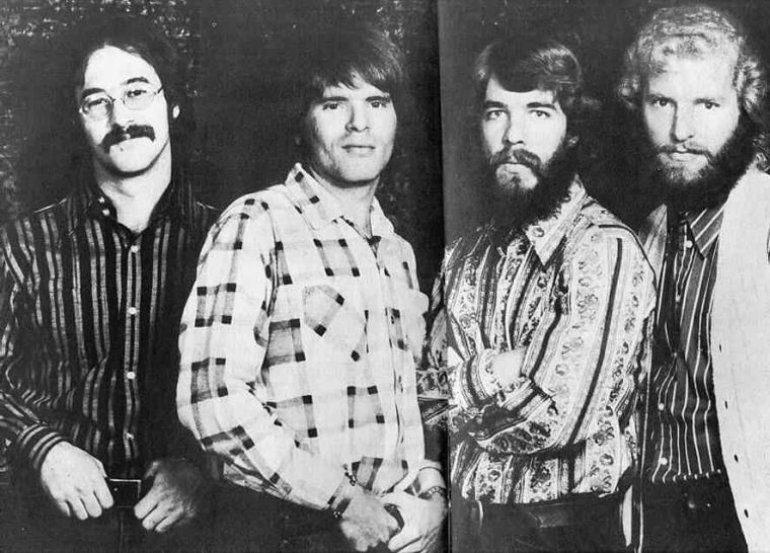
In “Lodi (Live in San Francisco, 1971)”, Creedence Clearwater Revival turn one of their quietest songs into something even more bruised and human—less like a hit, more like a man standing under stage lights and feeling the miles in his bones.
There are live performances that make a song bigger, louder, more explosive. And then there are performances like “Lodi (Live in San Francisco, 1971)”, which do something more unsettling and, in the long run, more powerful: they make the song feel truer. In this version, Creedence Clearwater Revival do not treat “Lodi” as a crowd-pleasing classic or a sentimental pause between harder-driving numbers. They sing it like a confession that has been carried long enough to grow heavier with time. That is what gives this performance its special force. The original studio recording was already one of John Fogerty’s finest acts of emotional imagination, released in April 1969 as the B-side of “Bad Moon Rising” and later included on Green River. As a single pairing, “Bad Moon Rising” / “Lodi” reached No. 2 on the Billboard Hot 100, while “Lodi” itself also charted separately enough to peak at No. 52 in the United States. Yet numbers only tell part of the story. The deeper truth is that “Lodi” became one of CCR’s most enduring songs because it carried the sorrow of a whole life in just a few plainspoken verses.
The live performance commonly labeled “Live in San Francisco, 1971” is tied to CCR’s July 4, 1971 appearance at Fillmore West in San Francisco, the final night of the venue’s famous closing run, and sources on the circulating recording note that the show was broadcast on KSAN-FM. That matters, because this was not the sound of a young band still climbing. This was a band already carrying the strain of success, personnel change, and internal fatigue. Tom Fogerty had left earlier in 1971, leaving CCR as a trio, and by then the group’s story was no longer one of pure ascent. In that light, “Lodi” hits differently. A song that once imagined the fear of becoming stranded now sounds as though it is being sung by musicians who know exactly how thin the line can be between glory and exhaustion.
That is one reason the performance lingers. The song itself is not literally autobiographical in the simple sense. Fogerty later said he had never actually visited Lodi before writing it, and chose the town in part because it had “the coolest sounding name.” But he also explained that the song imagined an older performer, a man trapped in the humiliating afterlife of faded promise, and that even at the beginning of his own career he was already thinking about that darker possibility. That is a remarkable thing in itself: a young songwriter writing not about stardom achieved, but about stardom lost—or perhaps never fully reached. In the live 1971 setting, that anxiety becomes even more poignant. What had once been a brilliant imaginative leap starts to feel eerily close to documentary.
Musically, “Lodi” has always stood apart in the CCR catalog. It is not built on swamp-rock swagger or political bite. It moves with a weary grace, a country-rock plainness, and a melody that sounds almost too humble for how devastating it really is. In the live San Francisco performance, that humility becomes the whole emotional point. The song does not beg for pity. It simply lays out the situation: the gigs are small, the money is gone, the crowd has thinned, and the road no longer feels like freedom. That restraint is exactly why it hurts. Creedence Clearwater Revival were masters of compression—few bands could say so much with so little—and “Lodi” may be their greatest example of how understatement can wound more deeply than drama.
There is also something moving about hearing this song in San Francisco of all places. CCR were Bay Area musicians, yet never really belonged to the psychedelic mystique usually attached to San Francisco rock. They were always tougher, leaner, more rooted in old American forms—rockabilly, country, rhythm and blues. At Fillmore West, on a night already shadowed by the venue’s own ending, they bring that outsider sensibility into a room full of history. The result is quietly perfect. A song about being stuck, sung at the close of an era, by a band already nearing its own final chapter. Sometimes context does half the singing.
And that is why “Lodi (Live in San Francisco, 1971)” feels so resonant. It is not merely a live version of a great song. It is a performance in which time itself seems to enter the music. You hear not only the narrator’s bad luck, but the weariness of the road, the fragility of success, the loneliness that can sit just behind applause. John Fogerty sings it with the kind of plain conviction that makes embellishment unnecessary. Nothing is pushed too hard. Nothing is oversold. The sadness arrives the old-fashioned way—by being told simply, and therefore believed completely.
In the end, “Lodi” endures because it understands a truth many songs avoid: not every dream crashes in flames. Some simply run out of gas in a town no one planned to stay in. And in this 1971 San Francisco performance, Creedence Clearwater Revival make that truth feel even larger, sadder, and more intimate. What begins as a song about one stranded musician becomes something broader—a meditation on pride, fatigue, and the fear that the world may stop listening before the heart has finished singing. That is why this live “Lodi” still cuts so deep. It does not just remember the road. It remembers the cost of it.