
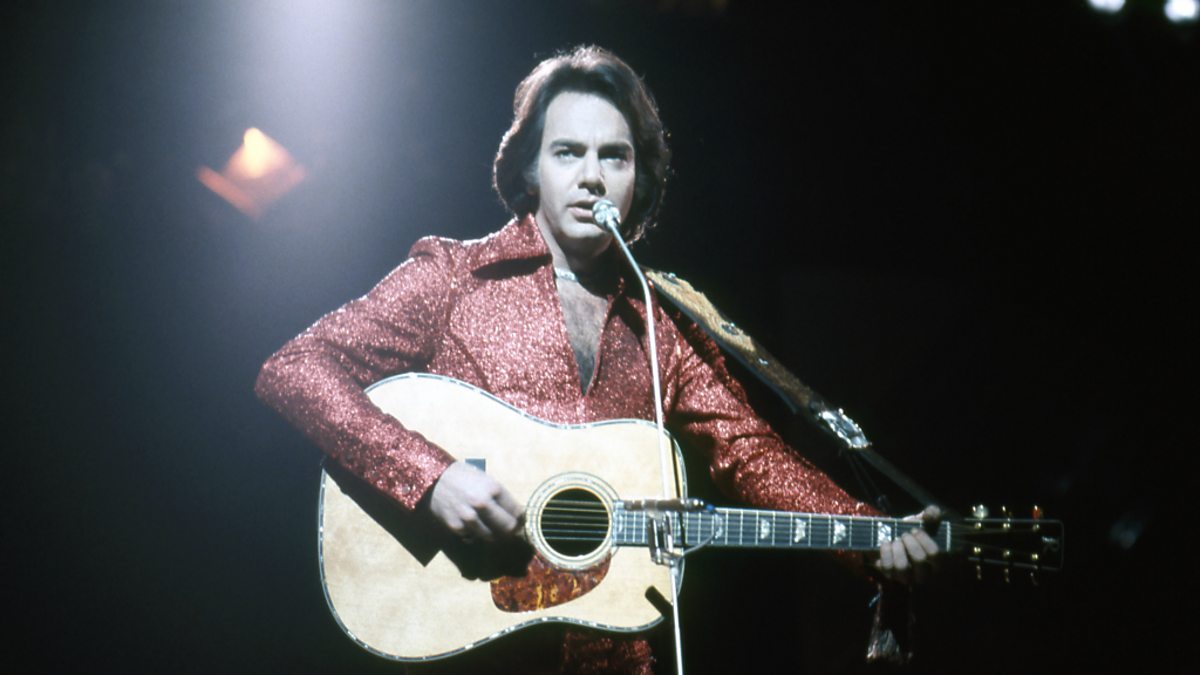
Neil Diamond’s “Chelsea Morning” turns Joni Mitchell’s bright urban reverie into something warmer and more grounded—a tender sunrise filtered through his unmistakable voice.
There are songs that arrive with thunder, and there are songs that enter the room like morning light. “Chelsea Morning”, as performed by Neil Diamond, belongs to the second kind. It was included on his 1971 album Stones, a record that reached No. 4 on the Billboard 200 and captured Diamond in one of the richest creative periods of his career. While his recording of “Chelsea Morning” was not one of his big chart singles, its place on that album matters. It shows another side of him: less grand proclamation, more inward glow. For listeners who know him through the commanding sweep of “Cracklin’ Rosie”, “Sweet Caroline”, or “I Am… I Said”, this recording offers something gentler, but no less expressive.
The song itself was written by Joni Mitchell and first appeared on her 1969 album Clouds. Before Neil Diamond recorded it, the best-known early cover had come from Judy Collins, whose version helped bring the song to a wider audience. Mitchell’s writing in “Chelsea Morning” is full of color, motion, and intimate observation. It is a song about a New York morning, yes, but also about awakening itself—the kind that comes not only from sunlight pouring through a window, but from the sudden awareness that life, for one suspended moment, feels beautiful enough to hold still.
What makes Neil Diamond’s version so compelling is that he does not try to outdo the song’s delicacy. He meets it on its own terms, then subtly reshapes it through tone and presence. Where Mitchell’s original has an airy, impressionistic sparkle, Diamond brings a deeper, more settled warmth. His voice does not float as much as it leans in. He sounds as though he is not merely describing the morning, but remembering it—turning the scene into something touched by reflection. That shift matters. In his hands, “Chelsea Morning” becomes a little less bohemian and a little more heartfelt, a little less like a passing image and a little more like a memory one carries for years.
That emotional shading fits beautifully within the character of Stones. Released in 1971, the album arrived during a remarkable stretch when Neil Diamond was balancing commercial power with deeper artistic ambition. Stones also included the towering “I Am… I Said”, one of the most autobiographical songs of his career. Beside a song that large and soul-baring, “Chelsea Morning” might seem modest at first glance. But that modesty is part of its power. It gives the album breath. It reminds us that a great singer does not always need to command the horizon; sometimes he only needs to stand beside a window and tell the truth softly.
The story behind the song carries its own resonance. Joni Mitchell wrote “Chelsea Morning” during her early New York years, and the title has long been associated with the city’s bohemian energy and artistic possibility. Over time, the song became one of those late-1960s compositions that seemed to preserve a whole atmosphere: sunlight on apartment walls, coffee, clutter, hope, the idea that one’s life might change before noon. Even its imagery feels tactile. There is fabric, color, music, movement. It is not nostalgia in the sentimental sense. It is something finer than that—the attempt to catch a fleeting hour before it disappears.
When Neil Diamond enters that world, he brings with him a different musical history. He was never a singer of detachment. Even at his most polished, there was always urgency in him, always a human pulse close to the surface. That is why his reading of “Chelsea Morning” remains so affecting. He does not treat the lyric as a painting to admire from across the room. He inhabits it. He finds the affection inside it, the gratitude, the slight ache that often accompanies beauty when one knows it cannot last. In that sense, his version is not simply a cover. It is a conversation between songwriters, between sensibilities, between two different ways of seeing tenderness.
Musically, the arrangement supports that intimacy. It avoids unnecessary heaviness and lets the melody breathe. The tune itself has always had an easy grace, but in the setting of Neil Diamond’s voice, the contours feel earthier, fuller. He gives the song a kind of emotional gravity without weighing it down. That balance is not easy to achieve. Many singers can preserve brightness; fewer can preserve brightness while adding depth. Diamond does both, and that is why his version lingers.
There is also something deeply revealing in the fact that he chose this song at all. Neil Diamond was one of the defining singer-songwriters of his era, a writer of grand hooks and durable emotional statements. Yet here he was, stepping into a composition by Joni Mitchell, an artist whose craft moved in a more impressionistic, literary direction. The result is a reminder that great songs travel well when they are rooted in honest feeling. “Chelsea Morning” survives reinterpretation because its emotional truth is universal: the joy of being present, the shimmer of an ordinary moment suddenly made sacred.
For many listeners, that is exactly why the song still works. It does not shout. It does not insist. It simply opens a window. And when Neil Diamond sings it, that window opens onto more than a city scene. It opens onto memory itself—onto mornings long gone, rooms once loved, and the quiet realization that some songs do not age because they were never chasing fashion to begin with. They were preserving feeling.
So while “Chelsea Morning” may not sit at the top tier of the most famous Neil Diamond recordings, it remains one of the most revealing. It shows his restraint, his interpretive intelligence, and his gift for emotional shading. On an album as strong as Stones, that kind of quiet beauty could easily be overlooked. But listen again, and it becomes clear: this is not filler, not a passing track, not a casual nod to a fellow songwriter. It is a small, graceful performance that still glows half a century later.