
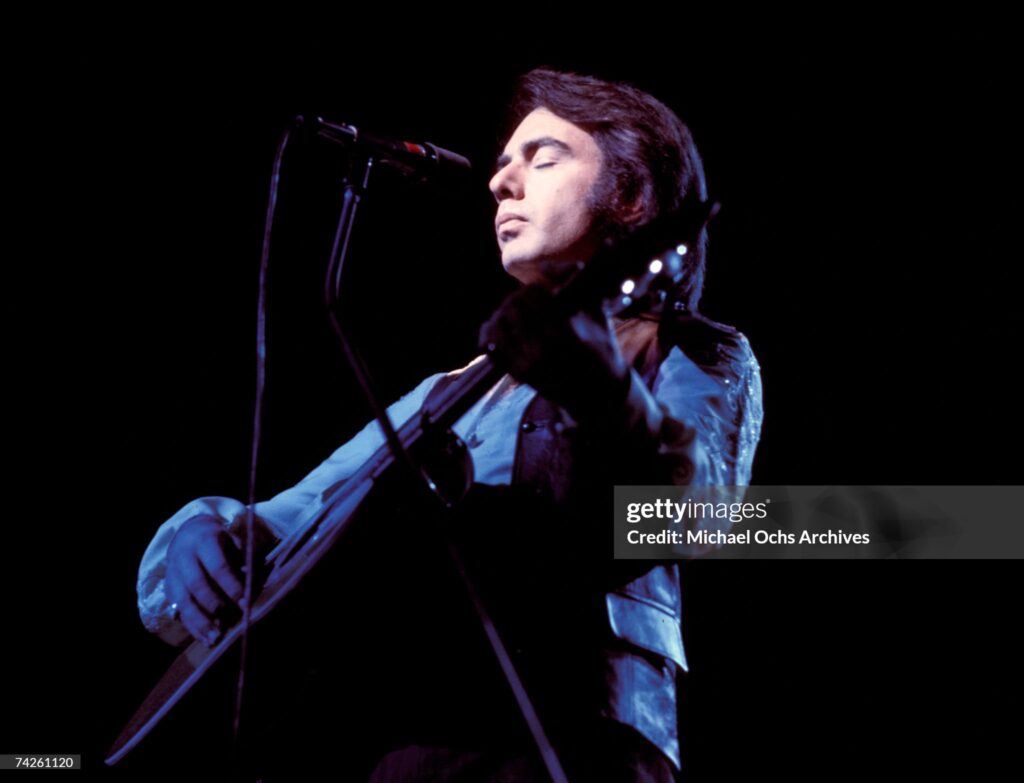
“Canta Libre” captures Neil Diamond at a reflective peak—singing not for spectacle, but for freedom, tenderness, and the private hopes people carry through uncertain times.
When Neil Diamond released “Canta Libre” in 1972, he was already one of the defining singer-songwriters of his era, but this song revealed another side of him—less theatrical than some of his biggest anthems, more inward, more humane, and perhaps more lasting because of it. It came from the album Canta Libre, issued in the summer of 1972 on Uni Records, at a moment when Diamond had learned how to balance commercial success with a more mature, contemplative style. The album itself performed strongly, reaching No. 13 on the Billboard 200, a reminder that his audience was willing to follow him beyond the obvious radio blockbusters and into songs of greater emotional shading.
The song “Canta Libre” was not among the very biggest chart-smashing singles of Diamond’s career, but its importance has never depended on that. It stands instead as one of those songs that loyal listeners return to with unusual affection. The title, drawn from Spanish, roughly suggests “sing free” or “sing freely,” and that spirit is exactly what gives the song its quiet power. There is a sense of release in it, but not the loud, triumphant kind. This is freedom expressed with grace, restraint, and thoughtfulness. Diamond does not push the idea like a slogan; he lets it breathe like a prayer.
That quality mattered in 1972. American popular music was changing quickly, and singer-songwriters were increasingly expected to sound personal, searching, and emotionally credible. Neil Diamond, who had sometimes been underestimated by critics because of his popularity, answered that climate not by abandoning melody, but by deepening it. “Canta Libre” feels like the work of an artist who understood that a song could be accessible and still carry emotional depth. The arrangement is polished, as one would expect from Diamond’s best early-70s recordings, yet the mood remains intimate. Nothing feels wasted. Nothing feels over-explained.
Part of what makes the song linger is the way it expresses longing without surrendering to despair. Diamond’s voice, always distinctive, is especially effective here—warm, slightly weathered, and full of feeling without turning sentimental. He had a rare gift for making grand emotion sound personal, and on “Canta Libre” that gift is everywhere. The song seems to speak to the need for inner liberation, for a place where the spirit can remain untouched by disappointment, time, or noise. It offers comfort, but it also offers dignity. That is one reason it has aged so well.
Behind the song is the larger story of the Canta Libre album, which followed a remarkably fertile period in Diamond’s career. By the early 1970s, he had already built a catalog that included major hits and deeply recognized performances, but he was also entering a phase where his records often carried a more cinematic emotional atmosphere. There is a richness to the production of this period, yet the best songs still rest on his central strength as a writer: he knew how to take large feelings—hope, loneliness, yearning, faith—and set them inside melodies people could carry with them for years. “Canta Libre” is a beautiful example of that balance.
The meaning of the song has invited different readings over time, and that openness is part of its beauty. Some hear it as a song of emotional survival, a quiet insistence that the soul can remain free even when life becomes heavy. Others hear in it a romantic tenderness, as though freedom itself is inseparable from love, trust, and the courage to stay open-hearted. Still others connect it to the broader spiritual searching that marked so much early-70s songwriting. Whatever interpretation one prefers, the emotional center remains the same: “Canta Libre” is about preserving something essential within oneself.
There is also something unmistakably elegant about Diamond’s decision to title the song in Spanish. It gives the piece a different color, a softer and more poetic aura. Rather than feeling ornamental, the phrase enlarges the song’s emotional horizon. It suggests a world beyond the ordinary phrasing of pop music, and that suits Diamond well. He was always drawn to songs that felt a little larger than everyday speech, songs that aimed for uplift without losing sincerity. Here, he achieves that balance with remarkable delicacy.
In retrospect, “Canta Libre” may not be the first title named in a quick summary of Neil Diamond classics, but that is precisely why it deserves renewed attention. It belongs to the part of an artist’s catalog where the deepest connection often lives—not always in the loudest hit, but in the song that stays beside you quietly, year after year. It is a record of maturity, of emotional intelligence, and of faith in music as a form of release. For listeners who have spent a lifetime hearing songs come and go, that kind of honesty never loses its value.
And perhaps that is the lasting magic of “Canta Libre”. It does not demand to be admired. It simply opens its hands and sings. In that calm gesture, Neil Diamond gave us something more enduring than trend or fashion. He gave us a song that understands how freedom often sounds in real life—not as noise, not as rebellion for its own sake, but as a steady, soulful voice refusing to let beauty be crowded out by the world.