
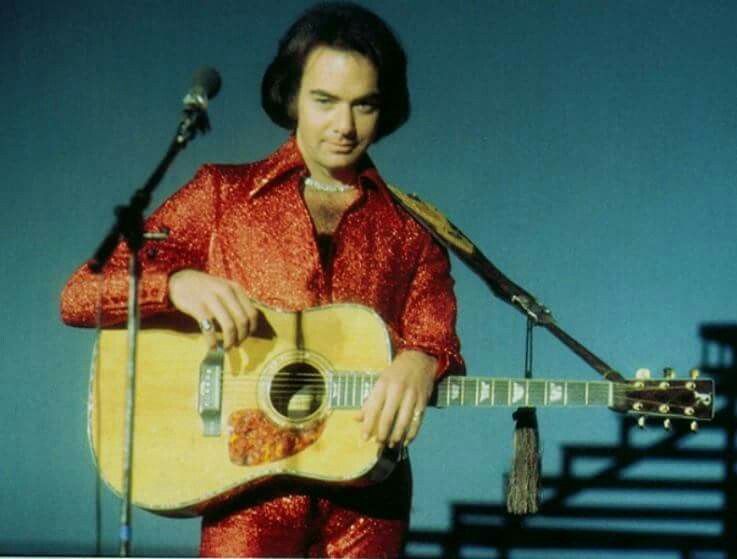
A quiet confession from Neil Diamond, “And the Singer Sings His Song” captures the lonely, enduring bond between an artist and the truth he keeps trying to sing into the world.
There is something deeply moving about the songs Neil Diamond wrote at the edge of his early fame—records that did not always roar to the top of the charts, but somehow told us more about the man than the bigger hits ever could. “And the Singer Sings His Song”, released in 1970 and later included on the album Tap Root Manuscript, is one of those records. It was not among Diamond’s most dominant pop smashes, but it did reach the Billboard Easy Listening chart, where it peaked at No. 36, and over the years it has come to feel like one of his most revealing statements—tender, self-aware, and quietly profound.
By 1970, Diamond was no longer simply a gifted songwriter from New York with Brill Building discipline and a restless imagination. He was becoming a major recording figure, already known for songs that could be grand, dramatic, and instantly memorable. Yet “And the Singer Sings His Song” does not lean on spectacle. Instead, it turns inward. It sounds like a man pausing in the middle of a fast-moving career to ask what remains when the applause fades and all that is left is the singer, the song, and the ache that brought them together in the first place.
That may be why the song still lingers. Its beauty is not flashy. It does not rush toward a giant chorus as if trying to conquer the radio. Rather, it unfolds with the measured emotional intelligence that became one of Diamond’s signatures. He understood that sincerity, when it is carefully phrased and honestly delivered, can travel further than noise. In this song, he sings not only as an entertainer, but as a man burdened and sustained by his own need to express something real.
The title itself is telling. “And the Singer Sings His Song” feels almost circular, almost inevitable—as though singing is not a choice but a condition of being. That idea runs through much of Diamond’s finest work. He often wrote about longing, searching, memory, and emotional distance, but here the subject is the act of singing itself, and what it costs. There is a suggestion that the performer must keep going, must keep offering the heart in musical form, even when certainty is gone. That is where the song becomes larger than autobiography. It speaks to anyone who has ever had to keep faith with their calling, even in moments of doubt.
Placed within the world of Tap Root Manuscript, the song gains even more resonance. That album, released in 1970, showed Diamond stretching beyond neat radio formulas and moving toward something broader in emotional and musical scope. It contained the hit “Cracklin’ Rosie”, of course, but it also revealed his increasing confidence as an album artist—someone willing to shape mood, theme, and atmosphere. “And the Singer Sings His Song” fits that moment beautifully. It belongs to the period when Diamond was learning that intimacy could be just as powerful as grandeur.
One of the song’s most affecting qualities is the way Diamond delivers it vocally. His voice had always carried a grain of yearning in it, that unmistakable combination of strength and vulnerability. Here, he does not overplay the emotion. He lets the feeling rise naturally, almost conversationally, and that restraint gives the performance its staying power. You hear not just a singer presenting a composition, but a writer standing inside his own words. The result is haunting in a subtle way—the kind of record that grows deeper with age because life gives the listener more experience to bring back to it.
There is also a quietly universal message at work. The song reminds us that art is often born from solitude, from the strange human need to turn feeling into form. In Diamond’s hands, that idea never feels abstract. He makes it personal. The singer is not a distant symbol; he is a living, feeling person trying to bridge the space between inner life and public performance. That is why the song still speaks across generations. Long after the chart positions have become footnotes, the emotional truth remains easy to recognize.
For listeners who know Neil Diamond mainly through towering anthems like “Sweet Caroline” or the high drama of later classics, “And the Singer Sings His Song” offers another doorway into his artistry. It reveals the reflective craftsman behind the star image, the man who knew that music was not only celebration but confession. And in many ways, that is what makes the song so valuable. It preserves a version of Diamond that feels especially human: thoughtful, searching, and unwilling to separate the performer from the person.
Some songs arrive with fireworks. Others arrive with a lamp lit in a quiet room. “And the Singer Sings His Song” belongs to the second kind. Its chart life was modest, its manner unforced, but its emotional afterglow has lasted. In it, Neil Diamond gives us one of his gentlest truths: that the singer keeps singing not because the world always listens, but because the song itself must be sung.