
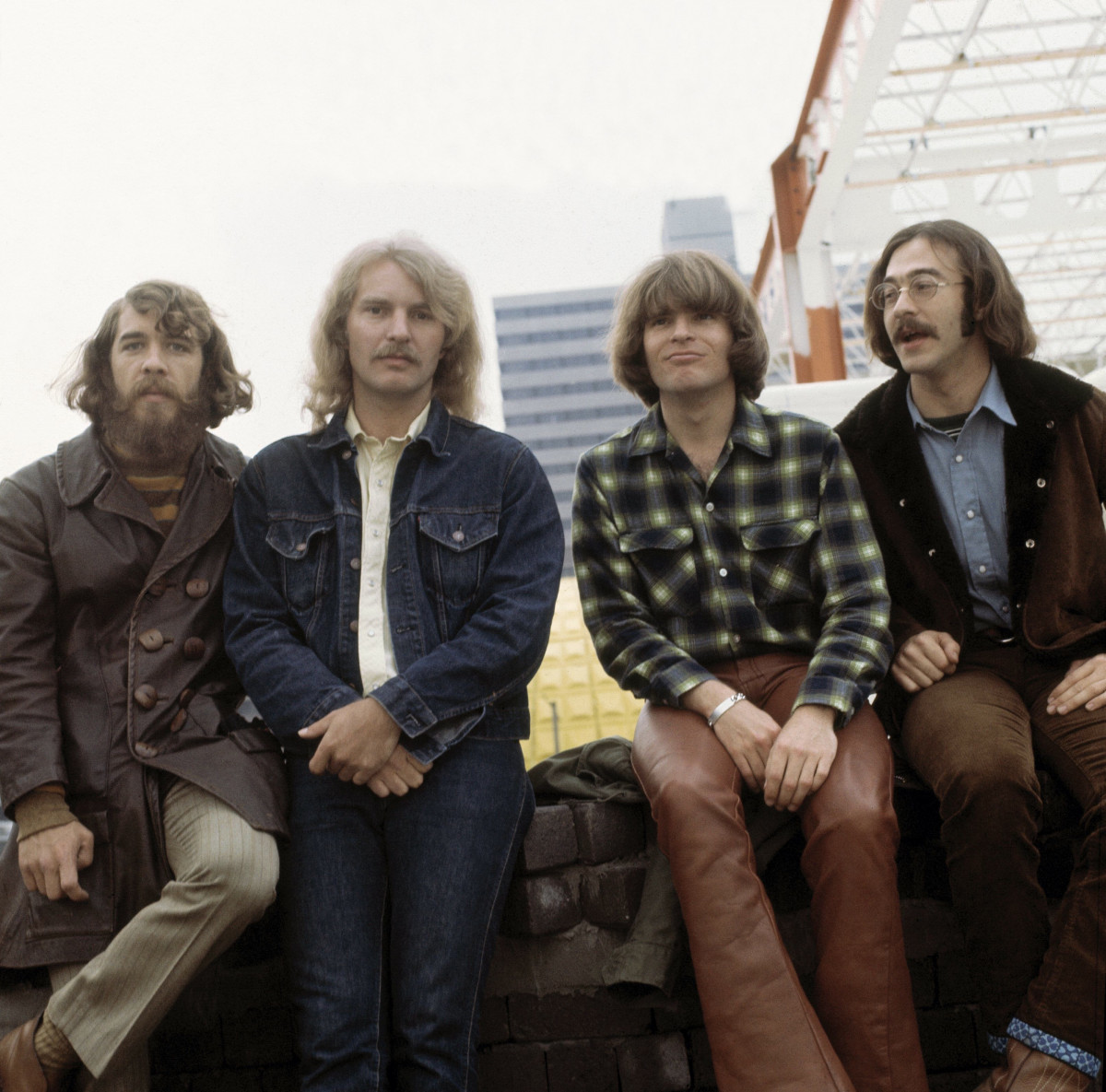
A raw early statement of dignity and endurance, The Working Man revealed that Creedence Clearwater Revival understood ordinary American struggle long before the band became a household name.
Long before Creedence Clearwater Revival turned into one of the defining American bands of the late 1960s and early 1970s, “The Working Man” was already pointing toward the emotional ground they would claim so powerfully. Written by John Fogerty and included on the band’s self-titled debut album, Creedence Clearwater Revival, released in 1968, the song was not issued as a major charting single and did not enter the Billboard Hot 100 on its own. Yet that fact only deepens its meaning. This was not a polished radio event designed for quick success. It was something rougher, truer, and in many ways more revealing: an early portrait of labor, fatigue, and pride from a band that would soon make working-class feeling one of its signatures. The debut album itself later reached No. 52 on the Billboard 200, modest compared with the triumphs that followed, but songs like this showed the spirit was already there.
There is something striking about the way “The Working Man” moves. It does not arrive with grand gestures. It pushes forward with grit. The guitar tone has a stubborn edge, the rhythm section keeps things grounded, and John Fogerty’s vocal does not sound theatrical. It sounds lived in. That is a crucial difference. Even in these early years, Fogerty had a gift for singing about strain and perseverance as if he had dust on his boots and a long day still ahead of him. He did not treat labor as a slogan. He gave it weight, weariness, and a kind of hard-earned honor.
This matters because Creedence Clearwater Revival never depended on ornament. Their greatest songs often felt as though they had been pulled from roadside America, from factory whistles, river towns, night shifts, cheap radios, and old obligations that never quite loosen their grip. “The Working Man” belongs to that world. It is one of the earliest clear examples of how the band could take blues-rooted rock and fill it with social texture without turning preachy. The song does not lecture the listener about class or dignity. It simply inhabits the life of someone who keeps going because there is no glamorous alternative. That restraint is part of what makes it endure.
The story behind the song also says much about where the band stood in 1968. CCR was still emerging from its earlier identity as The Golliwogs, still shaping the stripped-down sound that would soon explode on records like Bayou Country, Green River, and Willy and the Poor Boys. In that sense, “The Working Man” feels like a document of formation. You can hear the blues influence, the garage-band toughness, and the sharpening instinct for concise storytelling. What had not fully arrived yet was the massive commercial breakthrough. But the perspective was already remarkably clear. Fogerty was writing about ordinary lives with unusual seriousness, and that focus would become one of the reasons the band connected so deeply with listeners across generations.
There is also an emotional contradiction at the heart of the song that gives it lasting power. It is tough, but not triumphant in any easy sense. It respects work without romanticizing exhaustion. That balance is difficult to achieve. Many songs about labor drift into sentimentality or protest so broad that the individual disappears. “The Working Man” stays closer to the human pulse. You feel routine in it. You feel obligation. And beneath that, you feel identity itself: the notion that a person’s worth is too often measured by how much burden he can carry. That was a deeply recognizable truth in 1968, and it has hardly faded.
Musically, the track also offers an early look at what made Creedence Clearwater Revival different from many of their peers. While other late-1960s rock acts were reaching for psychedelic sprawl or ornate studio effects, CCR was moving in the other direction. They preferred compression over excess, groove over decoration, and atmosphere built from feel rather than studio trickery. “The Working Man” is not among their most famous recordings, but it carries that discipline. It sounds like a band discovering how powerful simplicity can be when it is driven by conviction.
For listeners who came to Creedence Clearwater Revival through the bigger hits, this song can feel like opening an old door and finding the house already fully inhabited. The themes that would later echo through songs such as “Fortunate Son”, “Green River”, and “Down on the Corner” are present here in embryo: class awareness, plainspoken language, American imagery, and a refusal to lose contact with everyday life. That is why “The Working Man” deserves more than casual mention in the band’s catalog. It is not merely an album cut buried in the early pages. It is part of the foundation.
And perhaps that is the quiet beauty of it. Some songs become famous because they arrive at exactly the right cultural moment. Others matter because they show an artist’s deepest concerns before the spotlight turns bright. “The Working Man” belongs to the second category. It reminds us that before the awards, before the legendary status, before the run of immortal singles, John Fogerty and Creedence Clearwater Revival were already listening to the sound of effort, endurance, and unadorned American life. In that rough-edged early recording, they found a truth that still rings with uncommon force.