
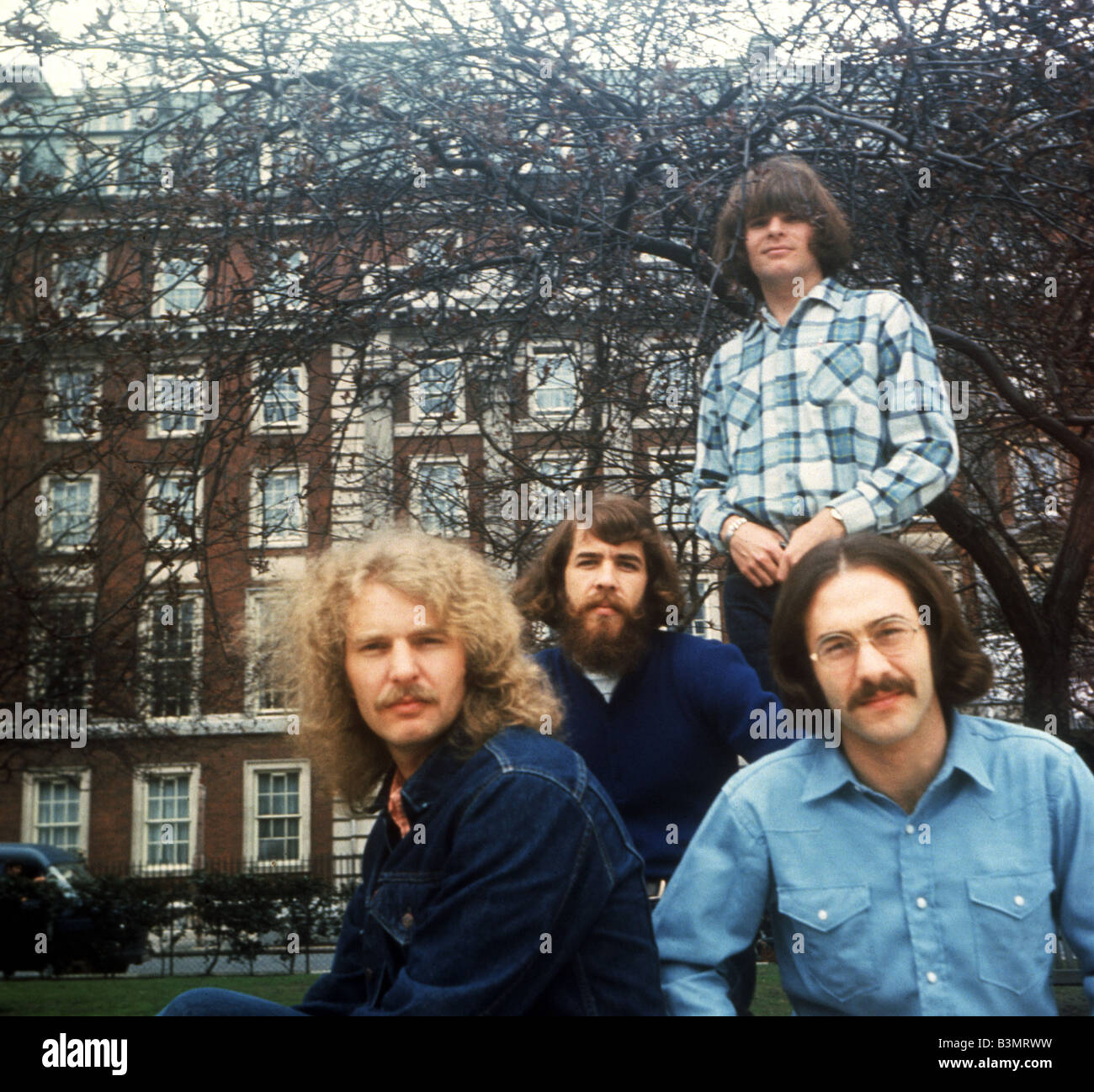
On Cross-Tie Walker, Creedence Clearwater Revival turns railroad dust, blues swagger, and restless motion into a compact portrait of American grit.
Cross-Tie Walker may not be the first song named when people remember Creedence Clearwater Revival, but that is part of its fascination. It arrived in August 1969 on Green River, the band’s third album, a record that went to No. 1 on the Billboard 200 and confirmed just how unstoppable CCR had become. The album also carried giants such as Bad Moon Rising, which reached No. 1 on the Billboard Hot 100, and Green River, which climbed to No. 2. In that company, Cross-Tie Walker remained an album cut rather than a chart headline, yet it has endured precisely because it captures something essential about the group: economy, toughness, groove, and a deep instinct for American musical language.
By the time Green River appeared, John Fogerty was writing with astonishing discipline. Creedence Clearwater Revival was releasing music at a pace that now feels nearly unimaginable, and still the songs rarely sounded rushed. Cross-Tie Walker is a perfect example of that gift. It is lean, muscular, and unadorned, but never careless. The track moves with the certainty of a band that understood exactly how to strip a song down until only the pulse remained. Doug Clifford keeps the beat driving forward with that unmistakable CCR firmness, Stu Cook gives the bass line its grounded push, Tom Fogerty adds the rhythm texture, and John Fogerty delivers the vocal as if he is inhabiting a dusty character from some half-remembered American roadside myth.
The title itself is a clue to the song’s power. A cross-tie is part of the railroad track, and the phrase Cross-Tie Walker suggests a man moving along the ties, somewhere between places, between labor and escape, between danger and freedom. That image belongs to an older America of freight lines, work boots, travel by instinct, and lives measured not by comfort but by movement. The song does not unfold like a detailed short story. Instead, it works through attitude, rhythm, and suggestion. It is less interested in explaining the character than in making you feel his stride. That was one of John Fogerty’s great strengths as a writer: he could make a world appear in a few strokes, with the music doing as much storytelling as the lyrics.
There is also something especially revealing in the way Creedence Clearwater Revival approached songs like this. Though the band came from El Cerrito, California, they drew from blues, rockabilly, country, Southern rhythm and blues, and old American folk imagery so convincingly that listeners often felt they had emerged from the bayou itself. Cross-Tie Walker shows that illusion at work in the best possible way. This is not imitation for its own sake. It is translation. CCR took the vocabulary of older roots music and recast it in a tighter, louder, late-1960s form. The result is neither museum-piece revivalism nor psychedelic excess. It is direct, earthy, and alive.
That helps explain the song’s meaning. On the surface, Cross-Tie Walker is a strutting rocker with blues DNA. Underneath, it feels like a song about motion itself: the need to keep going, the refusal to be pinned down, the rough dignity of a figure who lives close to the tracks and beyond polite society. There is a boast in the performance, but there is also weariness behind that boast, the kind that often runs through American roots music. Not sadness in the softest sense, but a knowledge of hard ground. That emotional mix is why the song lingers. It sounds loose, but it is emotionally precise.
What makes the track even more impressive is where it sits on Green River. On an album filled with unforgettable singles and rich mid-tempo mood pieces, Cross-Tie Walker adds grit and forward thrust. It does not ask for grand attention. It earns its place the old-fashioned way, through feel. Many famous bands have deep cuts that sound like leftovers; this one sounds like proof of depth. Even away from the spotlight, Creedence Clearwater Revival could lock into a groove and make a modest song feel timeless.
Years later, that may be the true beauty of Cross-Tie Walker. It reminds us that CCR was never only a singles band. Yes, they gave the world towering radio staples, but they also built albums with texture, weather, and character. This song still carries the smell of creosote, hot rails, and roadside dust. It still sounds like movement through a wide American landscape. And it still reveals how completely John Fogerty understood the marriage of voice, image, and rhythm. Some songs arrive as headlines. Others become companions. Cross-Tie Walker belongs to the second kind, and that may be why it keeps sounding better with time.