
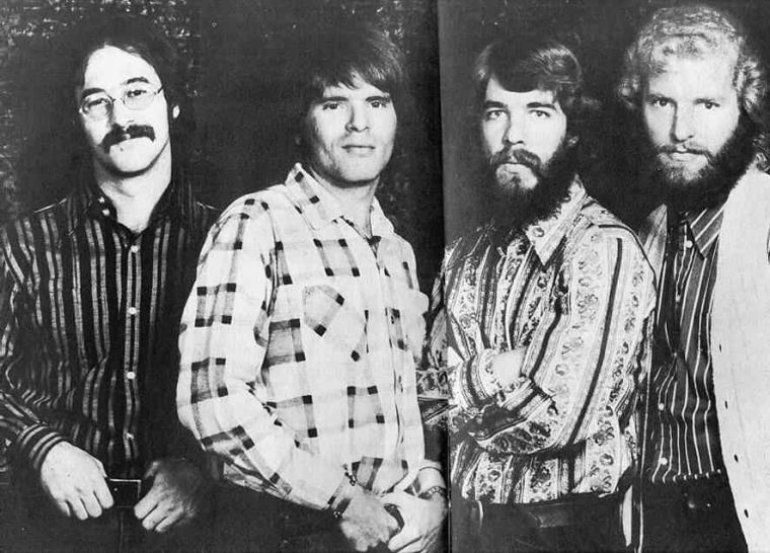
“Bonita” is not the Creedence people think they know — it is something smaller, younger, and more fragile, a brief early glimpse of the band before the swamp fire, before the classics, before the name itself had become legend.
When people see “Creedence Clearwater Revival – ‘Bonita’”, the first surprise is this: “Bonita” is not really a Creedence song from the famous late-1960s and early-1970s run at all. It belongs to the group’s pre-Creedence life, when they were still performing as Tommy Fogerty & The Blue Velvets. The track was recorded in late 1961 at Orchestra Studios in Oakland, California, released in early 1962, sung by Tom Fogerty, and credited as written by John and Tom Fogerty. Decades later, it was folded back into the larger Creedence story through the 2001 Creedence Clearwater Revival: Box Set, where it appears on disc one, track four, explicitly identified as one of the early Blue Velvets recordings.
That background matters more than usual, because “Bonita” can sound almost startling if one comes to it expecting the hard-driving force of “Green River,” “Proud Mary,” or “Fortunate Son.” It has none of that swamp-rock authority yet. No thunder, no bayou haze, no lean political bite. Instead, “Bonita” feels like a young band still standing at the doorway of identity, trying on melody, mood, and harmony before history had decided what they would become. In that sense, the song is not great because it is fully formed. It is moving because it is not. It lets you hear the group before the myth closed around them.
The song is also important for a quieter reason: it is one of the earliest officially released compositions bearing John Fogerty’s name, alongside “Have You Ever Been Lonely.” That alone gives “Bonita” a special place in the long Creedence story. The John Fogerty who would later write some of the most durable American rock songs of his era is still only beginning here. The writing is modest, the scale is small, the ambitions still close to local dance halls and regional singles. But the historical value is unmistakable. One hears not the finished master, but the first flicker.
And there is something rather touching in that.
Because “Bonita” lasts only 1 minute 43 seconds, it does not try to overwhelm the listener. It passes quickly, almost shyly. That brevity adds to its charm. It belongs to the old single era, when a song could be a small calling card rather than a grand artistic statement. The mood is youthful, melodic, and innocent compared with the darker textures that would later define CCR proper. It sounds closer to early rock ’n’ roll and pop than to the elemental American roots music Creedence would soon make their own. If later Creedence songs feel like weather systems, “Bonita” feels like a handwritten note.
That is why the song matters best when heard not as a lost masterpiece, but as an origin point. There is no evidence that “Bonita” had any significant national chart life, and that is hardly surprising. This was still the local, pre-fame period. The group would not sign with Fantasy Records until 1964, after which they became the Golliwogs, and only later, in 1967, did they emerge as Creedence Clearwater Revival. So “Bonita” lives outside the familiar success story. It comes from the years before the machine began to turn, before the identity was fixed, before the world knew what kind of band these four young musicians would become.
And perhaps that is exactly why it can affect listeners so strongly now. There is always something haunting about hearing a great band before greatness hardens into style. In “Bonita,” the future is still invisible. Nothing yet tells you with certainty that this same musical family will one day produce “Bad Moon Rising” or “Who’ll Stop the Rain.” That distance gives the track a strange tenderness. It reminds you that legends do not begin as legends. They begin as local kids in a studio, cutting a short single, hoping something might happen.
So the real beauty of “Bonita” is not that it sounds like classic Creedence. It does not. Its beauty is that it lets us hear the road before the road had a name. It is youthful, slight, historically important, and quietly endearing. And in that brief early shimmer, long before Creedence Clearwater Revival became one of America’s defining bands, “Bonita” preserves the sound of the beginning itself.