
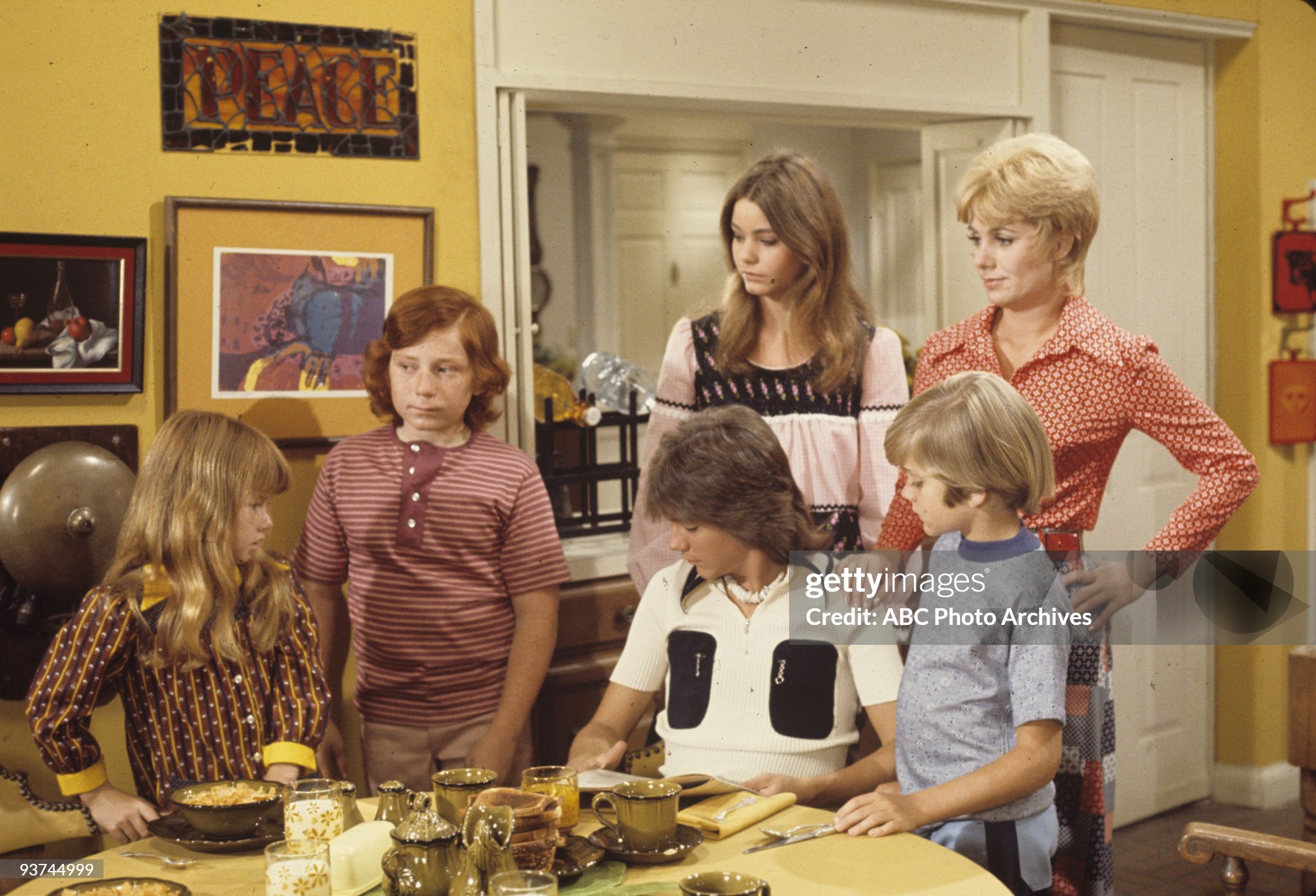
“Brown Eyes” is The Partridge Family at their most quietly intimate—an early-’70s pop love note where devotion feels less like a pickup line and more like a warm, lingering look.
If you’re looking for the clearest place to “file” The Partridge Family’s “Brown Eyes,” file it under the songs that don’t shout, yet somehow stay. It isn’t one of the era’s headline singles; it doesn’t arrive with the bright, radio-ready urgency of a chart climber. Instead, it arrives the way certain memories arrive—softly, mid-album, almost as if it doesn’t want to interrupt you. And then, without warning, you realize you’ve been listening with your guard down.
The important facts first, because they explain the song’s particular kind of presence. “Brown Eyes” appears on Sound Magazine—The Partridge Family’s third studio album—released in August 1971 on Bell Records, produced by Wes Farrell. On the record’s track list it sits right up front as track 2, running about 2:44–2:45, the kind of concise pop timing that says, I’ll tell you everything I mean—no extra words.
Crucially for “chart position at release”: “Brown Eyes” was not released as a single, so it didn’t have its own Hot 100 debut week or peak. Its “public moment” lives inside the album’s success. And Sound Magazine did very well: it peaked at No. 9 on Billboard’s album chart, and it was certified Gold in August 1971—proof that this music wasn’t merely TV-adjacent fluff, but a real pop commodity people carried home and played until the grooves softened.
Even the recording date feels like a small piece of nostalgia you can hold. Wikipedia’s session log for the album lists May 4, 1971 as the day “Brown Eyes” was recorded (alongside other Sound Magazine tracks). That date places the song right in the heart of the Partridge machine at full speed—when songs were being cut efficiently in Los Angeles studios by top-level session players, designed to sound effortless even when every detail was engineered.
The writing credit matters, too, because it tells you whose hands shaped the sentiment. “Brown Eyes” is credited to Wes Farrell and Danny Janssen. Farrell wasn’t just a writer here—he was a producer and a central architect of the Partridge sound, the man who understood how to package youth, romance, and radio gloss into something that felt personal on a bedroom turntable. By contrast, “Brown Eyes” isn’t built on a clever concept. It’s built on direct address. The narrator speaks to a single detail—those brown eyes—as if the whole world has narrowed down to one face, one gaze, one irresistible certainty.
And that’s the emotional trick of the song: it makes attraction feel safe. The lyric (in its simplest shape) is possession-free adoration—you’re beautiful and you’re all mine… I want you like you want me—the kind of early-’70s pop language that can sound naive, until you hear it in the right mood and recognize what it’s really reaching for: mutuality. Not conquest. Not drama. Just the soothing fantasy that desire might be returned with the same steadiness it’s offered.
Musically, The Partridge Family sound is always a collaboration between image and craft, and Sound Magazine’s personnel list quietly reveals the professionals behind the glow: Hal Blaine on drums, Larry Knechtel and Mike Melvoin on piano/keys, with David Cassidy and Shirley Jones credited on vocals, and the famously reliable background-vocal team that helped make the project feel bigger than “a TV band.” That studio excellence is exactly why a modest track like “Brown Eyes” can feel so smooth: it has the polish of people who knew how to make a chorus land like a smile.
What does “Brown Eyes” mean in the larger Partridge story? To me, it’s the sound of the franchise dropping its sitcom grin for a moment and letting sincerity breathe. The Partridge hits often sparkle with youthful momentum—songs designed to move crowds and sell the week. But “Brown Eyes” feels like the private scene after the episode ends: when the house is quiet, when the laughter track is gone, and the heart admits it wants something uncomplicated—someone to look at, someone to believe in, someone whose presence makes the world feel briefly less crowded.
That’s why the song still works. It isn’t trying to be iconic. It’s trying to be comforting. And sometimes that’s the deeper magic of early-’70s pop: beneath the marketing, beneath the manufactured “family,” there were still real emotions being simulated so skillfully they circled back around into truth. “Brown Eyes” doesn’t ask you to remember a chart year. It asks you to remember what it felt like—just once, or maybe more than once—to have your attention captured by something as simple as a look… and to believe, for the length of a song, that sweetness could be enough.