
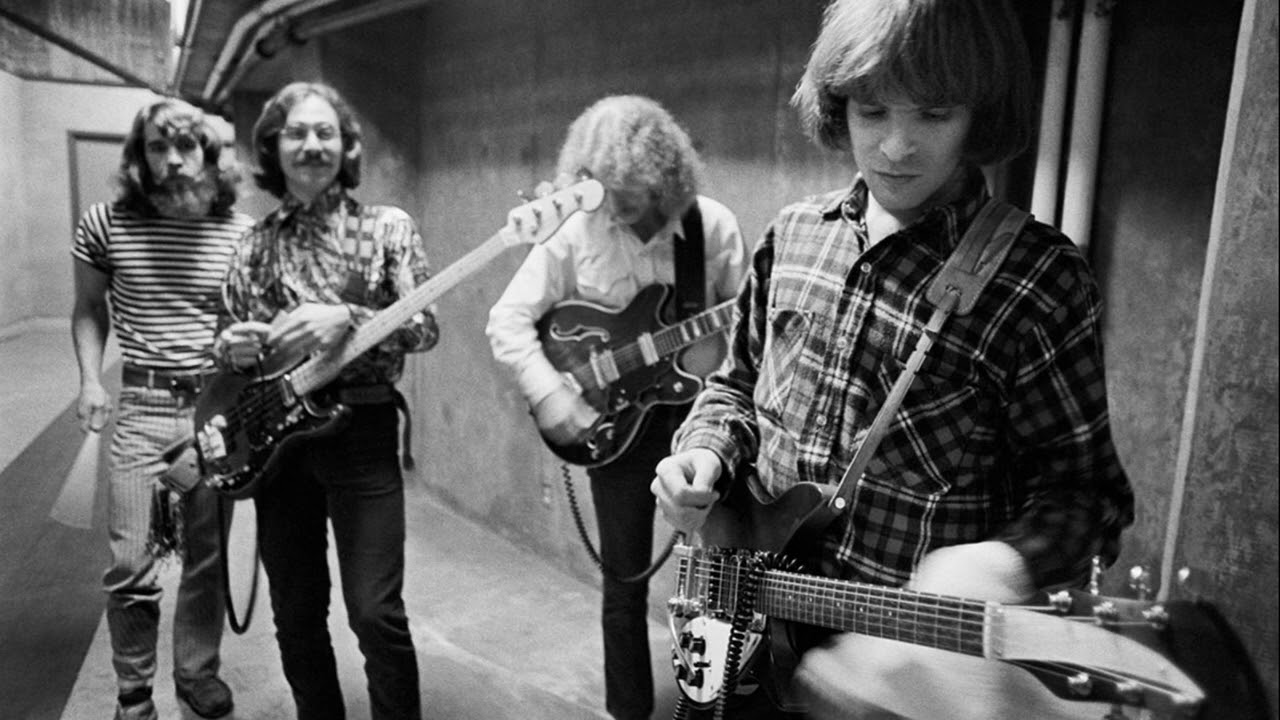
Chameleon is one of those quiet, shadowy Creedence Clearwater Revival songs that reveals a band in transition—still rooted in its swamp-rock soul, yet already leaning toward something more restless, mysterious, and emotionally unsettled.
Released in December 1970 on Pendulum, “Chameleon” did not come out as a major standalone single, so it did not earn its own run on the Billboard Hot 100. But the album that carried it, Pendulum, reached No. 5 on the Billboard 200, proving that Creedence Clearwater Revival still had enormous momentum even as the ground beneath the band was beginning to shift. In hindsight, that matters. “Chameleon” may not be one of the group’s biggest radio staples, but it stands today as one of their most revealing deep cuts.
There is something fitting about that title. A chameleon changes color, adapts, disappears into its surroundings while never quite becoming part of them. That image suits the song’s atmosphere perfectly. It also suits where CCR stood at the time. By late 1970, they were no longer simply the machine-like hitmakers who had torn through the previous two years with an astonishing string of singles and albums. On Pendulum, the sound broadened. The edges softened in places. Organ textures became more prominent. The arrangements felt moodier, more interior, less built for jukebox immediacy. “Chameleon” lives right in the middle of that change.
Written by John Fogerty, the song does not strike with the blunt force of “Fortunate Son” or the open-road brightness of “Up Around the Bend.” Instead, it moves with a sly, almost elusive quality. That is part of what makes it so memorable for listeners who have spent time with the full album rather than only the greatest-hits compilations. It feels like a song you discover later, when life has given you more patience for shades of feeling that are less obvious and more complicated. It is not flashy. It does not beg for attention. It lingers.
The story behind “Chameleon” is inseparable from the story of Pendulum itself. This was the final Creedence Clearwater Revival album recorded by the original four members before Tom Fogerty left the group. That fact gives the entire record a kind of bittersweet aura now. Even when the music sounds controlled and assured, there is a sense that something is changing—quietly, perhaps even reluctantly. “Chameleon” is not a breakup statement, and it was not marketed as some grand farewell. But in retrospect, it sounds like the kind of song a band makes when the old formula no longer tells the whole truth.
Musically, the track shows how far CCR could stretch without losing their identity. The groove is lean but not bare. The mood is darkly fluid. There is a sly tension in the way the song unfolds, as though it is always shifting shape just a little before you can settle into it. That is a remarkable achievement for a band so often praised for directness and economy. Creedence Clearwater Revival built their legend on songs that hit hard and fast, but “Chameleon” reminds us they also knew how to create atmosphere, suggestion, and unease.
Lyrically, the song’s meaning seems to rest in the image of a person or force that cannot be easily pinned down—someone changeable, seductive, evasive, perhaps even emotionally dangerous. That sense of instability gives the song its emotional color. It is not just about a creature changing appearance; it is about the unsettling experience of dealing with something that refuses to stay still long enough to be trusted. In that way, “Chameleon” has the feel of a warning wrapped inside a groove. It is not melodramatic. It is observant. And that subtlety is one reason the song has aged so well.
Another reason it continues to resonate is that Pendulum arrived during a period when American rock music itself was changing. The late 1960s urgency was giving way to something more reflective, and many bands were expanding their sonic language in the studio. CCR, despite often being described as a stripped-down roots band, were not frozen in place. “Chameleon” proves that. It shows John Fogerty exploring mood and character as much as momentum, while still keeping the band’s unmistakable earthy pull.
For many listeners, the emotional power of “Chameleon” comes from where it sits in the larger Creedence Clearwater Revival story. When people speak of CCR, they usually begin with the giants: “Bad Moon Rising,” “Proud Mary,” “Down on the Corner,” “Who’ll Stop the Rain.” Those songs deserve every bit of their reputation. But deep cuts like “Chameleon” are where a band’s inner weather often lives. That is where you hear uncertainty, experimentation, and a little of the loneliness that fame cannot smooth away. This song does not carry the immediate familiarity of the hits, but it offers something just as valuable: a glimpse of a legendary band as human beings moving through change in real time.
That may be why “Chameleon” feels richer with age. It belongs to that special class of album tracks that grow more meaningful the longer you live with them. What once sounded like a curious sidestep begins to sound like a confession in disguise. What once seemed minor begins to feel essential. In the case of Creedence Clearwater Revival, that is no small thing. Their catalog is packed with classics. Yet “Chameleon” still finds room to stand apart—not as a loud declaration, but as a subtle, smoldering sign that even the most dependable bands carry hidden seasons within them.
And perhaps that is the lasting beauty of the song. It catches CCR in a moment when they were still unmistakably powerful, still capable of greatness, but already touched by the complicated colors of transition. For listeners who love the deeper corners of classic rock, “Chameleon” is more than an album track. It is the sound of change arriving softly, before anyone could fully name it.