
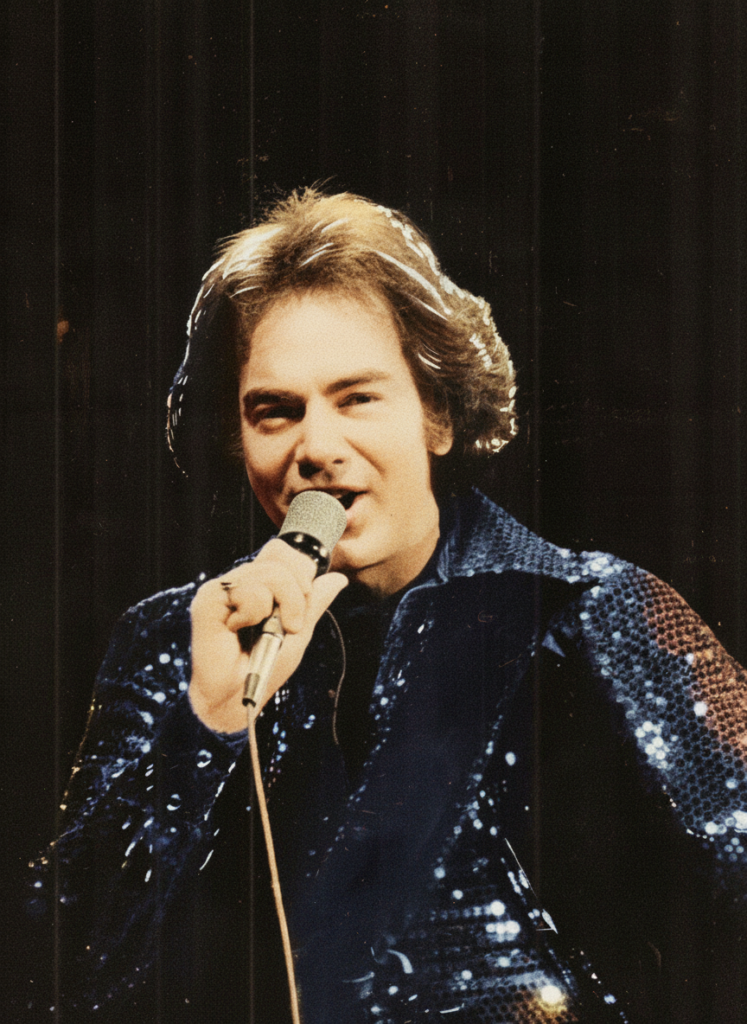
More than a song, Dear Father feels like a letter never fully mailed—Neil Diamond turning distance, gratitude, and unspoken feeling into something quietly unforgettable.
Not every important Neil Diamond song arrived with chart thunder. Dear Father is one of those pieces that never became one of his signature radio blockbusters, and there is no major standalone Billboard Hot 100 peak commonly associated with the song. In many ways, that is part of its lasting power. It has endured not as a giant single to be measured by numbers, but as a deeply personal performance that reveals another side of Diamond’s songwriting gift: the side that did not need spectacle, only honesty.
When listeners think of Neil Diamond, they often think first of the broad emotional sweep of songs like Sweet Caroline, Holly Holy, or Cracklin’ Rosie—songs built to fill a room, a stage, even a generation’s memory. But Dear Father belongs to a more inward tradition in his catalog. It comes from the period when Diamond was increasingly willing to write about roots, belonging, family tensions, memory, and the difficult space between love and understanding. In that sense, the song sits naturally beside the more reflective emotional world that also gave depth to songs such as Shilo and Brooklyn Roads.
What makes Dear Father so affecting is its emotional posture. It does not rush toward easy conclusions. It does not plead too loudly. Instead, it carries the tone of someone trying to bridge a distance that may have lasted for years. The title itself says almost everything: this is an address, a reaching outward, a song shaped like a conversation that perhaps should have happened earlier, or more clearly, or more tenderly. That is why the song feels so intimate. It is not built on grand storytelling. It is built on the ache of things left unsaid.
As a writer, Neil Diamond has always had a remarkable way of taking private emotion and giving it a public melody. Even when a song feels deeply personal, he rarely seals it off from the listener. Dear Father is a fine example of that balance. It suggests biography without requiring us to read it as literal confession. It feels real because Diamond understood something essential: family is rarely simple in memory. Gratitude and distance can live in the same line. Admiration and hurt can sit side by side. A child’s voice can still echo inside an adult one.
Musically, the song gains much of its strength from restraint. Rather than overwhelming the lyric, the arrangement allows the emotional center to remain front and clear. Diamond’s vocal approach is especially important here. He does not oversell the sentiment. He lets the phrasing breathe, and in doing so, he gives the listener room to feel the pauses, the hesitations, the weight of address. That was one of his great strengths in his finest reflective material: he knew when to push and when to let silence do some of the work.
There is also something unmistakably literary about Dear Father. The song unfolds less like a slogan and more like remembered correspondence. One can hear in it the sensibility of a songwriter who understood that emotional truth often arrives quietly. Diamond did not need ornate language to make a point. He knew how to place a simple phrase in the right melodic setting and let it gather meaning over time. That is one reason songs like this age so well. They are not tied only to the moment of release; they continue to open themselves differently as listeners bring more life to them.
From a historical standpoint, Dear Father stands as a reminder that charts tell only part of the story. If one looks for a major chart position for the song itself at the time of release, it does not occupy the same headline-making place as Diamond’s best-known singles. But in the long arc of an artist’s legacy, album-era songs and lesser-known recordings often become the truest windows into the writer’s inner world. Fans who move beyond the obvious hits often discover that these quieter pieces are where the artist speaks most directly.
The meaning of Dear Father has remained compelling because it touches something timeless. Nearly everyone understands the feeling of wanting to say more to a parent than circumstance, pride, or time allowed. That emotional current runs beneath the song without ever becoming heavy-handed. It is reflective, tender, and unresolved in the way real memory often is. And perhaps that is why it stays with people. It does not offer a neat ending. It offers recognition.
In the end, Dear Father may not be the song that defines Neil Diamond for casual listeners, but it helps explain why he mattered so much in the first place. He was never only a hitmaker. He was a writer of emotional interiors, of yearning, of home, of voices calling across silence. This song captures that gift with uncommon gentleness. Decades later, it still feels less like a performance than a message carried carefully through time.