
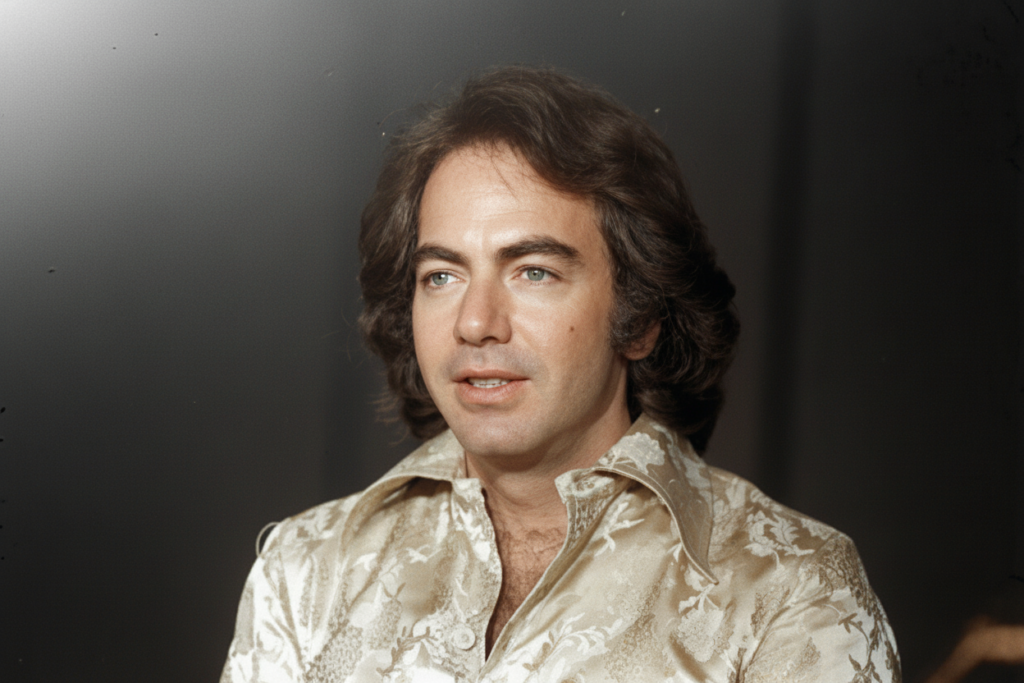
Neil Diamond sings Silent Night not as a grand display, but as a tender return to stillness, memory, and the kind of Christmas feeling that speaks softly and stays.
There are Christmas songs that arrive with sparkle, brass, and celebration, and then there are those that seem to lower the lights in the room the moment they begin. “Silent Night”, as recorded by Neil Diamond, belongs firmly to the second kind. His version does not try to reinvent one of the world’s most beloved carols. Instead, it does something far more lasting: it brings the song back to the heart. Released on The Christmas Album in 1992, Diamond’s reading came not as a standalone hit single but as part of a full holiday collection, which means “Silent Night” did not receive its own separate Billboard Hot 100 chart peak. That matters, because its legacy has never depended on chart fireworks. It has lived on through atmosphere, voice, and feeling.
That is very much in keeping with the song itself. “Silent Night” began in 1818 in Oberndorf, Austria, with lyrics by Joseph Mohr and music by Franz Xaver Gruber. Over the generations, it became more than a Christmas standard. It became a song of calm, reverence, and shelter. Few melodies in seasonal music are so instantly recognizable, and fewer still carry such a sense of stillness. Because of that, every singer who approaches it faces a delicate challenge: do too much, and the song loses its purity; do too little, and it drifts by without leaving a mark. Neil Diamond understood that balance.
By the time he recorded “Silent Night”, Diamond had already spent decades building one of the most distinctive voices in popular music. He could fill an arena, lift a chorus into a communal moment, and make even a familiar phrase feel personal. Yet one of the most remarkable things about his Christmas recordings is how often he chooses restraint over spectacle. On “Silent Night”, he leans into warmth rather than force. The arrangement is gentle, respectful, and unhurried. His voice, weathered in the best sense, carries the lyric with an intimacy that feels almost conversational. He sounds less like a performer reaching for effect and more like a man standing quietly inside the meaning of the song.
That may be why his version has such lasting appeal. Many listeners know Neil Diamond first through songs of yearning, devotion, and memory—songs in which emotion is never hidden behind cool distance. That same emotional openness serves “Silent Night” beautifully. He does not treat the carol as museum music, something to be preserved under glass. He sings it as if it still has work to do in people’s lives. The result is a performance that feels comforting without becoming sentimental, respectful without becoming stiff.
The story behind Diamond recording Christmas music is also quietly interesting. He was not an artist boxed in by one seasonal tradition or one narrow audience expectation. What he brought to holiday material was not a sense of novelty, but a deep respect for songs that had already become part of family memory. That is especially important with “Silent Night”, because this is a song that belongs as much to lived experience as to any recording history. People do not hear it only with their ears; they hear it through years of Christmas Eve gatherings, church services, winter drives, candlelight, decorations brought down from the attic, and the hush that sometimes falls over a house after everyone has finally sat down together. Diamond’s performance leaves room for all of that.
Musically, his version works because he trusts the melody. He does not oversing it. He allows the familiar rise and fall of the tune to do what it has always done so well: create peace through simplicity. The phrasing is careful, the pacing patient, and the emotion steady. There is no rush to impress. That kind of confidence often comes only from seasoned artists. Younger singers sometimes approach “Silent Night” as a showcase. Neil Diamond approaches it as a shared inheritance.
And that, in the end, may be the real meaning of this recording. In Diamond’s hands, “Silent Night” becomes a reminder that the strongest songs are not always the loudest ones. Sometimes the songs that stay with us are the ones that create space—space for gratitude, for memory, for reflection, for the faces and places Christmas brings back to mind. His version honors the sacred calm of the original while also sounding unmistakably like Neil Diamond: sincere, warm, and deeply human.
There is a special grace in that kind of performance. It does not demand attention. It earns it quietly. Long after the season’s noise has passed, after the decorations are packed away and the lights come down, a recording like this still lingers. Not because it chased the charts, but because it understood the song. And when Neil Diamond sings “Silent Night”, he reminds us why some music never needs to raise its voice to be heard.