
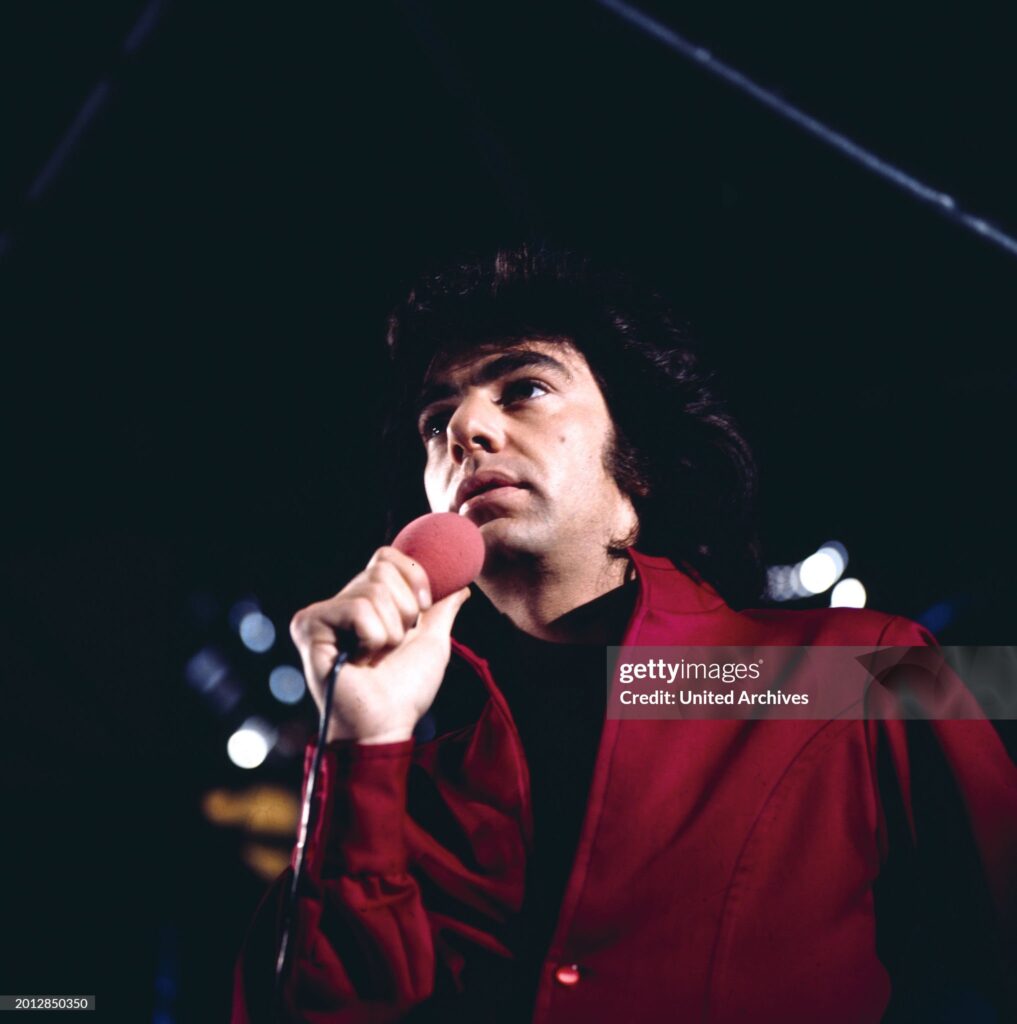
At its heart, “All I Really Need Is You” is not a grand declaration but a quiet realization: after all the noise, all the striving, and all the beautiful excess, love is still the one thing that matters most.
When Neil Diamond recorded “All I Really Need Is You”, he was already one of the defining singer-songwriters of his era, a man who could fill a room with drama, melody, and emotional force almost at will. Yet this song stands apart precisely because it does not chase size. It leans toward intimacy. Released in 1977 as part of the album I’m Glad You’re Here with Me Tonight, the track did not emerge as one of Diamond’s major charting singles, so it did not earn the kind of separate Billboard Hot 100 peak attached to his best-known radio hits. Instead, it lived inside the album experience, and in some ways that has helped preserve its private, unforced charm.
That context matters. I’m Glad You’re Here with Me Tonight arrived during a period when Neil Diamond was balancing the theatrical sweep people loved in him with a more reflective, mature kind of songwriting. The album is also remembered for containing his original version of “You Don’t Bring Me Flowers”, a song that would later become even more famous as a duet with Barbra Streisand. But tucked into that same emotional landscape was “All I Really Need Is You”, a song that feels less like a performance and more like a conversation held after the lights have dimmed.
What makes the song so affecting is its simplicity. Neil Diamond had always been capable of writing in broad strokes, giving listeners choruses that felt ready-made for arenas and radio alike. Here, though, he narrows the frame. The title alone tells the story: not ambition, not applause, not the rush of the outside world, but one person. That is the emotional center of the song. It is about emotional clarity, about arriving at a place where love no longer has to prove itself with spectacle. It only has to be true.
There is something deeply human in that idea. Many love songs are built on longing, pursuit, or fantasy. “All I Really Need Is You” feels wiser than that. It suggests a love that has already been tested by life, by distraction, by time, and by the thousand little things that pull people away from one another. What remains is not infatuation, but recognition. The song speaks in the language of devotion stripped down to its essentials. In that sense, it is not merely romantic. It is grounding. It tells us that peace sometimes arrives not through having more, but through knowing what matters enough to keep.
Musically, the song belongs to the warm, polished adult-pop sound that Neil Diamond wore so well in the late 1970s. The arrangement supports the lyric rather than overpowering it. Even when the melody opens up, there is restraint in the way the song breathes. Diamond’s voice does much of the work. He does not just sing the line; he inhabits it. One of his great gifts was the ability to sound both larger than life and strikingly vulnerable within the same performance, and this song leans decisively toward the vulnerable side. That is why it lingers. It does not ask to impress you. It asks to stay with you.
There is also a biographical truth hidden inside many of Neil Diamond’s best songs: beneath the polish, beneath the success, he often wrote from a place of searching. Even at his most commercially powerful, there was usually an undercurrent of restlessness in his work, a sense that the songs were trying to reach something steady and lasting. “All I Really Need Is You” feels like one of those moments when the search briefly settles. It is the sound of a man putting aside the crowded world for one clear emotional answer.
For listeners who return to Neil Diamond not only for the hits but for the feeling he could create, this song remains a rewarding deep cut. It may not carry the instant recognition of “Sweet Caroline”, “Cracklin’ Rosie”, or “Song Sung Blue”, but it reveals another side of him: less public, less booming, and perhaps more enduring. There is a special power in songs that never become overfamiliar. They wait quietly, and when you find them again, they seem to understand more of life than they did the first time around.
That is the lasting beauty of “All I Really Need Is You”. It does not depend on chart mythology or concert-sized grandeur. Its strength lies in emotional honesty. In a catalog full of famous choruses and unforgettable entrances, this song survives on tenderness. And perhaps that is exactly why it still reaches so deeply. Some songs entertain us for a season. Others become companions. This one belongs to the second kind.