
“I’m Here, You’re Here” is a small pop heartbeat—sweet, steady, and quietly brave—celebrating presence as if presence alone could keep the world from slipping away.
There’s a special kind of early-’70s innocence that doesn’t feel naïve so much as necessary—a bright sound designed to steady you. “I’m Here, You’re Here” by The Partridge Family lives in that feeling. It’s not one of the era’s loud, chart-towering Partridge signatures, yet it has a different kind of staying power: the warmth of a song that doesn’t argue or demand, it simply arrives and says, “Look—right now, we’re together.”
In the official discography, the track belongs to Up to Date, the group’s second studio album, released in February 1971 and produced by Wes Farrell at United Western in Hollywood. On the album’s track listing, “I’m Here, You’re Here” sits as track 4, nestled among the bigger pop engines of the record. And that album wasn’t a small thing: Up to Date reached No. 3 on Billboard’s Top LPs/Billboard 200 and was certified gold on March 25, 1971—a reminder that this TV-born phenomenon was, for a time, genuinely central to American pop listening.
The song’s writers also matter. “I’m Here, You’re Here” was written by Wes Farrell and Gerry Goffin—a pairing that tells you why the tune feels so professionally “inevitable.” Goffin, of course, had already helped shape the emotional vocabulary of 1960s pop; Farrell was the architect-producer of the Partridge sound machine. Together, they built a song that’s simple on purpose: a melody that keeps the door open, a lyric that says what it means without dressing it up.
Although it wasn’t pushed as a major A-side, the track did have a notable public “moment.” In June 1972, “I’m Here, You’re Here” was used as the B-side to The Partridge Family’s single “Breaking Up Is Hard to Do.” That detail feels almost poetic: on one side, a famous title about separation; on the other, a song insisting that being together is all that matters. Pop records used to do that—pair the headline drama with a quieter truth you’d only find if you bothered to flip the single over.
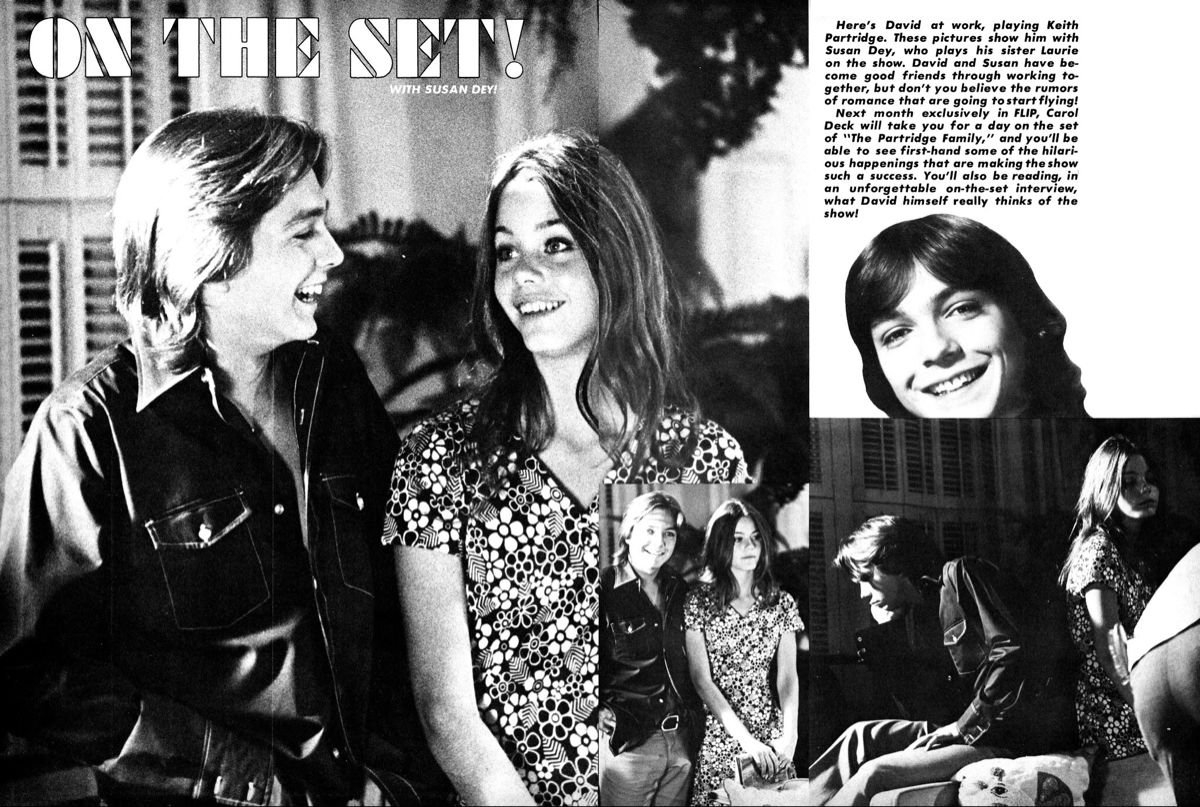
And then there’s the television connection, the way these songs didn’t just “release”—they entered living rooms. “I’m Here, You’re Here” was featured in the Season 1 episode “Why Did the Music Stop?”, which aired January 22, 1971, with the episode listing explicitly naming it as one of the songs performed. That date matters, because it places the song right inside the show’s early, peak-era warmth—when the Partridges still felt like a bright little promise of togetherness in a noisy world.
What does the song mean? It’s a celebration of the present tense. The lyric’s spirit—I’m here, you’re here, I don’t care where you’ve been before—isn’t just romantic; it’s almost philosophical. It suggests that love doesn’t have to interrogate history to feel real. It doesn’t have to cross-examine a person’s past. It can choose, instead, a gentler rule: what matters is that you’re here now. In an era that often sold “happiness” as a shiny product, this is a surprisingly human message—acceptance without paperwork, affection without conditions.
That’s why “I’m Here, You’re Here” still lands with a kind of tender nostalgia. It carries the sound of a time when pop music—especially this brand of carefully crafted TV-pop—was allowed to be openly earnest. No irony, no smirk. Just the soft insistence that closeness is a gift. And perhaps that’s the real secret: songs like this remind you that the heart doesn’t always want intensity. Sometimes it wants assurance. Sometimes it wants the simplest sentence in the world—sung clearly, sung kindly—so it can believe it for a few minutes: I’m here. You’re here.