
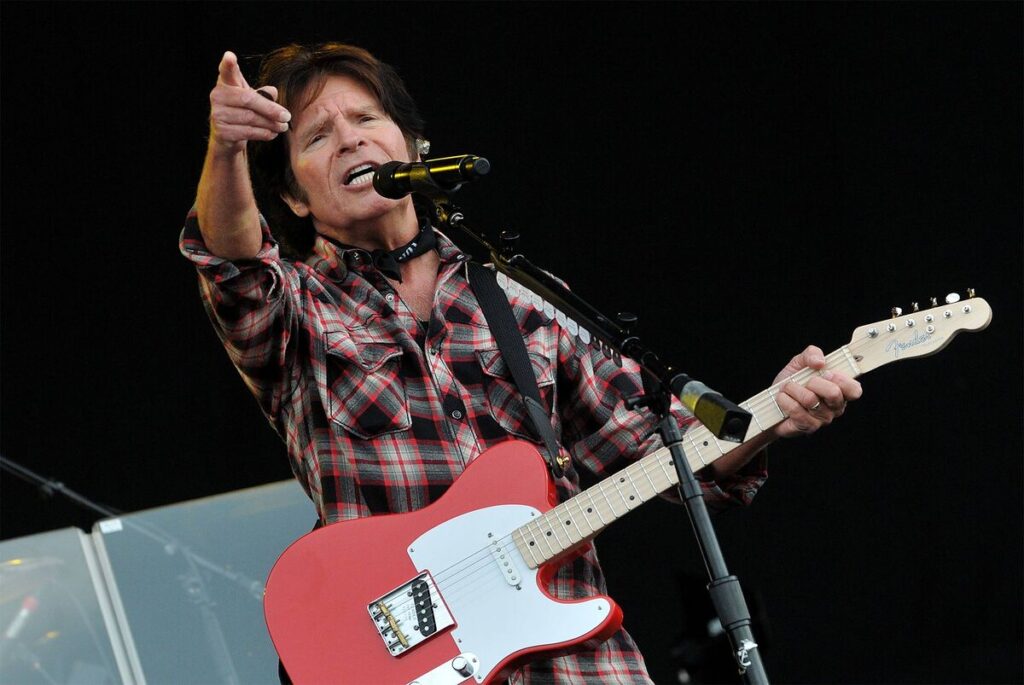
“Mystic Highway” is John Fogerty stepping off the well-lit road of nostalgia and onto a darker, truer stretch of asphalt—where the past hums behind you, but the future still insists on being driven into.
“Mystic Highway” arrived on May 28, 2013, as one of only two brand-new songs on John Fogerty’s album Wrote a Song for Everyone—released on his 68th birthday—and it immediately stood apart by doing the simplest, bravest thing: no guest stars, no shared spotlight, just Fogerty alone at the wheel. It’s track 4, running a long, unhurried 6:04, the longest cut on the record—a deliberate choice on an album otherwise designed as a star-studded celebration of his catalog.
The “ranking at launch” tells its own story of late-career vitality. Wrote a Song for Everyone debuted at No. 3 on the Billboard 200, becoming Fogerty’s highest-charting debut, with 51,319 first-week copies sold in the U.S. That No. 3 wasn’t a fluke peak either—chart records list the album’s US Billboard 200 peak at No. 3 (and No. 2 on Billboard’s Top Rock Albums), with strong showings across Europe and Canada. In other words: when “Mystic Highway” rolled out as the lead-off single, it did so with real momentum behind it, not merely as a sentimental footnote.
And yes—Fogerty chose to introduce this six-minute, solo track with a video/lyric-style clip that made the words part of the ride, brought to life through animated imagery. In an age when “content” often feels disposable, there was something oddly charming about that: like finding a handwritten note tucked into an old record sleeve.
The deeper backstory of the album makes “Mystic Highway” feel even more meaningful. The project’s core idea—revisiting Fogerty’s classics with modern collaborators—came from his wife, Julie, who suggested he reapproach his Creedence-era songs with artists he admired now, and Fogerty insisted on doing it “old school,” together in the same room, not stitched together by file-sharing. He also emphasized that he wanted collaborators to bring their visions so the songs would feel new, forcing him to work in fresh ways too. It’s a beautiful premise: a man reopening his own songbook not as a museum guide, but as a working musician still hungry for surprise.
So why does “Mystic Highway” matter so much inside all that celebration?
Because it’s the moment the party quiets down and Fogerty turns inward.
A review noted that, alongside the album’s other new song, “Mystic Highway” “bristle[s] with derision, expectation and hope.” That phrasing fits Fogerty perfectly: he has always been a songwriter who can glare at the world and still love it, who can distrust promises while still reaching for them. Another write-up described the song as a tale of a journey—uncertain, but worth taking—delivered with the “small indulgence” of an expansive instrumental stretch midway through.
That’s the heart of “Mystic Highway” as a listening experience: motion as meaning. The “highway” here isn’t just geography; it’s time itself—years compressing, old ghosts appearing in the rearview, the strange spirituality of late-night driving when the mind finally stops performing for anyone else. Fogerty doesn’t sound like a man trying to prove he still has it. He sounds like a man who knows exactly what he has—and has decided it’s finally safe to spend it slowly.
In a catalog filled with instantly recognizable hits, “Mystic Highway” is something rarer: a long-form mood, a living stretch of road. It’s the sound of an artist refusing to be embalmed by his own legend—choosing instead to keep traveling, to keep writing, to keep believing that the next bend might still reveal something he hasn’t named yet.