
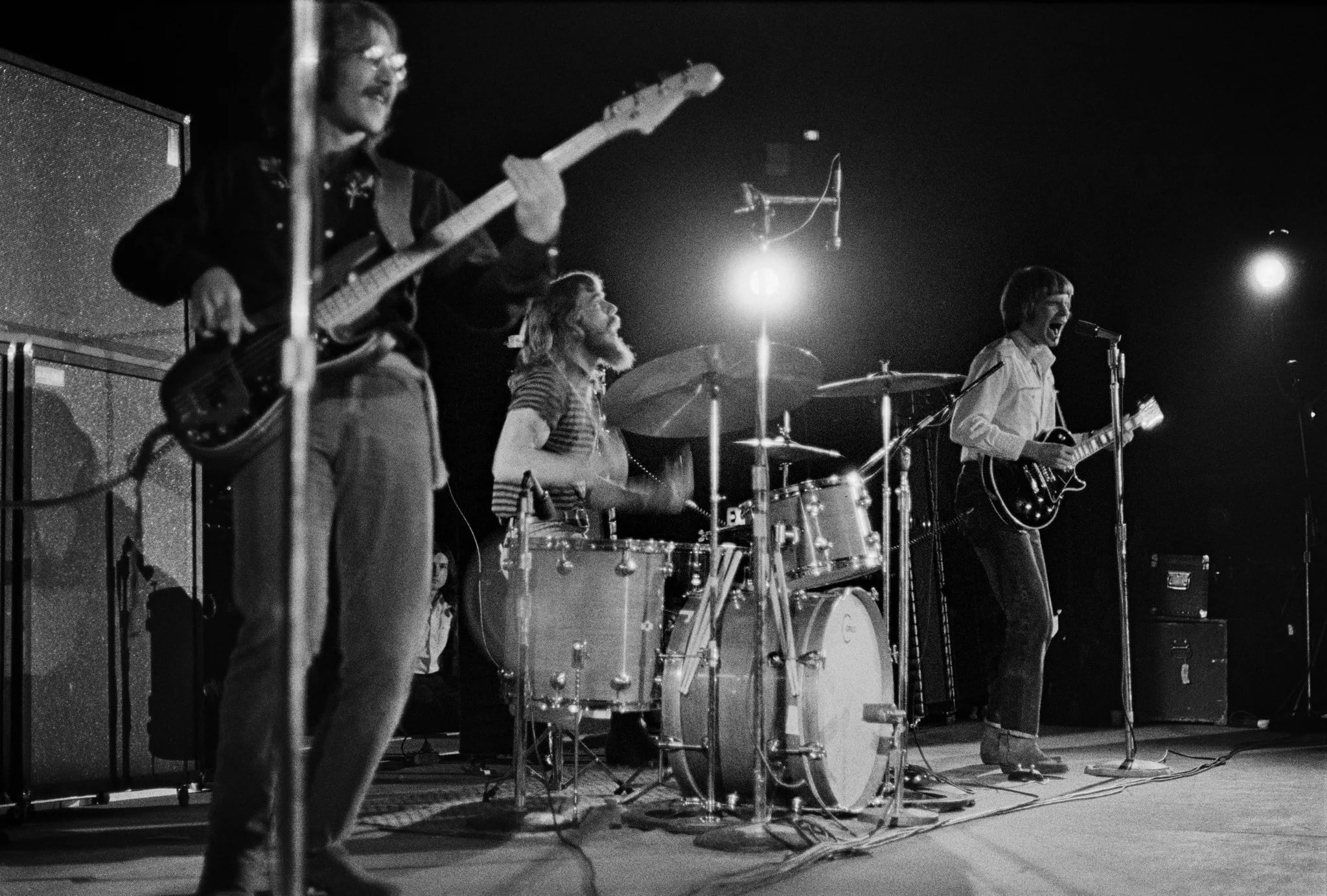
“Proud Mary” is the great American daydream in motion—leaving the grind behind, letting the river carry you toward something cleaner, simpler, and quietly triumphant.
Released as a single in January 1969 by Creedence Clearwater Revival on Fantasy Records, “Proud Mary” quickly became the band’s first truly massive breakthrough. It rose to No. 2 on the Billboard Hot 100, with its peak week dated March 15, 1969—the first of CCR’s remarkable run of singles that would stall at No. 2 yet still feel like No. 1 in the culture. In the UK, it reached No. 8 on the Official Singles Chart, first entering the chart on March 6, 1969 and staying on for 13 weeks. The song also anchored the band’s second studio album, Bayou Country, released on January 15, 1969, a record that announced CCR’s swamp-rock identity with uncommon clarity. And on the flip side of the single sat “Born on the Bayou”—a pairing that felt like one continuous landscape: river water on one side, bayou mist on the other.
But the real reason “Proud Mary” endures isn’t the numbers—it’s the way it makes escape sound earned. That opening, so plain and confident, is like a door clicking shut on a life that has demanded too much: “Left a good job in the city…” The lyric is not a fantasy of endless pleasure; it’s a fantasy of relief. You can almost feel the shoulders dropping. You can almost hear the sigh that comes when you finally step away from the noise and decide—without speeches, without drama—that you are going to live differently.
The story behind it is just as striking. In a 1969 account, John Fogerty said he wrote the song in the two days after being discharged from the National Guard—an abrupt return to civilian life that lines up eerily well with the lyric’s first sentence about leaving a “good job.” Yet the song didn’t begin as a riverboat tale at all. Later liner-note discussion and Fogerty’s own recollections describe how early fragments included a different “Mary”—a working woman, a washerwoman/maid figure—and how the theme shifted as pieces came together, until “Mary” became a boat and the song found its mythic current. That evolution is part of its magic: “Proud Mary” feels discovered rather than manufactured, as if Fogerty simply listened hard enough to the words until they revealed the river underneath.
And that river is mostly imaginary—at least geographically. Fogerty later emphasized he wrote it as a mythical riverboat on a mythical river, a kind of timeless American South dreamscape rather than a literal travelogue. That’s why the song travels so well through decades and across borders: it isn’t pinned to one town or one biography. It’s pinned to a feeling almost everyone recognizes—the urge to slip away from what is expected, to trade status for breath, to find dignity in motion. Even the chorus—those rolling syllables—hits like a small spiritual, echoing the gospel and R&B harmonies that CCR revered, while still sounding unmistakably like a rock band with mud on its boots.
What makes Creedence Clearwater Revival special here is their refusal to over-explain. “Proud Mary” doesn’t deliver a moral; it offers a passage. It says: if you’ve been worn down by the city’s bright pressure, there is a river somewhere—real or imagined—where the current doesn’t demand you be anything other than moving forward. And when that groove locks in, it feels less like escapism than like permission: to start again, to be lighter, to let the world’s harsh edges soften behind you.
That is why “Proud Mary” still sounds so alive. It isn’t nostalgia as decoration—it’s nostalgia as lifeline, the kind that reminds you the road out has always existed, and sometimes all it takes is one song brave enough to set sail.