
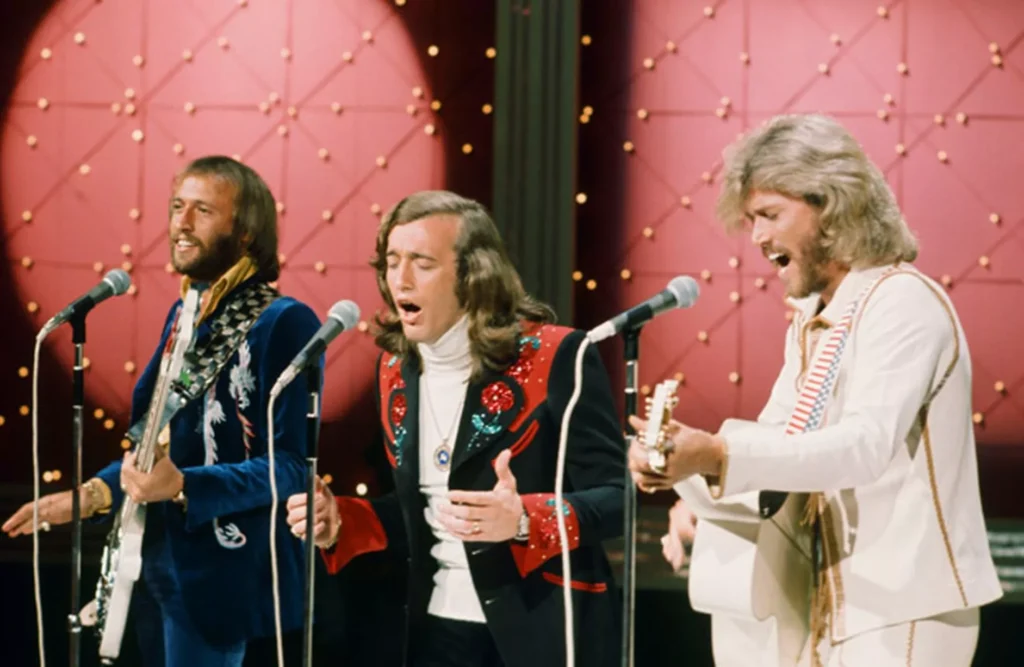
“Don’t Forget to Remember” is the Bee Gees turning goodbye into a keepsake—love reduced to one last request: carry me in your memory, even if you can’t carry me in your life.
If there’s a single record that captures the Bee Gees’ strange gift for sounding tender and bruised in the same breath, it’s “Don’t Forget to Remember”. Released as a standalone single in August 1969, it arrived at a moment when the group’s public story was fraying—yet the music, almost defiantly, remained graceful. The song was written by Barry Gibb and Maurice Gibb, and it leans into a country-pop vocabulary—gentle acoustic color, a hint of Nashville twang in the vocal, and that unmistakable Bee Gees instinct for a melody that doesn’t just play… it lingers.
Because you care about chart truth at the moment of arrival, here are the clean coordinates. In the UK, “Don’t Forget to Remember” first entered the Official Singles Chart on 16 August 1969 at No. 43, and it ultimately peaked at No. 2 (staying on the chart for 15 weeks). In the United States, it reached a much more modest height—peaking at No. 73 on the Billboard Hot 100; a chart-run archive also lists a Billboard debut date of 30 August 1969 and a peak week of 27 September 1969 at that same No. 73 position. The record’s B-side was “The Lord”, which matters in its own quiet way—because Bee Gees B-sides from this era often feel like a second, shadowy chapter to the single’s main emotional argument.
The story behind the song is inseparable from the Bee Gees’ 1969 rupture. It was recorded on 7 May 1969 at IBC Studios, London, during the post-Odessa fallout when Robin Gibb had departed the group. Even the personnel detail reads like a photograph taken mid-storm: Barry and Maurice at the center, drummer Colin Petersen still present, and Peter Mason—a would-be replacement for Robin—possibly contributing harmony vocals that may or may not have survived the final mix. The single sleeve, as Wikipedia notes, features “the three remaining Bee Gees,” a subtle reminder that this wistful love song was also, in real life, being sung by a band learning how to stand with an empty space beside them.
And yet, what makes “Don’t Forget to Remember” endure isn’t gossip or lineup trivia. It’s the emotional shape of the plea. The lyric is simple—almost painfully so: don’t forget to remember me, and the love that used to be. That’s a very adult kind of heartbreak. There’s no attempt to bargain the relationship back into existence. It accepts that the romance has already died. All it asks for is memorial—an act of tenderness so small it feels humiliating, and so human it feels inevitable.
There’s also a fascinating aesthetic choice here: the Bee Gees, who had just made the lavish, orchestral sprawl of Odessa, answered a personal crisis not with more grandeur, but with country restraint—as if the only honest response to loss is plain speech and a melody that doesn’t need a costume. Maurice even described the released single as “Jim Reeves-ish,” pointing to that smooth, tearful tradition where heartbreak is expressed with manners—never messy, never loud, but quietly devastating.
Later, the song would be gathered onto the 1970 album Cucumber Castle—a project tied to the group’s TV special of the same name, and notably the only Bee Gees album recorded without Robin’s participation. That context makes the title feel almost symbolic: a “castle” built during a time when the brothers’ musical kingdom was temporarily split—yet here is this single, still elegant, still melodic, still reaching out like a hand through fog.
In the end, “Don’t Forget to Remember” isn’t just a pretty 1969 hit that peaked at No. 2 in Britain. It’s a small emotional lesson the Bee Gees knew early: when love ends, you don’t only lose the person—you lose the future you rehearsed in your mind. And sometimes, the only mercy left is memory. Not the sharp kind that tortures you, but the gentle kind that says: Even if we’re finished, what we had was real. Please—don’t forget to remember.