
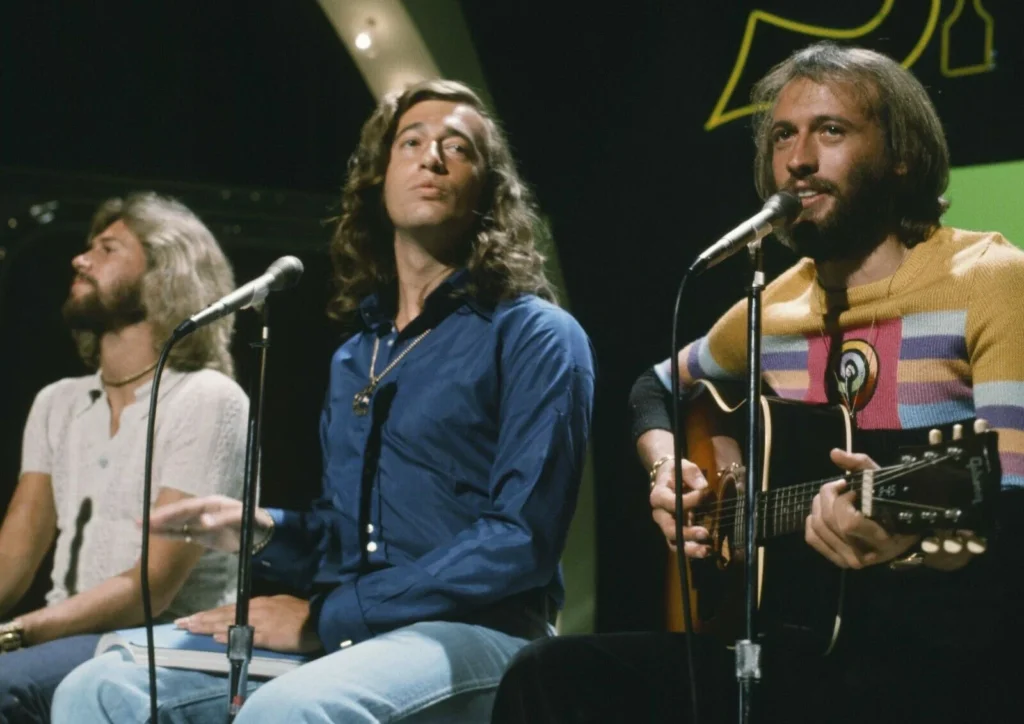
“Holiday” is the Bee Gees’ bittersweet reminder that the brightest comfort can still be wrapped in a minor key—like a smile you wear to keep the loneliness from showing.
Before the feeling carries us away, it helps to pin the song to its exact moment in time. “Holiday” was released as a U.S. single in September 1967, drawn from the Bee Gees’ first internationally released album, Bee Gees’ 1st. In America, it debuted on the Billboard Hot 100 at No. 84 on the chart dated September 30, 1967, and later climbed to a peak of No. 16. (On the rival Cash Box chart it rose as high as No. 12, underscoring that the record had real traction beyond a single publication’s rankings.)
There’s also a quietly fascinating twist for anyone who assumes all Bee Gees hits were global in the same way: “Holiday” was not released as a single in their native United Kingdom, because Polydor UK chose to push “World” instead, from the next album Horizontal. That absence gives “Holiday” a particular aura—almost like an American postcard from 1967 that the UK never officially mailed.
On Bee Gees’ 1st, “Holiday” sits near the very beginning, track 2 on Side One, nestled beside other early-career marvels as the group moved from Australian success into full international visibility. The album itself was released 14 July 1967 in the UK and 9 August 1967 in the U.S., so by the time “Holiday” arrived as a single that September, the Bee Gees were already building a distinct identity: pop that could be ornate, dramatic, and strangely vulnerable all at once.
The “behind the scenes” facts read like a snapshot of a band learning how to paint with shadows. “Holiday” was recorded on 21 April 1967 at IBC Studios in London, written by Barry Gibb and Robin Gibb, and produced by Robert Stigwood with Ossie Byrne. The track’s signature “weep” comes from its strong orchestral presence, arranged by Bill Shepherd, and from the unusual vocal setup: Barry and Robin share lead vocals, while all three Gibb brothers contribute the famous “dee dees” in the chorus. In other words, this isn’t just a love song—it’s a carefully staged mood piece, built like a little theater scene in under three minutes.
Even the trade press heard that difference immediately. Billboard called it “an intriguing ballad change of pace” from the earlier hit “To Love Somebody,” and singled out the quality of the production; Cash Box praised the organ backdrop and vocals; Record World framed it as another of the Bee Gees’ distinctive, inventive “mood pieces.” That phrase—mood piece—is the key to why “Holiday” endures. It doesn’t try to dazzle you with a twist ending. It tries to surround you, softly, until you’re living inside its weather.
And what weather it is.
“Holiday” is written like a paradox: the word itself suggests sunshine, ease, permission to breathe—yet the music leans inward, tinted with melancholy. That tension is the song’s secret. It understands a truth many listeners only learn over time: sometimes we call something a “holiday” not because life is perfect, but because we need a temporary shelter from what hurts. The lyric’s beloved is described as the holiday—something “worthwhile,” something that makes the “puppet” smile—language that feels almost childlike, but also faintly haunted. A puppet doesn’t move on its own; it is moved. So tucked inside the sweetness is a confession of vulnerability: you have power over me. Not tyranny—just the quiet power love always seems to carry.
That’s where the Bee Gees were already extraordinary in 1967. They could write pop melodies that sounded immediate, almost simple, and then lace them with emotional ambiguity. In “Holiday,” the chorus doesn’t explode into triumph; it opens like a window on a gray afternoon. The orchestration doesn’t feel like luxury for its own sake—it feels like the echo of a thought you can’t stop thinking. And the shared lead vocal between Barry and Robin gives the song a particular intimacy, as if two halves of the same heart are speaking: one reaching for comfort, the other already aware that comfort can be fragile.
The B-side choice deepens the picture. In the U.S. and Australia, “Holiday” was backed with “Every Christian Lion Hearted Man Will Show You.” That pairing is telling: the A-side is romantic yearning in a velvet suit; the B-side leans into the album’s more mystical, searching atmosphere. Together, they reveal a young band already balancing the earthly and the spiritual—the desire to be loved and the desire to understand what love even means.
So what does “Holiday” ultimately mean? It’s not merely a song about a person who makes you happy. It’s a song about the human need to name our refuge—because naming it makes it feel real. A holiday, in life, is temporary. It ends. You return to the ordinary world. And perhaps that is why the Bee Gees set this idea in a minor key: to hint, gently, that even our safest havens can’t stop time, can’t stop change, can’t stop the loneliness that waits patiently outside the door.
Yet the song never turns bitter. Instead it offers something quietly merciful: the belief that even brief refuge is worth celebrating. That even if love doesn’t last forever in the way we once demanded, the hours it gave us—those soft, bright intervals—still mattered. In that way, “Holiday” becomes not just a 1967 hit that debuted at No. 84 and rose to No. 16 in the U.S., but a small, beautifully arranged piece of emotional wisdom.
It’s the Bee Gees, still young, already reminding us: sometimes the heart survives by borrowing a little sunlight—one “holiday” at a time.