
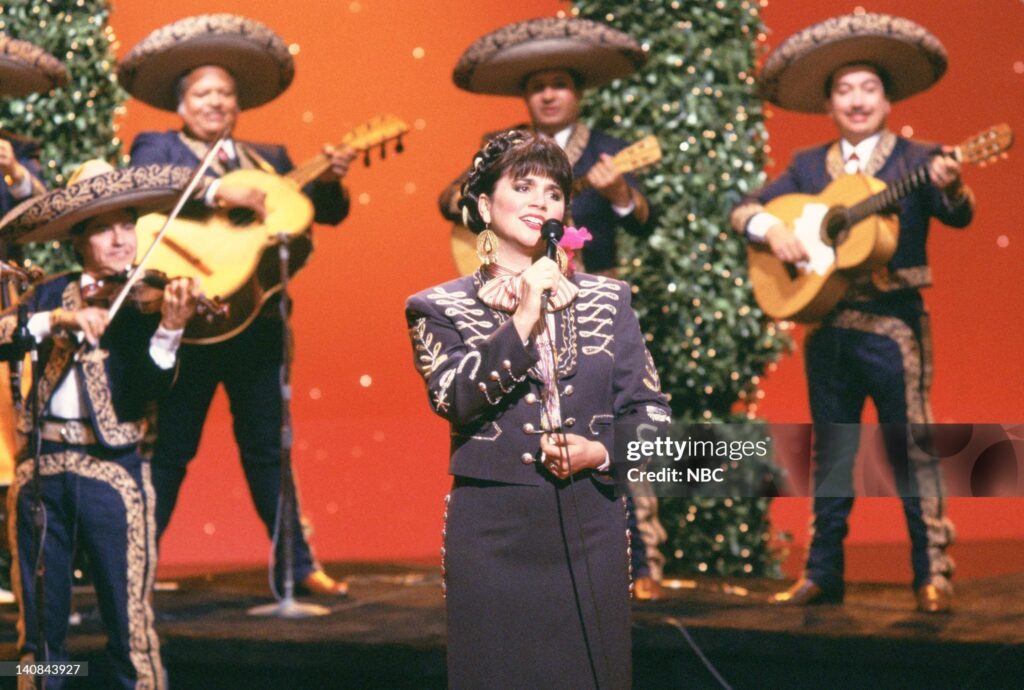
“Rogaciano el Huapanguero” is a mourning song in bright clothing—a huapango that grieves the death of a beloved singer while letting his spirit ring out in falsetto one last time.
On paper, “Rogaciano el Huapanguero” is “just” a three-minute track—track 7 on Linda Ronstadt’s Mexican masterwork Canciones de Mi Padre (released in November 1987). But in the ear, it’s something bigger: a small drama of loss and regional pride, sung with the kind of commitment that makes you feel the mountains behind the melody.
First, the essential facts—because this song deserves to be held with care. Ronstadt’s recording of “Rogaciano el Huapanguero” credits the composer as Valeriano Trejo, and the track runs about 3 minutes on the original album sequencing. It appears on Canciones de Mi Padre, a full-length tribute to the songs Ronstadt grew up hearing and singing at home—music she later described as part of her family’s Sunday afternoons, tied to memory as tightly as food, laughter, and the particular hush that falls when an older relative begins a song.
If you’re looking for “debut ranking,” the most reliable chart marker is for the album: Canciones de Mi Padre peaked at No. 42 on the Billboard 200. Yet its real “ranking” is cultural: the Library of Congress added the album to the National Recording Registry in 2022, a formal acknowledgement that this wasn’t a novelty detour—it was American history sung in Spanish. The same project also earned Ronstadt a GRAMMY for Best Mexican-American Performance (as the Recording Academy recounts in its GRAMMY Rewind feature).
Now, the story inside the song.
“Rogaciano el Huapanguero” is rooted in huapango, a Mexican song form known for its rhythmic drive and, famously, its falsetto—that sudden, haunting leap in the voice that sounds like a cry thrown across distance. In an interview excerpted by WYSO (from Terry Gross’s Fresh Air conversation), Ronstadt herself explains the style in plain, human terms: mountain regions shape a kind of yodeling so the voice can “throw” across space, and the rhythm—often described in terms like 6/8—has a distinctive “hitch in the gate” that you learn by feel as much as by counting.
The lyric world is not romantic in the soft-focus sense—it’s romantic in the old, tragic way. La Huasteca is “in mourning”; its huapanguero has died; the falsetto that once carried the soul of the troubadour is gone. UCLA’s Strachwitz Frontera Collection even tags the song’s theme with blunt accuracy: lament, death, funeral, despair—and confirms Trejo as composer on Ronstadt’s recording.
And yet—here’s the miracle—the song doesn’t collapse under sorrow. It moves. It dances. It keeps the pulse of life going even as it speaks to death. That’s the emotional trick huapango can pull off when it’s done right: grief doesn’t stop the music; grief rides inside it. Ronstadt sings as if she’s carrying a name that matters, not showing off a style. Her voice doesn’t treat Spanish as costume. It treats Spanish as inheritance.
This is also why the album context matters so much. Canciones de Mi Padre happened because Ronstadt—supported by producer Peter Asher—pursued a collaboration with Rubén Fuentes (of Mariachi Vargas de Tecalitlán) and drew top musicians from several renowned mariachi ensembles in Los Angeles. The Library of Congress essay notes there was even creative tension: Fuentes leaned toward a modern, urban mariachi sound, while Ronstadt kept reaching for the older “música ranchera’s heyday” feeling she remembered. That push and pull is exactly what makes “Rogaciano” feel alive: it respects tradition, but it’s recorded with the clarity and force of an artist who knows precisely what she wants to preserve.
So what does “Rogaciano el Huapanguero” mean when you listen today?
It’s a eulogy for an unnamed kind of hero: the regional singer whose voice belongs to a place the way a river belongs to a valley. It’s the sound of a community realizing that when one voice disappears, something in the landscape goes quiet too. And it’s also a quiet promise—because the song itself becomes the replacement falsetto. Ronstadt sings the mourning, and by singing it, she refuses to let Rogaciano vanish. In that sense, the track is not only about death. It’s about the stubborn afterlife that music can grant: the way a voice, once truly heard, keeps traveling—over mountains, over years, over the private distances inside our own hearts.