
“Be My Baby” becomes a lullaby in Linda Ronstadt’s hands—proof that the fiercest teenage longing can, with time, soften into pure tenderness without losing its glow.
The version you’re hearing from Linda Ronstadt isn’t the famous “Wall of Sound” thunderclap; it’s a late-career act of transformation. She recorded “Be My Baby” for her 1996 studio album Dedicated to the One I Love, released June 25, 1996—an album of classic pop and rock songs reimagined as children’s lullabies, co-produced by Ronstadt and George Massenburg. In that gentle setting, “Be My Baby” appears as track 2 (3:16), no longer a teenage plea shouted over booming drums, but a hush delivered close to the ear—like a hand smoothing the air at bedtime.
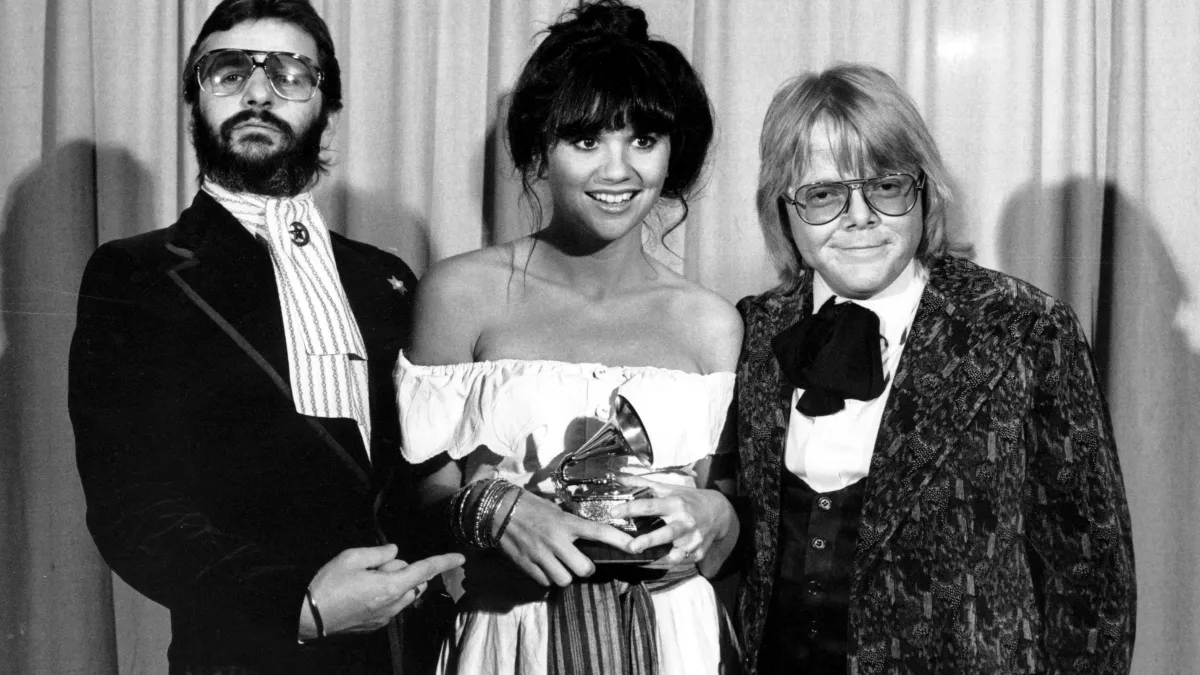
Commercially, the “ranking at launch” belongs to the album rather than the song as a single: Dedicated to the One I Love reached No. 78 on the Billboard album chart and—beautifully on-theme—hit No. 1 on Billboard’s Top Kid Audio chart. Chart-run databases that track weekly entries list the album’s Billboard debut at No. 114 before it climbed to that No. 78 peak. The industry, meanwhile, crowned the project with a particular kind of respect: at the 39th Annual Grammy Awards (1997), Ronstadt and Massenburg won Best Musical Album for Children for Dedicated to the One I Love.
Those facts set the stage, but the deeper story sits inside the song’s long memory. “Be My Baby” was originally recorded by the Ronettes, released in August 1963, written by Phil Spector, Jeff Barry, and Ellie Greenwich, and produced by Spector in his defining Wall of Sound style. It became the Ronettes’ biggest hit, reaching No. 2 in the U.S. and No. 4 in the UK—a record whose opening drum figure feels like the first heartbeat of modern pop. The Library of Congress later placed the recording in the National Recording Registry (added in 2006), a formal way of saying what listeners already knew: this wasn’t merely a hit; it was a cornerstone.
So what does Linda Ronstadt do when she approaches something that iconic?
She changes the song’s purpose while preserving its promise.
In 1963, the Ronettes’ Ronnie Spector sang desire like a bright dare—romance as adrenaline. In 1996, Ronstadt reframes that same devotion as comfort. The lyric’s essential vow—be mine, stay close, choose me—is left intact, but the emotional temperature drops from fever to warmth. And that is not diminishment. It’s maturation. It’s the song surviving its own youth.
Part of the magic is the album’s whole sonic world. Dedicated to the One I Love was recorded mainly between September 1995 and January 1996 (with “Winter Light” noted as recorded earlier), and it’s built with delicate, almost luminous textures—arrangements meant to soothe rather than stun. In that context, “Be My Baby” becomes less a street-corner declaration and more a private ritual: a melody that rocks instead of rattles, a chorus that folds into the room like lamplight.
And that’s the song’s meaning here—love not as conquest, but as shelter.
There’s also something quietly moving in Ronstadt’s choice of material. She wasn’t revisiting these classics to prove she could sing them (she’d proved that a hundred times over). She was, instead, preserving them—carrying a generation’s pop language into a new setting, as if to say: these songs raised us, and they can still keep watch over us. The result is nostalgia with a heartbeat: not a museum exhibit, but a living thing, softened by time and still faithful to its first spark.
If the Ronettes’ “Be My Baby” is the sound of love bursting open—urgent, dazzling, a little reckless—then Linda Ronstadt’s “Be My Baby” is what comes after: love remembered, love steadied, love turned into a gentler kind of certainty. It’s the same dream, sung from farther down the road—where longing doesn’t need to shout to be believed.