
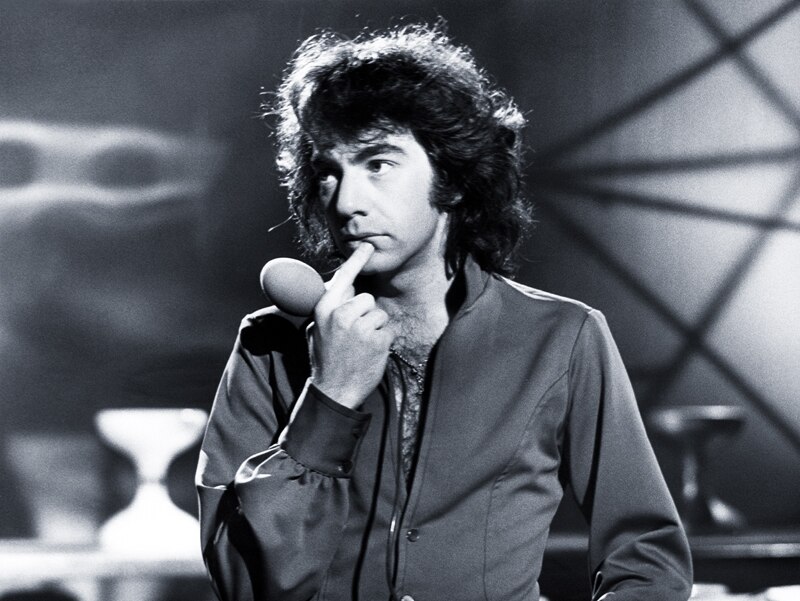
“Morningside” is Neil Diamond’s small, solemn elegy about what we leave behind—how a life can end in silence, yet still speak through the work of one’s hands and the memory carried by children.
If there is a song in Neil Diamond’s catalog that feels less like pop and more like a carved epitaph, it is “Morningside.” It closes his 1972 album Moods as side two’s final track, and it is preceded by a brief orchestral throat-clearing—“Prelude in E Major”—as if the record itself asks the listener to sit up straighter before the story begins. On paper it’s just sequencing; in the ear it’s ritual: a door opening onto something hushed and heavy, a ballad that doesn’t entertain so much as remember.
Moods was released in July 1972 on Uni Records, produced by Tom Catalano and Neil Diamond, with orchestral work arranged and conducted by Lee Holdridge. The album’s impact was immediate and defining—it reached No. 5 on the U.S. Billboard 200, and it earned a Grammy nomination for Album of the Year (1972). That big, bright success is often remembered through the sunshine of “Song Sung Blue,” but “Morningside” is the shadow on the edge of the photograph—the part that makes the smile look real.
What makes the song cut deeper is the story behind it. Accounts connected to Diamond’s fan-archival sources preserve an attributed explanation: Diamond wrote “Morningside” as a tribute to his grandmother, described as “a sweet, beautiful woman” who died alone in a New York hospital, “with no one even caring.” It’s a brutal thought, stated plainly—and Diamond answers it with a narrative of an old man’s death and the lonely dignity of what he leaves behind. Even Lee Holdridge’s role becomes part of that emotional framing: after hearing the piece, he wanted to add a prologue—“Prelude in E Major”—so the orchestra could quietly signal, pay attention; this matters.
In the lyric, “Morningside” doesn’t plead for sympathy. It reports. An old man dies; the world turns away; and still, in the aftermath, there is craft—a table “made of nails and pride,” words carved by hand: “For my children.” The brilliance is how the song refuses easy comfort. It doesn’t pretend that a good life guarantees a gentle ending. Instead it suggests something more complicated, and perhaps more truthful: that legacy is often built in silence, and sometimes the only tenderness the world offers arrives after it is too late to be felt by the one who needed it most.
There is also a second life to “Morningside” that matters to its public footprint. After the studio version’s quiet closing role on Moods, the song reappeared as a live performance on Hot August Night, recorded August 24, 1972 at the Greek Theatre in Los Angeles and released December 9, 1972. In 1973, “Cherry, Cherry” (live) was issued as a single from that live album, with “Morningside” (live) on the B-side—and the single’s U.S. chart peak reached No. 31 on the Billboard Hot 100 (with No. 19 on Billboard’s Adult Contemporary chart). The numbers are respectable; the deeper point is symbolic. Diamond was willing to place a song this stark in the slipstream of a crowd-pleasing concert release—proof that he believed the darkest stories deserved a stage, too.
In the end, “Morningside” feels like the moment a room goes still and nobody quite knows why—until they realize the song has touched something personal: the fear of being forgotten, the hope of being understood, the quiet pride of making something that might outlast us. Neil Diamond sings it with a gentleness that never becomes softness. It’s the gentleness of someone telling the truth carefully—because the truth is heavy, and it must be carried with both hands.