
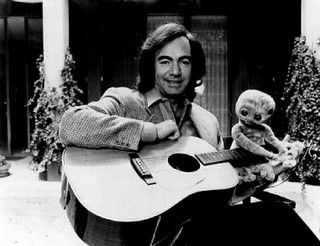
“Candlelight Carol” is Christmas wonder spoken in questions—an adult voice trying to measure the immeasurable, until the only honest answer left is awe.
When people say Neil Diamond has a gift for making a room feel warmer, they often point to the anthems—the ones built for applause. But his recording of “Candlelight Carol” works in the opposite direction: it draws the light inward, toward the cradle, toward the hush, toward the fragile places where words turn into prayer. It is crucial to be exact about what this song is. “Candlelight Carol” is not a Neil Diamond original; it’s a modern choral classic written (music and lyrics) by John Rutter in 1984, commissioned by John Romeri (then Director of Music at the Church of the Assumption in Bellevue, Pennsylvania), and first released on record by The Cambridge Singers in 1987. That pedigree matters, because it explains why the song feels less like “seasonal product” and more like something reverent—crafted for choirs, for candlelit spaces, for the kind of quiet that makes even a confident singer choose restraint.
Diamond brought the carol into his own world on The Christmas Album, Volume II, released October 11, 1994, produced by Peter Asher. On that album’s track list, “Candlelight Carol” appears as track 9 with a runtime of 4:09. The album’s “ranking at release” is modest but meaningful: it reached No. 9 on Billboard’s Holiday Album chart and was certified Gold by the RIAA on December 6, 1994—proof that a holiday record built on choirs and orchestral dignity could still find a wide audience in the mid-’90s. (The album also had a Billboard 200 run during the 1994–95 holiday season, peaking outside the very top tier—another reminder that Christmas albums often live by returning rather than exploding.)
The “story behind” Diamond’s version is really a story of craft. The track’s credits consistently point to a carefully built choral-orchestral setting: David Campbell is credited with the string arrangement, and Robert Prizeman with vocal/choir arranging, while Asher remains the steady hand at the production desk. The ensemble matters too: album documentation lists the Ambrosian Singers as the choir on this track, alongside the Angel Voices boys’ choir, with John McCarthy and Robert Prizeman in choral leadership roles. These details aren’t decoration; they are the very architecture of the song’s feeling. “Candlelight Carol” is meant to glow, not dazzle—like a room lit by flame rather than stage lights.
And then there is the lyric itself: a sequence of questions so gentle they almost feel like a parent speaking under the breath. How do you capture the wind on the water? How do you count all the stars in the sky?—questions that begin in nature, then turn toward the real subject: How can you measure the love of a mother? The brilliance of Rutter’s writing is that it doesn’t lecture the listener into belief. It invites the listener into wonder. It suggests that the Nativity is not only a theological claim, but an emotional one: that the love Mary feels for the child is so vast it becomes its own proof—something you can’t calculate, only witness.
In Neil Diamond’s hands, those questions sound especially poignant because his voice carries age, history, and a certain earned gravity. He doesn’t sing this like a choir director’s showpiece. He sings it like someone who has lived long enough to know that the deepest truths rarely come with certainty—they come with reverent disbelief. The carol’s refrain—“Candlelight, angel light / firelight and star glow”—isn’t merely pretty imagery; it’s a soft insistence that the world, at its best, can still be illuminated by tenderness.
So the meaning of “Candlelight Carol”—especially in this 1994 Diamond recording—is not “Christmas cheer” in the shallow sense. It is the older, steadier kind of cheer: the kind that survives because it is built on humility. The song begins by admitting we cannot measure the most important things, and it ends by letting the heart accept that limitation without despair. In the glow of choirs, strings, and Diamond’s unforced sincerity, the carol becomes what it was always meant to be: a small lantern held up against winter darkness, saying—without shouting—that wonder is still possible.