
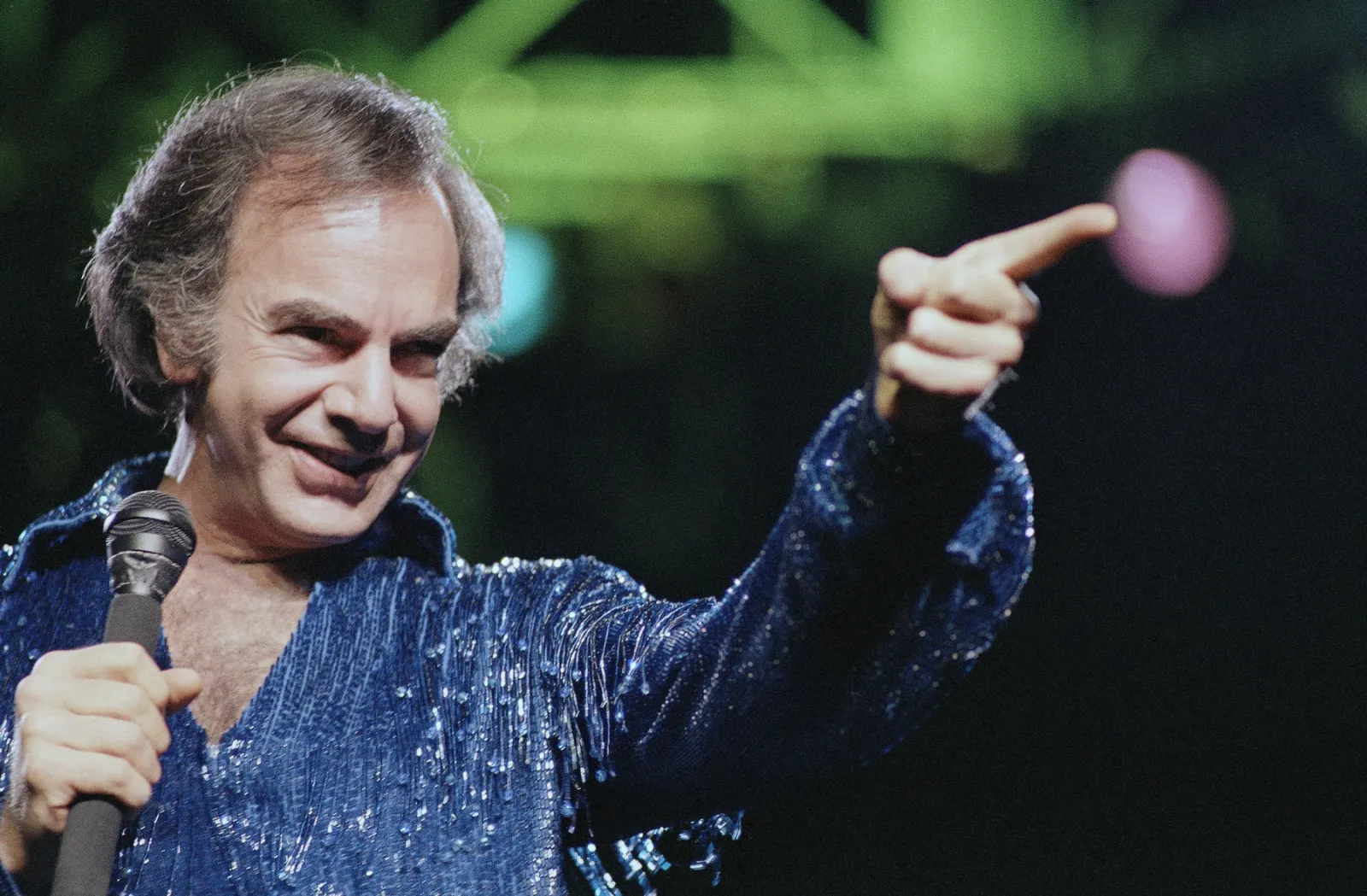
“Everybody’s Talkin’” in Neil Diamond’s voice is a quiet escape plan—leaving the noise behind to go wherever the weather finally “suits your clothes.”
“Everybody’s Talkin’” wasn’t introduced as a Neil Diamond chart weapon. It arrived, instead, as an album-opening statement—the very first track on Touching You, Touching Me, released November 14, 1969. Because Neil Diamond did not launch his version as a major standalone U.S. single at the time, it doesn’t have a clean “debut position” on the main American singles charts under his name. Its entrance into listeners’ lives was more intimate than that: you dropped the needle (or pressed play) and there it was—like a curtain rising on a mood.
The song itself already carried a wandering spirit and a formidable lineage. “Everybody’s Talkin’” was written by Fred Neil, who recorded it in the mid-1960s; it later became globally famous through Harry Nilsson, whose hit version—propelled by its association with the film Midnight Cowboy—reached No. 6 on the U.S. Billboard Hot 100 and won a Grammy Award. In other words, by late 1969, the song was already a kind of modern folk standard: an anthem for anyone who has ever stood in a crowded room and felt strangely alone.
So why would Neil Diamond—at a moment when his own songwriting was catching fire—choose to begin an album with someone else’s song?
That’s the revealing part. Touching You, Touching Me is the era when Diamond was balancing two truths about himself: the craftsman who could write his own unmistakable classics, and the interpreter who could take a song and make it feel newly personal. The album’s track list makes that duality plain: it opens with “Everybody’s Talkin’” (a Fred Neil composition), then moves through “Mr. Bojangles” (Jerry Jeff Walker), before circling back to Diamond originals like “Holly Holy.” It’s almost as if he’s saying, right at the start: I can speak in my own words—but I also know how to live inside yours.
And the meaning of “Everybody’s Talkin’”—the longing—fits Diamond like a well-worn coat. The lyric is not a fight, it’s a retreat: everybody’s talking at me… I don’t hear a word they’re saying. It’s the sound of urban overload and emotional exhaustion, of the world pressing too close. The fantasy that follows—going where the sun keeps shining through the pouring rain—isn’t just travel. It’s self-preservation. It’s the desire to step out of the harsh light of other people’s expectations and return to a simpler inner climate.
In Neil Diamond’s hands, that desire doesn’t come off as a fashionable, cinematic cool (the way Nilsson’s version can feel like a drifting hero’s theme). Diamond’s reading feels more grounded—less “movie,” more “real life.” He sounds like a man who knows what it is to be surrounded by voices and still feel unheard. There’s a particular ache in that: not youthful rebellion, but adult weariness. The kind that doesn’t explode; it just quietly makes plans.
That’s also why the placement matters so much. Opening Touching You, Touching Me with “Everybody’s Talkin’” frames the entire album as an emotional journey rather than a simple collection of songs. Before Diamond even gets to his own declarations of love and longing, he starts by admitting the fundamental condition: the world is loud, and the heart sometimes needs to disappear for a while just to stay intact.
If you listen to it as a memory-piece—one of those tracks that carries the scent of late-’60s radio and the hush of bedroom speakers—it becomes less about “running away” and more about reclaiming a private self. “Everybody’s Talkin’” is the rare song that doesn’t pretend social noise is harmless. It names the fatigue, then offers a gentler horizon. And when Neil Diamond sings it at the threshold of 1969, it feels like he’s opening a door for the listener too: come on—step out of the crowd for three minutes. Let the weather suit your clothes again.