
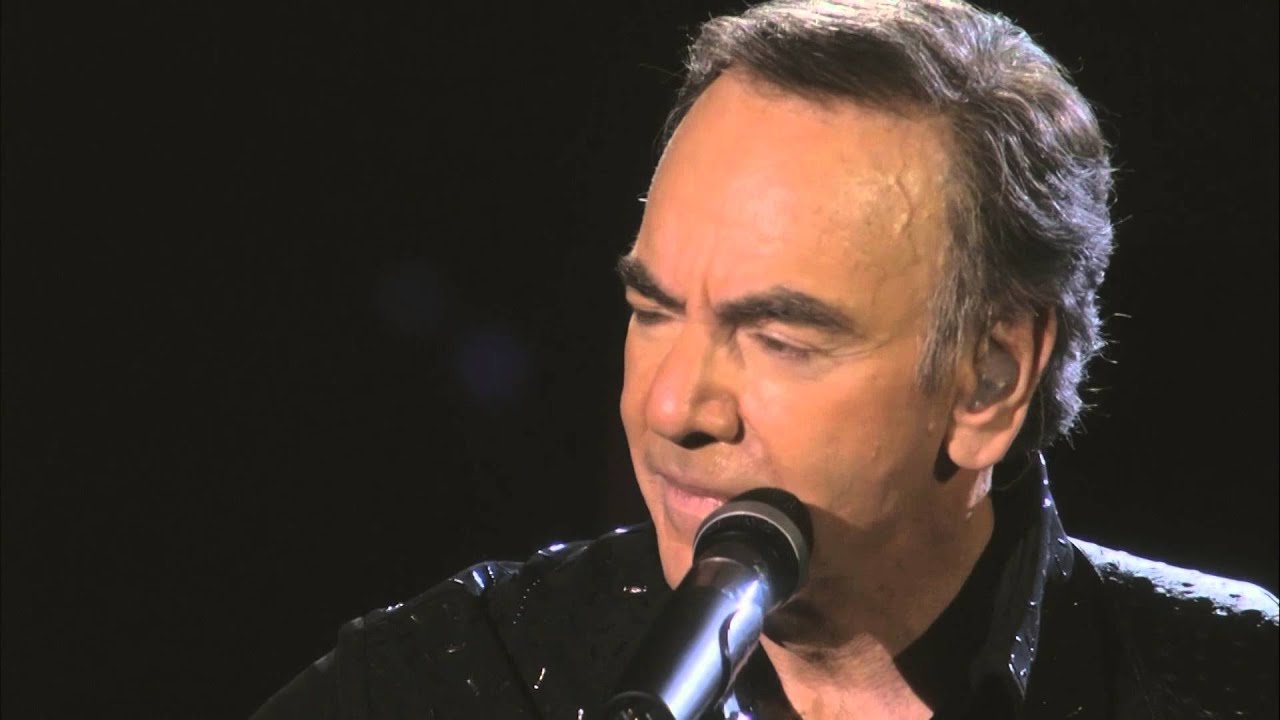
A coming-of-age plea wrapped in pop drama—“Girl You’ll Be a Woman Soon” is about claiming your own heart before the world claims it for you.
When “Girl You’ll Be a Woman Soon” first arrived in March 1967, it sounded like a young man standing at the edge of adulthood, calling to someone he couldn’t quite reach—not because she didn’t feel the same, but because the world around her was already writing her story. It was released on Bang Records, recorded in 1966, and issued as a single that quickly became one of Neil Diamond’s early signature moments. Just for You is where the song first lived in album form, but it was the 45 that carried its urgency into living rooms and car radios.
The chart story—so often the public’s shorthand for “impact”—was genuinely strong. In the U.S., the single reached No. 10 on the Billboard Hot 100, a Top 10 peak that placed Diamond among pop’s most bankable new voices of 1967. Internationally it also made clear waves: it hit No. 8 in Canada, No. 34 in Australia, and later charted in the Netherlands (a No. 27 peak shown in the standard discography tables). These aren’t just statistics—they’re proof of how quickly the song’s emotional premise traveled. People in different places heard the same thing: a romantic voice insisting that growing up isn’t just something that happens to you; it’s something you decide.
Part of the reason it landed so cleanly is the way it was made. The record was produced by Jeff Barry and Ellie Greenwich—hitmakers with a keen sense of how to frame drama in under three minutes. There are even small collector details that hint at how carefully the mood was sculpted: the mono single/LP mix and the stereo LP mix differ in when the strings enter and how the fade plays out, as if the song itself had two slightly different ways of remembering the same night.
But the lasting power isn’t in the production trivia. It’s in the emotional argument at the center of the lyric. Diamond sings to a girl poised between “what they say” and “what you feel.” The narrator knows her friends and family disapprove of him; the song’s tension comes from that familiar pressure—voices outside the relationship trying to appoint themselves as judge and jury. Diamond’s approach is persuasive rather than forceful: he doesn’t just demand love, he urges independence. Don’t let them decide. Don’t let them finish your sentence. That’s why the title is so potent. It’s not merely flirtation—it’s a threshold. Soon implies inevitability, and the song becomes a countdown to self-ownership.
Listening now, you can hear how the track belongs to the late-’60s moment without being trapped by it. It has the pulse of folk-rock/pop-rock, but the storytelling is pure Diamond: direct, conversational, slightly theatrical, as if he’s singing both to her and to the room full of people who think they know what’s best for her. It’s the kind of song that makes you remember how intense “permission” used to feel—how monumental it was to choose someone (or choose yourself) in the face of disapproval.
And then, decades later, the song gained a second life in a completely different cultural weather. It re-entered popular conversation through Pulp Fiction, where it appears in a version performed by Urge Overkill—a cover recorded in the early ’90s and later propelled by the film’s soundtrack. That cover even became a charting hit in its own right, peaking at No. 59 on the U.S. Hot 100 and No. 37 in the UK. The fascinating part is how little the core message had to change. Different decade, different guitar tone, different cultural frame—same emotional lever: desire colliding with control, and the stubborn human wish to choose freely.
So what does “Girl You’ll Be a Woman Soon” mean when the novelty of its era has faded? It means that love, at its most honest, isn’t only about attraction—it’s about agency. It’s about the moment you realize your life is becoming yours, and you can no longer live it as a committee decision. The song is romantic, yes, but it’s also quietly radical: it champions the inner voice over the crowd. And that may be why it endures. Because even when the hairstyles change, even when the radios and the rooms and the years move on, there’s still that same soft panic—Who gets to decide who I become?
Diamond’s answer is tender and insistent: let it be you.