
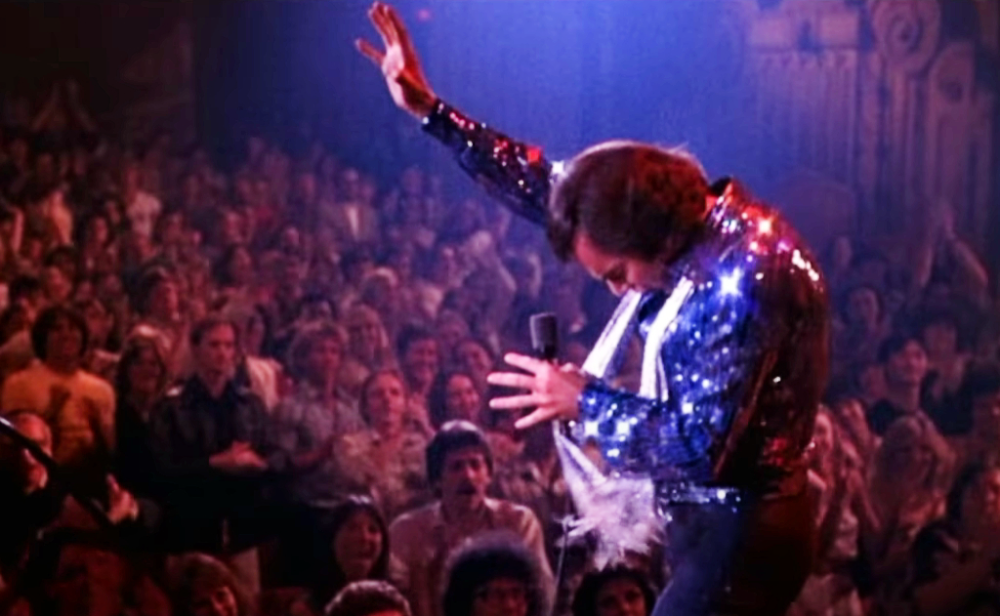
“America” was born for a movie, but Neil Diamond sang it so boldly, so emotionally, and on such a grand human scale that it escaped the screen and became something larger — not just Hollywood drama, but a full-throated anthem of arrival, hunger, and hope.
There are movie songs that serve their scene, and there are movie songs that break free from the film that introduced them. “America” belongs firmly to the second category. Written and recorded by Neil Diamond for The Jazz Singer, the song first appeared on the soundtrack album released in November 1980, then emerged as a single in April 1981. It climbed to No. 8 on the Billboard Hot 100 and became Diamond’s sixth No. 1 on Billboard’s Adult Contemporary chart. Those are strong numbers, but they only hint at the larger truth: “America” did not remain merely a soundtrack success. It grew into one of the defining statements of Neil Diamond’s career — a song that carried the emotional scale of cinema, yet somehow felt bigger than the film that gave it birth.
That is part of what makes the song so compelling. In the abstract, “America” could have been just another inspirational movie tune, the sort of song written to underline a character’s journey and then left behind by history. But Neil Diamond was too instinctive a performer, and too dramatic a songwriter, to leave it at that. He understood that the word America was already carrying more than plot. It carried migration, reinvention, longing, struggle, and a near-biblical sense of promise. In The Jazz Singer, those themes fit the story. Outside the film, they became even larger. The song stopped sounding like accompaniment and began sounding like declaration. That is why it endured: it was not merely cinematic. It was emotional on a national scale.
The historical context matters enormously. The Jazz Singer soundtrack was one of the most commercially important releases of Diamond’s early-1980s period, and it contained major songs including “Love on the Rocks,” “Hello Again,” and “America.” This was a moment when Diamond was already a veteran star, no longer needing to prove he could write a hit, but still capable of finding fresh grandeur when the material called for it. “America” became one of the great examples of that late-career authority. Billboard later ranked it the No. 62 pop single of 1981, and the single version itself was carefully designed to feel bigger than studio walls, using overdubbed crowd noise to create the effect of a live, communal swell. That production choice was shrewd. The song is about arrival, movement, masses, and shared aspiration; it almost had to sound public.
What makes “America” feel bigger than Hollywood, though, is the way Diamond sings it. He does not treat it like a tidy theme song. He attacks it with the fervor of a man who believes every line has to lift. That was one of his great gifts. Neil Diamond could take material that might have seemed broad or even overreaching on paper and make it feel fully inhabited. In lesser hands, “America” might have turned pompous. In his hands, it becomes urgent, proud, and deeply human. The song is not about abstraction; it is about motion — ships, names, cities, generations crossing over into possibility. Even when the sentiment grows enormous, Diamond keeps the feeling tied to bodies, journeys, and lives. That is why the song still moves people. It reaches upward, but it never entirely leaves the ground.
There is also something beautiful in the song’s double identity. On one level, “America” is unmistakably theatrical. It belongs to a film, and it knows how to fill a room. On another level, it is rooted in one of the deepest stories in American life: immigration as both hardship and promise. That tension gives the song its special force. It is not naïve, exactly. It understands distance, hunger, and yearning. But it insists that the arrival matters, that the striving matters, that the dream is worth singing at full volume. This is one reason the song later developed such a wide afterlife beyond the movie itself. It could be used in public ceremonies, sporting events, patriotic contexts, and celebrations of immigrant identity precisely because it was built large enough to leave the frame of the plot behind. Even later reporting on Diamond’s career still notes “America” as one of the songs that escaped its original setting and entered public ritual.
And perhaps that is the real key. “America” is not bigger than Hollywood because it rejects Hollywood. It is bigger because it absorbs the emotional spectacle of Hollywood and then pushes beyond it into something more communal. A movie song usually belongs first to characters. This one quickly began belonging to crowds. To listeners. To memory. To people who heard in it not just a soundtrack cue, but an anthem of arrival and becoming. It is one of the classic Neil Diamond moves: taking a word, an image, or a theme so large it might collapse under its own ambition, and singing it until it feels undeniable.
So yes, “America” began as a movie song. But in Neil Diamond’s hands, it became something much grander — a song of movement, promise, and emotional scale so large that the screen could barely contain it. That is why it still stands. Not merely as one of the highlights of The Jazz Singer, but as one of the great Neil Diamond performances full stop: bold, open-hearted, and vast enough to make Hollywood seem like only the starting point.