
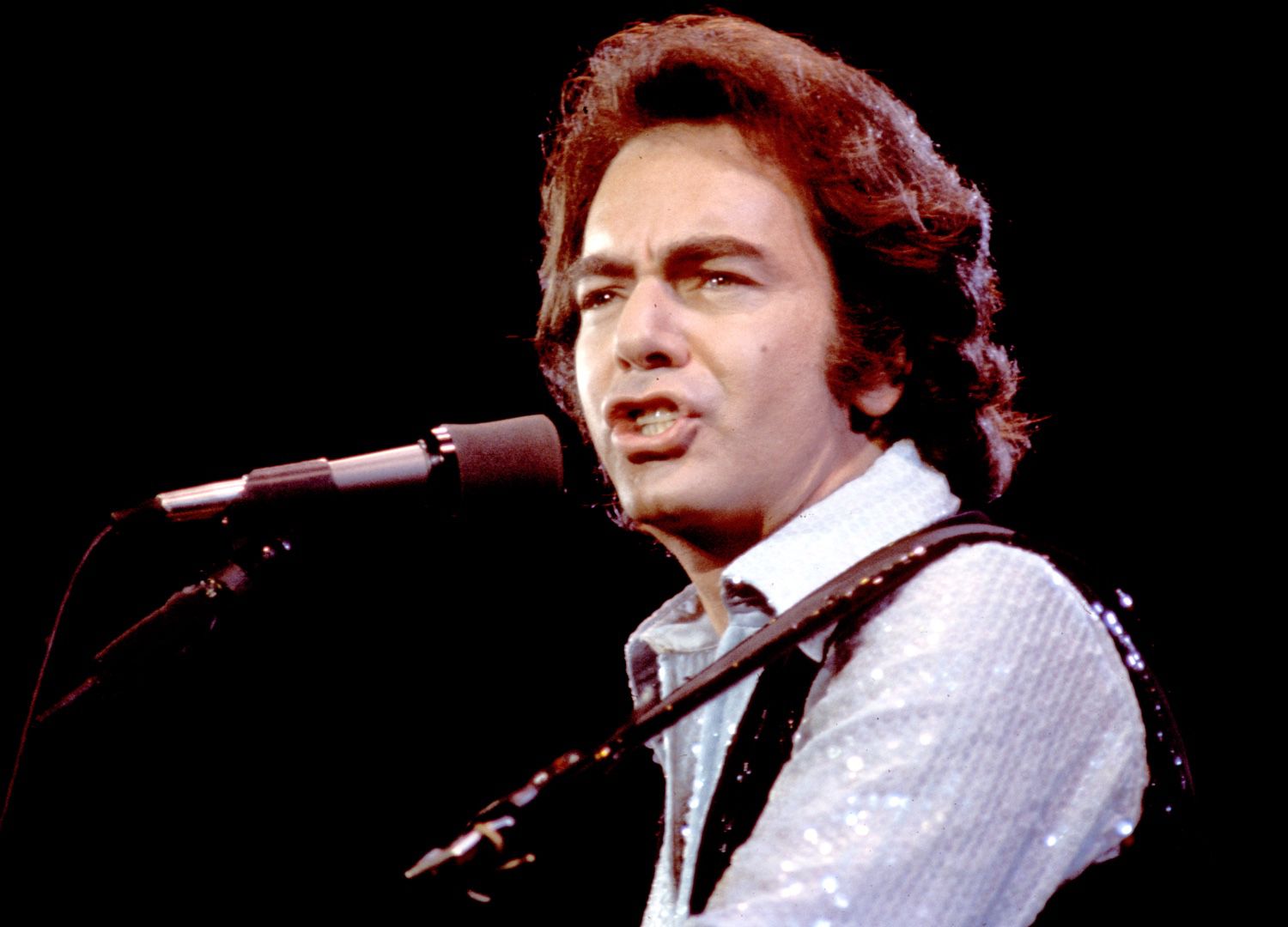
“Moonlight Rider” is Neil Diamond whispering romance into the dark—an after-hours reverie where motion becomes comfort, and the night feels like the only place a tender truth can finally speak.
There are Neil Diamond songs that stride straight into the room—big hooks, big declarations, the kind of chorus that seems designed for a crowd to answer back. “Moonlight Rider” does something quieter and, in its own way, more revealing. It arrives like a late thought you didn’t know you were carrying: a warm, gently pulsing track that feels less like performance and more like a private scene—two people suspended in night air, the world reduced to distance, breath, and a promise implied rather than shouted.
The crucial facts belong right up front, because “Moonlight Rider” has an unusual “release story” compared with Diamond’s classic-era singles. The song was officially unveiled in 2018 as part of Neil Diamond – 50th Anniversary Collector’s Edition, a 6CD career-spanning retrospective released by Capitol/UMe on November 30, 2018. This set wasn’t just hits and familiar album cuts—it also included a full disc of material described as unreleased songs and rarities, giving listeners a new doorway into Diamond’s vault. On the track list, “Moonlight Rider” appears on Disc 6—the disc devoted to that “unreleased songs” trove.
That context matters for chart talk, too. “Moonlight Rider” wasn’t rolled out like a traditional radio single with a neat Billboard peak to pin to its lapel. Its “moment” is the box set itself—an archival unveiling rather than a commercial campaign. Still, it wasn’t released in silence: Ultimate Classic Rock premiered an official lyric video for “Moonlight Rider” on December 17, 2018, explicitly tying the track to the Nov. 30, 2018 release of the 50th Anniversary Collector’s Edition.
And then there’s the most satisfying detail of all for anyone who values authenticity: credits databases list Neil Diamond himself as the songwriter, and also credit him on the production side for this recording—so the song feels stamped with that unmistakable Diamond authorship, even in a “newly revealed” form.
So what is “Moonlight Rider” actually saying—beneath the glow?
It’s a night-song in the oldest, truest tradition: a piece of music that treats darkness not as danger, but as shelter. In daylight, we explain ourselves. We tidy up our feelings so they look respectable. At night, the edges soften. The heart speaks in a more honest language—less argumentative, more instinctive. “Moonlight Rider” lives in that nocturnal honesty. The title alone carries its own mythology: a “rider” is someone in motion, someone traveling through uncertain territory, someone who keeps going because stopping would mean facing what hurts. But “moonlight” changes the meaning of motion—turning travel into romance, restlessness into a kind of lullaby.
That’s the nostalgia the song stirs: not nostalgia for a specific year, but nostalgia for a feeling—the feeling of being on the road late, windows cracked, music low, the world outside reduced to passing lights. The kind of night where you can admit the thing you couldn’t say at noon. Diamond has always understood that a love song doesn’t have to be loud to be absolute. Often, the deepest devotion sounds like someone choosing to stay gentle.
It’s also hard not to hear “Moonlight Rider” as part of a larger late-career echo. The song emerged publicly in 2018, in the same era when listeners were re-measuring Diamond’s legacy with fresh gratitude—through retrospectives, honors, and that sense of looking back across a long road and realizing how many miles his voice traveled alongside people’s lives. The 50th Anniversary Collector’s Edition frames exactly that: five decades of work, revisited with affection and perspective. In that setting, a song like “Moonlight Rider” feels like an extra page found in an old journal—something you didn’t know you needed until it’s suddenly in your hands.
In the end, “Moonlight Rider” isn’t asking to replace the towering, communal Diamond anthems. It’s doing something subtler: reminding you that the man who could fill arenas also knew how to sing for the quiet hours—when love is less a proclamation than a presence, and the night, soft as velvet, lets you believe again in tenderness without having to defend it.