
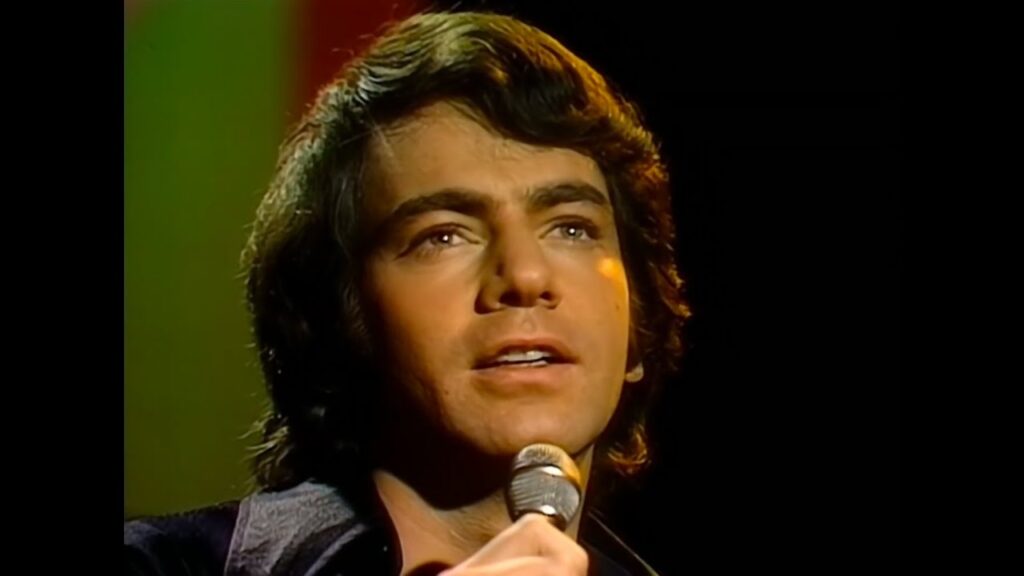
Neil Diamond’s “Suzanne” is a tender act of surrender—walking willingly into someone else’s world, knowing the beauty will never quite become possession.
First, the essential fact—because it shapes everything that follows: “Suzanne” in Neil Diamond’s repertoire is Leonard Cohen’s song, not an original Diamond composition. Diamond recorded it for his 1971 album Stones, where it appears explicitly credited to Leonard Cohen. That one line of authorship matters: it tells you Diamond is stepping into a poem already beloved, already haunted, and choosing not to “outshine” it, but to inhabit it—like an actor who understands the power is in the script and the silence between the lines.
Diamond’s version was released on Stones (album release date commonly cited as November 5, 1971), a record that—at the time—sat firmly in his early-’70s peak: big emotions, cinematic arrangements, and a voice that could sound both confessional and larger-than-life. The album itself rose to a No. 11 peak on the Billboard 200, a strong showing that underlines how wide Diamond’s audience had become by then. But “Suzanne” was not positioned as a headline single from the project—its power is more intimate, more album-deep, like a quiet room you discover down the hallway after the grand living room has already dazzled you.
And what a room it is.
Cohen’s “Suzanne” began with a very real geography and a very real muse: Montreal, the Old Port, and Suzanne Verdal, whose presence in Cohen’s life helped spark a lyric that feels half remembered, half dreamed. The Canadian Songwriters Hall of Fame notes Cohen’s own explanation that the song was “begun” with Montreal in mind even before a woman’s name entered it—already suggesting place would be as important as person. Accounts of Verdal and that Montreal chapter—tea, the harbor, the peculiar spell of companionship that is close but not “owned”—have circulated for decades, adding a human silhouette behind the song’s luminous fog.
Diamond approaches that fog differently than Cohen. Where Cohen often sounds like he’s speaking from the inside of the candle flame—dry, wry, almost conversational—Neil Diamond sings as though the feeling has swelled to fill the whole chest. He doesn’t “translate” the lyric into his own autobiography; instead, he magnifies the ache that’s already there. The famous images remain: the river, the boats, the tea “from China,” the sense that this woman is both tender and unreachable, half invitation and half warning. What changes is the emotional light. Diamond’s voice turns the scene into something warmly cinematic—less a private notebook, more a slow pan across a memory you can’t stop replaying.
The meaning of “Suzanne” has always resisted a single tidy label, and that’s part of why it lasts. It’s romantic, yes, but it’s also about the strange boundaries of intimacy—how someone can draw you close, feed you, charm you, make you feel chosen… and still remain, fundamentally, their own country. As one thoughtful exploration of the song’s backstory puts it, the real-life Suzanne was someone Cohen loved in a complicated, not-easily-defined way, and the song’s power is in that ambiguity—desire braided with restraint.
In Diamond’s hands, that ambiguity becomes almost painful in its sweetness. You can hear a man singing as if he’s discovered that wonder and frustration can share the same breath. The lyric doesn’t beg for a happy ending; it simply keeps returning to the spell. That’s the adult truth at the heart of “Suzanne”: sometimes the most unforgettable love stories aren’t the ones that “work out”—they’re the ones that change the weather inside you, and then leave you with the sound of boats going by in your head long after the room is empty.
So if you’re coming to Neil Diamond – “Suzanne” expecting chart fireworks, you’ll miss the point. The real “ranking” of this performance is private: it lives in how gently he holds Cohen’s imagery, how earnestly he lets the lyric remain mysterious, and how he turns a quiet Montreal walk into a universal moment—standing near someone you can’t truly keep, yet feeling, for a little while, that you could spend the night forever.