
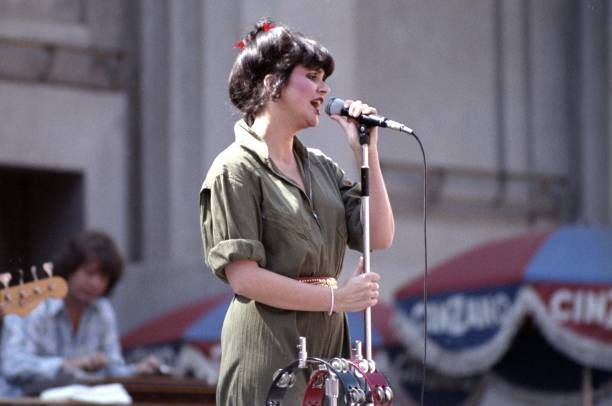
“My Funny Valentine” is a love song that refuses perfection—Linda Ronstadt sings it like a tender acceptance of human flaws, lit by the soft glow of Nelson Riddle’s last great arrangements.
When Linda Ronstadt recorded “My Funny Valentine,” she wasn’t trying to “go jazz” as a fashionable detour. She was completing a long, deliberate conversation with the Great American Songbook—one that had already reshaped how people heard her voice. Her version appears on For Sentimental Reasons (released September 22, 1986), the final installment of her celebrated trilogy with bandleader/arranger Nelson Riddle. That album is more than a tasteful side project: it peaked at No. 46 on the Billboard 200 and No. 3 on Billboard’s Top Jazz Albums, and it was described as the last of their collaborations—made especially poignant by the fact that Riddle died during the making of the record. Those are the kinds of facts that change the temperature of the listening. You don’t just hear an “arrangement.” You hear time passing, a closing chapter, the quiet dignity of artists finishing a sentence together.
In that context, “My Funny Valentine” sits like a jewel with a hairline crack—beautiful precisely because it’s honest about imperfection. The song itself is older than any recording, older than the idea of “covers” as we know them: it was written by Richard Rodgers (music) and Lorenz Hart (lyrics) for the 1937 Broadway musical Babes in Arms, where it was introduced by the teen star Mitzi Green. The premise of the lyric is still quietly radical: instead of praising an idealized lover, it lists endearing shortcomings—“unphotographable,” “laughable”—and then offers the most intimate vow of all: don’t change. Love, in this song, is not a pedestal. Love is recognition.
That’s why Ronstadt was such a natural messenger for it in 1986. By then, she’d already proven she could be fearless in genre and identity—rock, country, pop, Mexican folk traditions—without ever sounding like she was merely visiting. With “My Funny Valentine,” she brings a different kind of strength: restraint. She sings as if she’s leaning close enough to tell you the truth without raising her voice. On paper, the lyric can look almost teasing; in her performance, the teasing turns tender, like a smile that arrives after an argument has ended and nobody wants to reopen the wound. The affection feels mature—less the giddy rush of falling in love, more the steady choice to stay.
And then there’s Nelson Riddle—the invisible co-lead in this duet. For Sentimental Reasons is steeped in big band and traditional pop elegance, but it never feels showy for its own sake. Riddle’s genius was always about framing: he knew how to place a singer in the center of a room made of strings and brass without drowning the human breath. Knowing that this album was recorded across July 1985 to May 1986, and that it became the closing chapter of their trilogy, adds a hush to the orchestration—like everyone involved understood they were preserving something that wouldn’t come again.
So what is the deeper meaning of “My Funny Valentine” in Ronstadt’s hands? It becomes a song about merciful love—the kind that doesn’t demand performance from the person being loved. It says: I see your awkward edges, your imperfect angles, and I’m not here to correct you into someone else. That message lands differently when delivered by a singer whose career was so often associated with power. Here, she uses power the way the best singers do: not to overwhelm, but to clarify.
If you play “My Funny Valentine” now, try listening as though it’s late and the world has stopped insisting you be polished. That’s where this song lives best—where you can admit that the people who matter most are not flawless, only beloved. And in that soft room of sound—Linda Ronstadt, Nelson Riddle, and a tune born on Broadway in 1937—you can feel why this standard has survived for so long: it tells the truth about love without making it ugly, and it makes imperfection sound like home.