
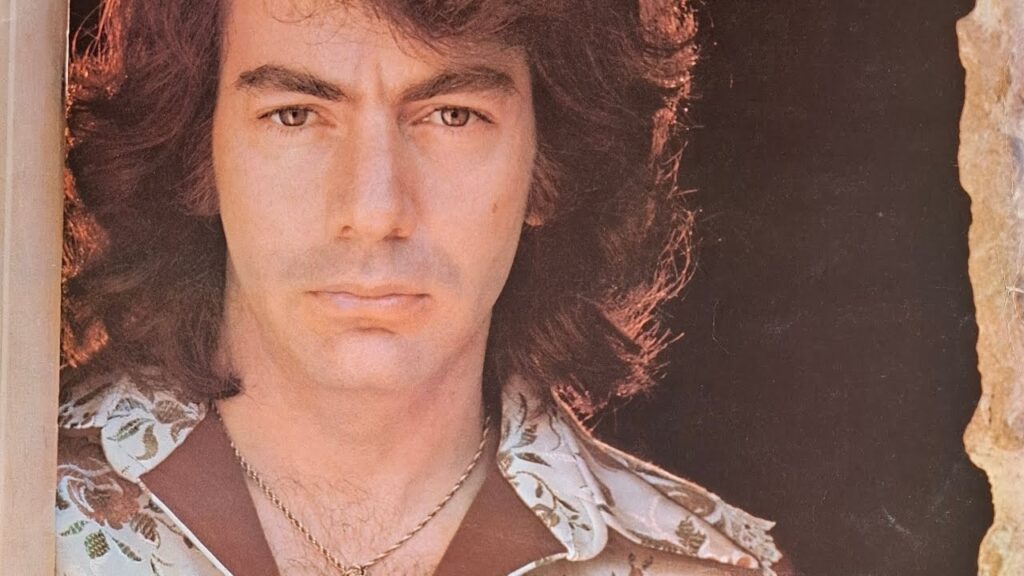
“Slow It Down” is Neil Diamond pressing a gentle hand to the world’s racing pulse—asking us to breathe, to listen, and to remember that a life isn’t meant to be swallowed in one hurried gulp.
By the time Neil Diamond released “Slow It Down” in 2008, he had already lived several careers inside one name: the Brill Building craftsman, the arena poet, the romantic monument. Yet this song arrives not as a victory lap, but as a kind of late-evening counsel—spoken with the calm authority of someone who has watched decades speed by and finally decided that speed is not the same thing as progress. “Slow It Down” appears as track 11 on Diamond’s album Home Before Dark, running 4:56, and—importantly—Diamond wrote it himself.
There’s no splashy singles-chart “debut position” for “Slow It Down” because it was not pushed as a major standalone single in the way Diamond’s classic hits were; it was designed to live inside the album’s emotional arc, arriving near the end like an afterthought that turns out to be the point. But the album surrounding it did make a striking entrance. Home Before Dark was released in early May 2008 and became Neil Diamond’s first No. 1 album on the Billboard 200, debuting at the top with a first week of 146,000 copies—an extraordinary late-career summit that proved the old voice could still speak to a modern moment. In the same month, the album also debuted at No. 1 in the UK, echoing that transatlantic embrace.
Those facts matter because “Slow It Down” is not the sound of an artist chasing relevance—it’s the sound of relevance finding him, because the song’s message is timeless. On Home Before Dark, Diamond worked again in the stripped, truth-first spirit associated with Rick Rubin’s approach to capturing voices as they are, not as we wish them to be. That production context helps explain why “Slow It Down” lands the way it does: not glossy, not frantic, but grounded—like a man speaking across a kitchen table rather than a stage.
Lyrically, the song opens with a kind of tough affection—an older voice talking to someone younger (and, if we’re honest, to the younger self we all keep hidden in the back room). It’s full of modern verbs—hurry up, eat on the run, greed, speed—and then the quiet pivot: are you really sure? It’s a simple question, but it carries a lifetime of subtext. Diamond doesn’t scold; he diagnoses. He recognizes that ambition can turn into appetite, that appetite can turn into exhaustion, and that exhaustion has a way of stealing the very joys we thought we were working for. The chorus—“Slow it down”—is not just instruction. It’s a remedy, offered with the gentle stubbornness of someone who has learned the hard way that the heart has its own tempo.
What makes “Slow It Down” especially moving is how it reframes success. In younger pop writing, success is often a summit: you get there, the story ends, the lights go up. Here, success is redefined as presence. The song urges you to “catch the sound of your heart,” to notice what is happening before it passes you by. That’s the emotional center: the fear that life will become a blur of errands, achievements, and noise—while the real music, the inner rhythm that makes living meaningful, goes unheard. It’s not nostalgia for the sake of nostalgia; it’s a plea for attention, for the kind of attention that turns ordinary minutes into memories you can actually keep.
In the wider context of Home Before Dark, the placement of “Slow It Down” is almost architectural. The album is full of late-career reflections—songs that look back without collapsing into self-pity—and then, near the end, Diamond offers this counsel like a lantern on the last stretch of road. It’s the kind of track that doesn’t necessarily grab you on first listen the way a chorus like “Sweet Caroline” does. Instead, it grows in the mind. You find yourself remembering it at odd times—when the day has run too fast, when the phone won’t stop, when the to-do list starts to feel like a second job. And suddenly the line isn’t just a lyric. It’s a handrail.
That is the quiet power of Neil Diamond – “Slow It Down.” It doesn’t try to be immortal through spectacle. It tries to be useful. It tries to save something—your breath, your attention, your tenderness—before the world spends it for you. And maybe that’s why it belongs so naturally on an album that finally gave Diamond his first Billboard No. 1 at age 67: because the song understands what charts never will. Time is the only true currency. Everything else is just noise—unless you choose, one chorus at a time, to slow it down.