
“Deck the Halls / We Wish You a Merry Christmas” is celebration without irony—ancient melodies braided together, carried by a voice that understands joy as something shared, not performed.
When Neil Diamond recorded “Deck the Halls / We Wish You a Merry Christmas”, he wasn’t trying to modernize Christmas. He was returning it to the room—to voices raised together, to songs learned before we knew who wrote them, to melodies that survive precisely because they belong to everyone. This medley is not about novelty or reinterpretation. It is about continuity.
The most important facts belong at the front.
Neil Diamond recorded “Deck the Halls / We Wish You a Merry Christmas” for his album The Christmas Album, Volume II, released in October 1994 on Columbia Records. The album was produced by Peter Asher, whose work favored clarity, warmth, and musical dignity over excess. On the record, this medley appears as a single unified track—short, bright, and intentionally familiar—serving as a moment of communal lift amid a collection that balances reflection with celebration.
Both songs in the medley are traditional Christmas carols, centuries old in spirit and function.
“Deck the Halls” traces its melody to the Welsh carol “Nos Galan”, dating back to the 16th century, originally a New Year’s song.
“We Wish You a Merry Christmas” emerged from English folk tradition, historically sung by carolers going door to door, its lyrics carrying not only good wishes but a gentle insistence on hospitality. These songs were never meant to be “owned.” They were meant to be passed along, voice to voice, winter to winter.
Neil Diamond understands that instinctively.
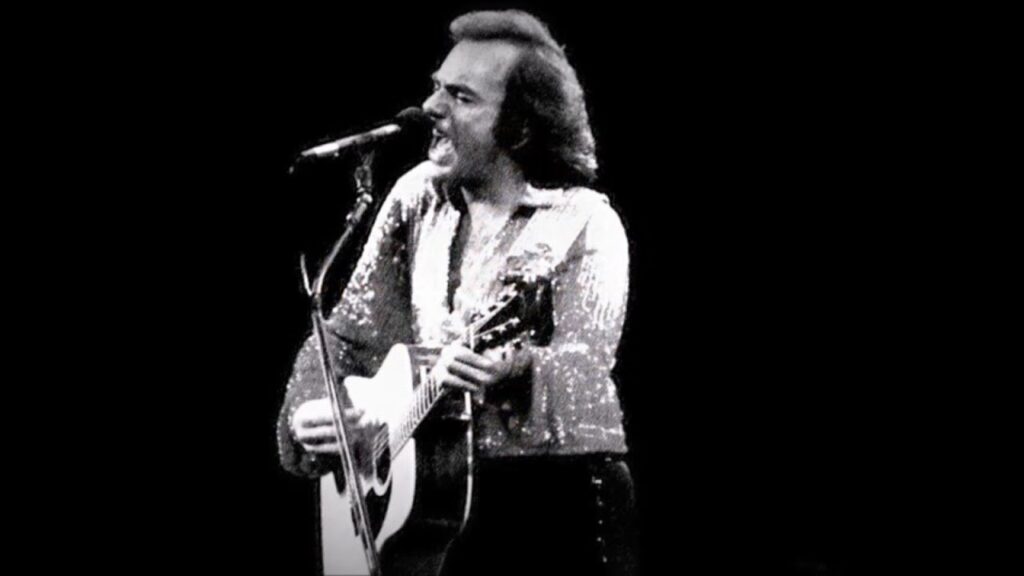
His performance does not seek to personalize the songs in an autobiographical way. Instead, he hosts them. He sings as if opening the door and inviting everyone in, allowing the melodies to do what they have always done—gather people together. There is confidence in that restraint. Diamond does not compete with the carols’ history. He respects it.
Vocally, his tone is firm, warm, and unmistakably human. By the mid-1990s, Diamond’s voice carried decades of use—grain, weight, and lived experience—and that texture gives this medley its character. Where younger voices might make these songs sound decorative, Diamond makes them sound inhabited. You hear not just cheer, but presence. Not performance, but participation.
The arrangement reflects that philosophy. The orchestration is bright but disciplined, festive without being frantic. There is movement, but no clutter. The transitions between “Deck the Halls” and “We Wish You a Merry Christmas” feel natural, almost conversational, like one group song giving way to another as the evening deepens. Nothing overstays its welcome. That brevity is intentional. These are not songs meant to dominate attention. They are meant to circulate.
Emotionally, the medley works because it avoids exaggeration. Neil Diamond does not oversell joy. He trusts it. He understands that Christmas music doesn’t need to convince people to feel something—they already arrive carrying memories, absences, traditions, and expectations. His job, here, is not to instruct emotion, but to support it. The result is a track that feels comfortable in the background and rewarding when heard closely.
There is also something quietly meaningful about Diamond choosing to record traditional carols rather than original holiday material at this stage of his career. By 1994, he had nothing left to prove as a songwriter. Turning to folk tradition was not a creative shortcut—it was an acknowledgment that some songs do not belong to the writer, but to the season itself. In that sense, “Deck the Halls / We Wish You a Merry Christmas” functions less like a track and more like a ritual.
Over time, this medley has become one of those recordings that doesn’t demand spotlight but earns return visits. It plays well in shared spaces—living rooms, kitchens, gatherings where conversation matters as much as music. That quality is not accidental. It reflects an older understanding of holiday songs: they are not meant to overpower the moment. They are meant to frame it.
And that may be the lasting value of Neil Diamond’s approach here. He does not chase nostalgia through gloss or irony. He allows the carols to remain what they are—simple, communal, durable—and adds only what he must: a steady voice, a respectful presence, and the sense that joy, when it’s real, doesn’t need embellishment.
In the end, “Deck the Halls / We Wish You a Merry Christmas” as sung by Neil Diamond is not about spectacle. It is about belonging. About the way familiar melodies can still gather people across time. About how celebration, at its best, is not something you perform for others—but something you share, briefly, honestly, and together, before the year turns again.