
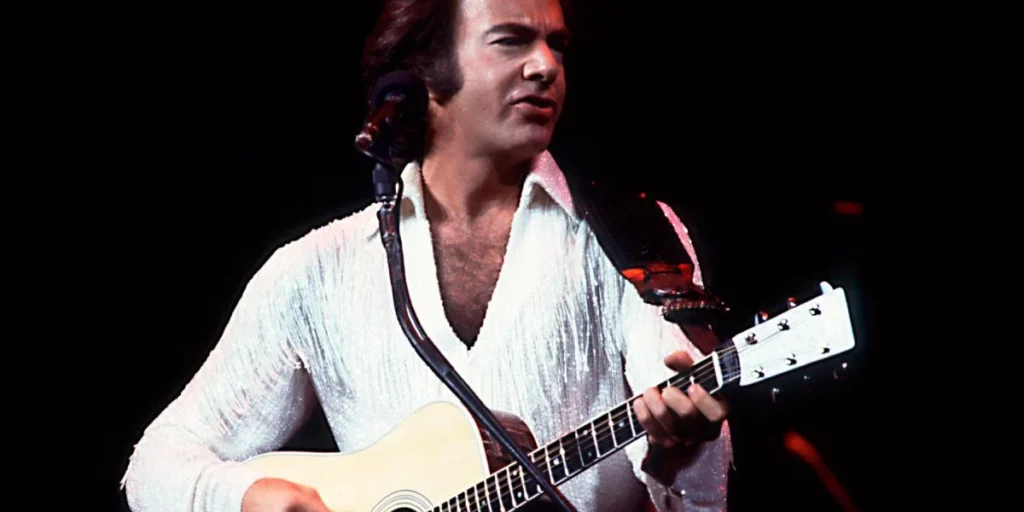
“Alone Again (Naturally)” is a gentle-sounding confession that carries the heaviest kind of sorrow—proof that the quietest melodies can hold the loudest grief.
When Neil Diamond chose to record “Alone Again (Naturally)” for his 2010 covers album Dreams, he wasn’t simply tipping his hat to a famous hit—he was walking into one of pop music’s most delicately devastating rooms and letting the air settle around his own voice. Diamond’s version was released on Dreams on November 2, 2010, where it appears as track 3. The album itself reached No. 8 on the Billboard 200, a strong late-career showing for a record built not on chasing the present, but on honoring the songs that shaped his listening life.
Of course, the song’s original life is the one that made it unforgettable. Gilbert O’Sullivan wrote and recorded “Alone Again (Naturally)” in 1971, releasing it as a single in early 1972—and it became a worldwide sensation. In the United States, it spent six non-consecutive weeks at No. 1 on the Billboard Hot 100 between late July and early September 1972, and finished as No. 2 on Billboard’s 1972 year-end Hot 100. Those numbers aren’t merely “success statistics.” They underline an extraordinary cultural moment: a song with the emotional gravity of a confession—touching on despair, loss, and spiritual doubt—became the most widely shared kind of pop experience, played in daylight, on car radios, in grocery stores, everywhere.
That’s the first miracle of “Alone Again (Naturally)”: it is structured like a pop ballad, yet it behaves like a private diary page you weren’t meant to read. It famously has no conventional chorus; instead, each verse lands on the title line—alone again, naturally—like the soft, repeated sound of a door closing. The music stays civilized, almost courteous, while the lyric keeps lowering you into deeper water. That contrast is the song’s emotional trap: it can sound “pretty” right up until you realize you’re holding something genuinely dark.
So what happens when Neil Diamond sings it nearly four decades later?
Diamond’s career has always been about big feeling—sometimes shouted joyfully, sometimes whispered like a vow—but here he chooses a different kind of bigness: the bigness of restraint. His voice is older, weightier, less interested in proving anything. And that maturity matters, because this song is not heartbreak-as-drama; it’s heartbreak-as-weather. By 2010, Diamond didn’t need to “act” pain. He could simply let the lyric stand there and speak, and his tone—seasoned, slightly gravelled, profoundly human—does the rest.
There’s also a quietly fascinating side-note to the song’s lore: O’Sullivan later recalled that Neil Diamond covered the song and expressed astonishment that a 21-year-old could have written something so emotionally mature. Whether you hear that as admiration or disbelief, it points to the central truth: this is a young person’s song that already sounds like it has lived a long time. Diamond’s cover, then, isn’t an attempt to modernize it—it’s almost the opposite. It’s the sound of an older voice meeting a young writer’s bleak clarity and saying, without embellishment: yes, I recognize this room.
The meaning of “Alone Again (Naturally)”—in any version worthy of the song—is not that sadness is “beautiful.” It’s that sadness is real, and often terribly well-mannered. People can be falling apart while still speaking politely, still walking through ordinary days, still trying to behave. The phrase naturally is the knife: as if being left alone is not even surprising anymore, but expected, almost normal. That single word turns loneliness into a kind of fate, something the narrator has learned to wear like clothing.
In Diamond’s hands, that fate doesn’t feel theatrical—it feels remembered. His recording on Dreams becomes less a cover than a late-night acknowledgment: some songs don’t age, they deepen. They wait for you to catch up to them. And when you do, you realize they weren’t only telling one person’s story in 1972—they were quietly rehearsing the language the rest of us would need, sooner or later, when we found ourselves alone again… and trying to sound composed while the heart tells the truth.