
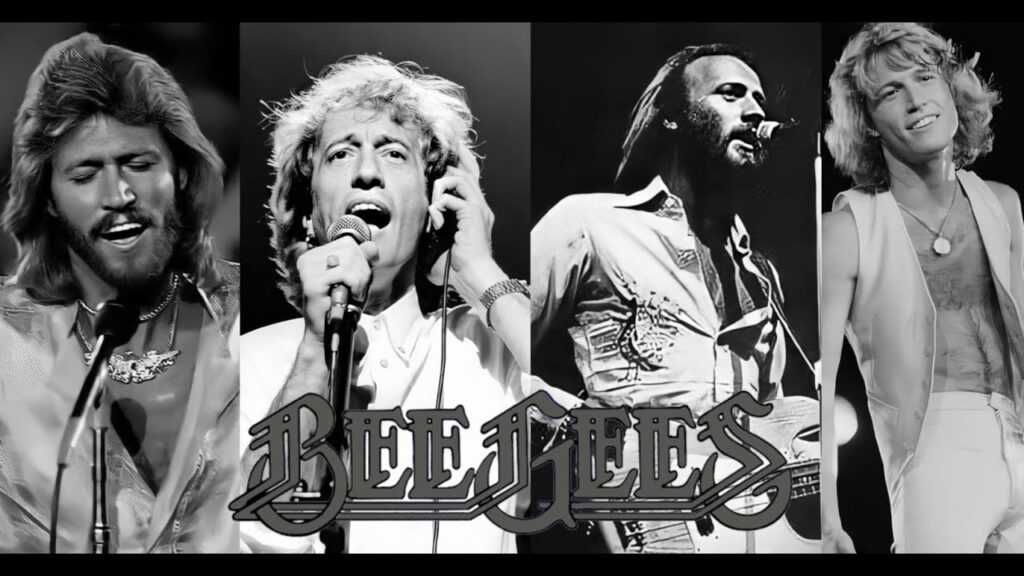
A Fragile Plea Against the Erosion of Love
When “Our Love (Don’t Throw It All Away)” emerged in 1977 on the Bee Gees’ double album Saturday Night Fever: The Original Motion Picture Soundtrack—though not as part of its official tracklist but as a contemporaneous composition circulating within their creative circle—it carried the unmistakable ache of romantic fragility that had come to define the Gibb brothers’ late‑’70s work. Written by Barry Gibb and Blue Weaver, and later recorded by Andy Gibb for his 1978 album Shadow Dancing, the song found its most haunting incarnation through the Bee Gees’ own interpretation, released on their 1979 compilation Bee Gees Greatest. While never issued as a standalone single by the group, Andy’s version reached the Top 10 on the Billboard Hot 100, peaking at No. 9—proof that its quiet melancholy resonated deeply amid an era dominated by glittering disco rhythms.
At its heart, “Our Love (Don’t Throw It All Away)” is an elegy for connection on the brink of dissolution. The Bee Gees, long celebrated for their ability to fuse pop sophistication with naked emotional sincerity, crafted here a ballad that moves with deliberate restraint. The melody unfolds like a confession whispered in half‑light—Barry Gibb’s falsetto carrying both tenderness and fear, an invocation to hold on when love begins to fray. The arrangement is subtle yet luxuriant: cascading strings, gentle electric piano, and a rhythm section that breathes rather than insists. This was not music made for the dance floor but for the solitude that follows it—the stillness after the mirror ball stops spinning.
The song’s origins trace back to the creative explosion surrounding Saturday Night Fever, when the Bee Gees were balancing their mastery of chart‑topping disco with a yearning to return to emotional balladry. Written during sessions at Château d’Hérouville in France, “Our Love” demonstrates how Barry Gibb’s songwriting transcended genre conventions; beneath its glossy production lies a soul song in pop clothing. It articulates one of the oldest truths in human experience: that love is both sacred and terribly fragile, and that losing it often feels like erasing part of oneself.
Lyrically, it is less a narrative than a dialogue between faith and doubt. The voice of the singer oscillates between pleading and remembering—a delicate tension between hope and resignation. In this duality resides its power: every repeated invocation to “not throw it all away” becomes a mantra against impermanence itself. The Bee Gees, so often associated with exuberance and falsetto‑driven euphoria, remind us here of their deeper artistry—their capacity to render vulnerability in symphonic terms. “Our Love (Don’t Throw It All Away)” endures not merely as a love song but as a meditation on what it means to still believe when belief itself begins to fade.