
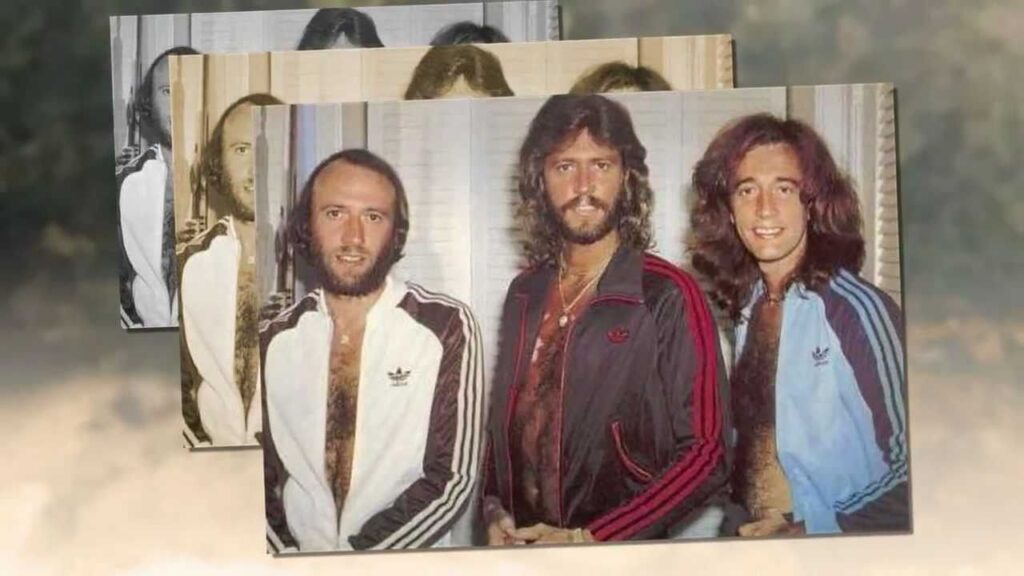
“Lovers” feels like a late-night vow whispered over a steady beat—an insistence that love isn’t a mood, but a decision two people must choose together.
For the Bee Gees, “Lovers” sits in a very specific, very important moment: the calm just before the world called them the kings of Saturday night. The song appears on Children of the World (released 13 September 1976 on RSO Records) and runs about 3:36, with lead vocals shared by Barry Gibb and Robin Gibb—Robin often gliding in that unmistakable, aching falsetto that could make even confidence sound fragile.
Now, about “the ranking at release,” told honestly: “Lovers” was not pushed as a major A-side hit in the U.S. Instead, it became widely known as the B-side to “Boogie Child”, a single issued in January 1977 (UK: 4 February 1977). “Boogie Child” peaked at No. 12 on the Billboard Hot 100, debuting at No. 84 on January 15, 1977, and reaching its peak on March 12, 1977—meaning many listeners first met “Lovers” the old-fashioned way: by turning the record over and letting the needle fall on the “other” song.
Meanwhile, Children of the World itself had real weight in the marketplace: it debuted on the Billboard 200 at No. 20 (chart date October 2, 1976) and later peaked at No. 8—a solid top-ten footprint that signaled the Bee Gees weren’t merely evolving, they were accelerating.
But “Lovers” isn’t remembered because of a chart statistic. It’s remembered because of what it feels like inside that album: a private room in a record built for motion.
To understand the story behind it, you have to picture the Bee Gees in 1976—already seasoned, already scarred, already brilliant, but still hungry to reassert control. Their manager Robert Stigwood had changed U.S. distribution arrangements, which meant the group could no longer work with producer Arif Mardin, who’d helped shape their prior sound. They began Children of the World with Richard Perry but split after creative disagreements, and the brothers took the wheel themselves, with Barry leading in the control room alongside engineer Karl Richardson and musical adviser/arranger Albhy Galuten—a team that would soon become synonymous with their late-’70s domination.
That context matters, because “Lovers” carries the stamp of a band learning how to make groove and tenderness share the same space. It isn’t a grand romantic speech; it’s more like an insistence repeated until it becomes belief. The lyric leans on repetition—“We’ll be lovers…”—not as laziness, but as emotional strategy. Sometimes the heart repeats itself because it’s trying to convince the mind. Sometimes it repeats because it’s frightened the moment will slip away if it stops speaking.
There’s something almost wistful in how “Lovers” balances confidence and pleading at once. The title promises intimacy, but the tone suggests negotiation: got to make you understand. That small phrase is the bruise beneath the shine. It implies there’s distance to cross, doubt to soften, a hand to hold that hasn’t yet decided to stay. The Bee Gees were masters at this particular emotional color—desire that isn’t arrogant, romance that doesn’t swagger. Even at their most rhythmic, they often sang like men who understood how easily love can be lost to timing, pride, or simple misunderstanding.
And as an album track—especially one that lived on the flip side of “Boogie Child”—“Lovers” embodies a kind of old listening culture many of us miss. You didn’t “skip.” You discovered. You learned the record’s hidden rooms. You found the songs that didn’t shout for attention but rewarded it. In that sense, “Lovers” feels like a secret kept in plain sight: tucked between bigger titles on a platinum-era album, waiting for the listener who stays long enough to hear what the Bee Gees were really saying in 1976.
Not just dance with us.
But: stay with me—choose this—be my lover, for real.