
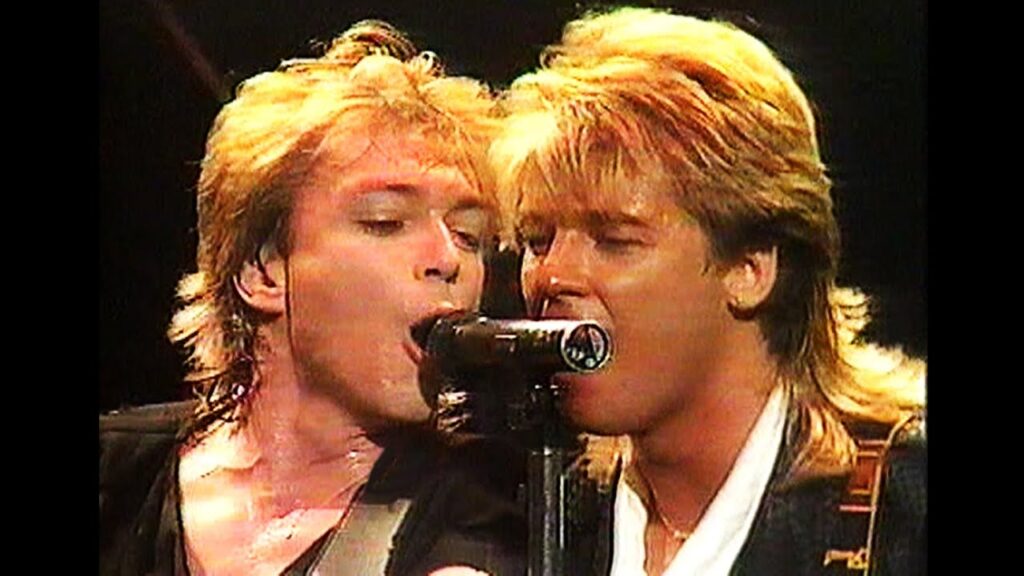
“The Story of Rock and Roll” is David Cassidy stepping out of the teen-idol spotlight and into the long shadow of musical history—asking, almost softly, where he fits when the applause fades.
Before the feeling, the facts—because in this case, the facts are part of the drama. “The Story of Rock and Roll” is a Harry Nilsson composition that David Cassidy recorded for his RCA-era album Gettin’ It in the Street, issued in Germany and Japan in November 1976. The record did not reach the album charts, and in a twist that still feels like an industry shrug, the album was shelved in the U.S. near its planned release; already-pressed American copies only surfaced later, effectively dumped onto the market in July 1979. On the original LP sequencing, “The Story of Rock and Roll” sits as Side One, track 4 (and track 7 in the full running order), running right around five minutes—long enough to feel like a little journey rather than a quick radio note.
That context matters, because this isn’t just “another album cut.” It’s a song living inside a half-hidden chapter of Cassidy’s career—a period when he was trying, very deliberately, to redraw the outline people had traced around him. Gettin’ It in the Street was co-produced by David Cassidy and Gerry Beckley (of America), a pairing that already signals intent: less bubblegum gloss, more musician-to-musician seriousness. The title track even features Mick Ronson on lead guitar, a name that carries real rock gravity. Yet the record’s commercial story in the U.S. stalled hard—its title single barely grazed Billboard’s periphery at No. 105 (Bubbling Under).
So why does “The Story of Rock and Roll” feel so poignant here? Because it’s meta—a song about rock’s own mythology, sung by a man the world had already labeled, too neatly, as a manufactured heartthrob. Nilsson wrote the song years earlier, and it had already lived a public life: The Turtles released their version as a 1968 single, and it reached No. 48 on the Billboard Hot 100. That matters because Cassidy wasn’t choosing an obscure novelty—he was choosing a ready-made “history lesson” track, a compact celebration of rock’s turns and detours, its swagger and its innocence.
And here’s the emotional pivot: when Cassidy sings this song in 1976, he’s not only telling rock’s story—he’s quietly telling his. By then, the distance between the screaming stadium years and the harder adulthood of the music business had grown wide. The 1970s were full of reinventions, and Cassidy’s reinvention didn’t arrive with a triumphant headline. It arrived with an album that slipped out overseas, then vanished domestically into cut-out bins. That’s why “The Story of Rock and Roll” lands with a particular kind of ache: it’s a man singing about a genre built on freedom while negotiating an industry that could still close doors without apology.
The musicianship on this era also hints at what Cassidy wanted the listener to hear: that he wasn’t just a face, he was a working artist in a room with players. Accounts of the album’s sessions credit Bryan Garofalo with handling lead guitar on “The Story of Rock and Roll,” with David Kemper on drums and Jay Gruska on keys across much of the record. Whether you come for the biography or just the sound, those details underline the point: this was band work, not a prefabricated TV tie-in.
And the meaning? It’s both simple and quietly devastating. A “story” suggests something you can stand outside of and narrate cleanly. But rock and roll—real rock and roll—doesn’t sit still long enough to be summarized. It slips through fingers, mutates, steals from yesterday, becomes tomorrow, and leaves everyone a little older in the process. Cassidy’s performance, placed inside a record that itself became elusive, turns the song into a meditation on belonging: Who gets to claim the music? Who gets written into the story? Who gets left out?
In the end, “The Story of Rock and Roll” isn’t just a fun retrospective. In David Cassidy’s hands, it becomes a tender act of reaching—toward credibility, toward lineage, toward a place in the musical family photo that he could inhabit on his own terms. And there’s something deeply human in that: the sense that even after fame has come and gone, a singer can still stand at the edge of the stage lights and say, in his own voice, I was here too—and I loved this music enough to try again.