
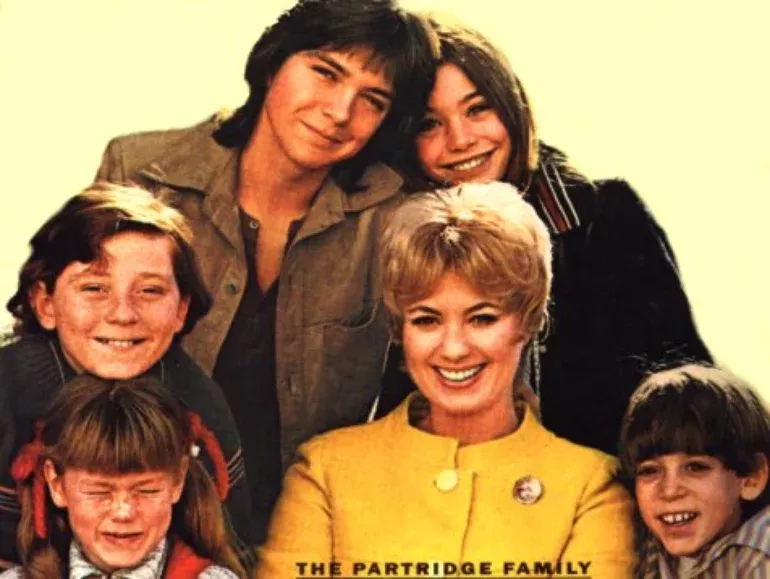
Lookin’ For A Good Time is one of those late-era The Partridge Family recordings that sounds sunny on the surface, yet quietly carries the wistful feeling of a bright moment already slipping into memory.
There is something especially touching about “Lookin’ For A Good Time” because it comes from the later chapter of The Partridge Family story, when the frenzy of their earliest hits had begun to settle and the music itself started to reveal a little more maturity beneath the bubblegum shine. Released on the 1973 album Bulletin Board on Bell Records, the song was not one of the group’s major standalone American chart smashes, and that is precisely part of its charm. It lives a little off to the side of the biggest headlines, away from the towering success of “I Think I Love You”, which famously reached No. 1 on the Billboard Hot 100, and away from other major hits like “Doesn’t Somebody Want to Be Wanted” and “I’ll Meet You Halfway”. Instead, “Lookin’ For A Good Time” endures as a reminder that not every memorable song announces itself with a chart trophy. Some simply stay warm in the heart.
By the time Bulletin Board arrived, the world around The Partridge Family had changed. The early burst of television-driven pop that made them household favorites was no longer the whole story in popular music. Tastes were shifting. Rock had grown heavier in some corners, singer-songwriters were becoming more intimate and confessional, and mainstream pop was becoming sleeker, glossier, and more rhythm-conscious. In that atmosphere, “Lookin’ For A Good Time” feels like a record trying to hold onto joy without sounding childish. It still has bounce, polish, and a clean melodic lift, but there is also a gentle restlessness in it, as if the song knows that good times are not just found; sometimes they are chased.
That emotional tension is what makes the track more interesting than its title alone might suggest. On paper, “Lookin’ For A Good Time” sounds carefree, almost like a disposable invitation to fun. But when heard in the broader context of the group’s final recording era, it becomes something richer. This is not merely a celebration song. It is a search song. The phrasing itself matters: not having a good time, but looking for one. That subtle difference changes everything. Suddenly, the tune becomes about longing, motion, and the very human hope that somewhere ahead there is still a little sparkle left to be found.
Musically, the song reflects the reliable craft that supported so much of The Partridge Family catalog. Although the television image centered on the fictional family band, the records themselves were built with the help of top Los Angeles studio talent, guided by producer Wes Farrell. The signature voice most listeners connected with the group was, of course, David Cassidy, whose tone brought both youthful energy and surprising emotional color to many of the recordings. That combination mattered. In a song like “Lookin’ For A Good Time”, the arrangement may sound easy and radio-friendly, but the vocal style gives it a little ache around the edges. That is often where the real feeling in a Partridge Family record lives: not in grand dramatic gestures, but in the slight tug between brightness and yearning.
The song also says something important about where David Cassidy and the broader Partridge Family phenomenon stood in 1973. Cassidy was no longer just the fresh-faced idol from the beginning of the decade. He was growing older, his audience was growing with him, and the music had to sit in that uneasy but fascinating transition. “Lookin’ For A Good Time” belongs to that moment. It still carries the approachable warmth that made the group so beloved, yet it also hints at a more grown emotional landscape. That is one reason later listeners often return to these lesser-celebrated tracks. They hear not just pop craftsmanship, but transition. They hear youth trying to keep its smile while adulthood is already visible on the horizon.
There is also a nostalgic power in the song’s place within Bulletin Board. The album itself arrived near the end of the group’s recording life, and because of that, every strong track on it feels a little more poignant. Fans who came of age with the series and its music often hear these later songs differently than the giant early hits. The first wave of hits can feel tied to a moment of pure excitement. But songs like “Lookin’ For A Good Time” feel more reflective now. They remind us how quickly a pop era can pass, and how the records left behind become small time capsules of who we were when we first heard them.
What does the song mean, then, after all these years? At its heart, it speaks to a simple but enduring desire: the hope of breaking free from monotony, doubt, or emotional fatigue and finding a pocket of light again. That is why the song has lasted beyond its chart footprint. Its message is modest, but deeply recognizable. Everyone knows what it is to go looking for a better hour, a brighter evening, a little lift in the spirit. In that sense, “Lookin’ For A Good Time” is more than a cheerful pop tune from a television-era group. It is a beautifully unpretentious expression of optimism, sung at a moment when optimism itself was becoming more complicated.
And maybe that is why the song still glows. It captures The Partridge Family not at the explosive height of their fame, but at a more revealing point: seasoned, polished, a touch wistful, and still reaching for melody that could make life feel lighter. For listeners who love the deeper corners of classic pop, “Lookin’ For A Good Time” is not a forgotten leftover. It is a late-period gem, carrying the sweetness of the group’s identity and the faint, unmistakable shadow of time passing behind it. That mixture is hard to fake, and even harder to forget.