
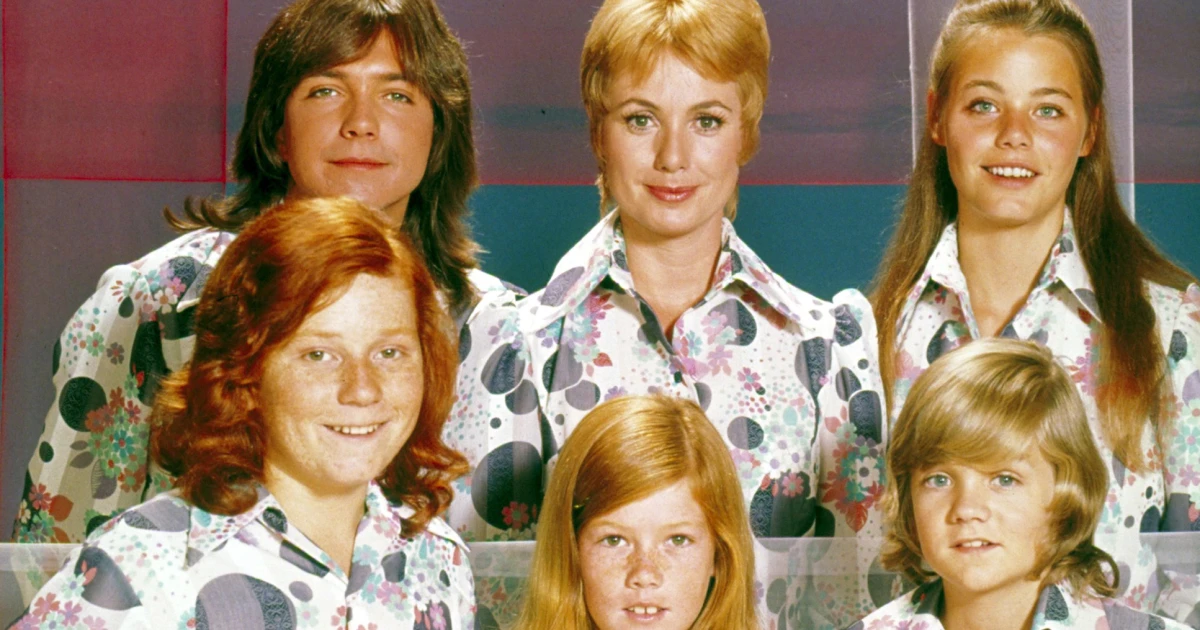
It’s All In Your Mind reveals how The Partridge Family could take a bright pop surface and hide something far more tender underneath: the lonely struggle of pretending a feeling is only imagination.
It’s All In Your Mind was never one of the giant, era-defining chart smashes that first made The Partridge Family unavoidable on radio and television, and that is precisely why the song feels so special today. While I Think I Love You reached No. 1 on the Billboard Hot 100 in 1970, and later hits like Doesn’t Somebody Want to Be Wanted climbed to No. 6 and I’ll Meet You Halfway reached No. 9, It’s All In Your Mind lived more quietly in the group’s catalog. It is generally remembered as a deeper album-era recording rather than a major chart single of its own. Yet sometimes the songs that do not dominate the headlines are the ones that stay with us longest, because they ask for listening instead of applause.
That is the hidden beauty of this recording. The Partridge Family was, of course, born from television. The series debuted in 1970, and for many listeners the group became inseparable from that warm, bright image of a musical family rolling down the road in a painted bus. But behind the sitcom premise was a very real pop machine, guided by producer Wes Farrell, powered by top Los Angeles studio musicians, and carried above all by the unmistakable lead voice of David Cassidy. He brought youthful charm to the hits, but he also brought vulnerability, and songs like It’s All In Your Mind remind us that his best performances were often the ones that sounded as if they were holding something back.
The title alone tells you almost everything about the emotional world of the song. To say something is all in your mind is to dismiss it, to reduce it, to insist that the heart is making trouble where no trouble exists. But great pop songs often live in the gap between what we say and what we feel. That is where this one lingers. Beneath its polished arrangement, the song carries the ache of denial. It understands that familiar human habit of trying to explain away longing, uncertainty, or romantic confusion, even when the feeling has already taken hold. In that sense, the song is not simply about love; it is about self-protection. It is about the stories people tell themselves when emotion begins to feel too large, too embarrassing, or too real.
Musically, the recording fits beautifully into the smoother, more reflective side of the Partridge Family sound. The group could certainly deliver bright bubblegum energy when needed, but this kind of song works differently. It leans on softness, melodic ease, and a carefully shaped vocal line that lets mood do the work. There is no need for bombast here. The feeling comes from restraint. David Cassidy sings with the kind of warmth that made so many listeners feel he was singing directly into the room rather than out into an arena. That intimacy matters. A song about trying to deny what you feel would collapse under too much production bravado. Instead, It’s All In Your Mind finds its power in understatement.
What makes the song so compelling now is the contrast it offers to the public memory of The Partridge Family. For many people, the name still calls up a burst of color, catchy choruses, and a distinctly early-1970s kind of optimism. All of that is real. But songs like this reveal the emotional shading inside the catalog. They show that the group’s recordings were not only about sugar-coated hooks. There was often a wistful undercurrent, a sense that behind the smiles and harmonies lay the kinds of doubts and hesitations that never go out of style. That is why rediscovering a lesser-known title can be so moving. It restores dimension to an act that history sometimes remembers too narrowly.
There may not be one dramatic, legendary studio anecdote attached to It’s All In Your Mind, and in some ways that suits the song. Its story is quieter. It belongs to that rich middle ground of pop history where craftsmanship, sincerity, and mood could still create something lasting without the mythology of scandal or reinvention. It was part of a body of work made during a period when The Partridge Family was balancing commercial demand with moments of genuine emotional nuance. Listeners who return to the song now often hear more than they did the first time, because age has a way of sharpening the meanings of songs about doubt, memory, and the heart’s refusal to stay neatly explained.
And perhaps that is the true meaning of It’s All In Your Mind. It is not really telling us that feeling is imaginary. It is showing us how people try, often unsuccessfully, to tame emotion by naming it unreal. That old tension gives the song its staying power. Long after bigger hits have had their celebratory spin, a song like this remains quietly alive, waiting for the right afternoon, the right memory, the right silence between thoughts. In that space, The Partridge Family sounds less like a television phenomenon and more like what they also were at their best: a keeper of soft, human truths wrapped in melody.