
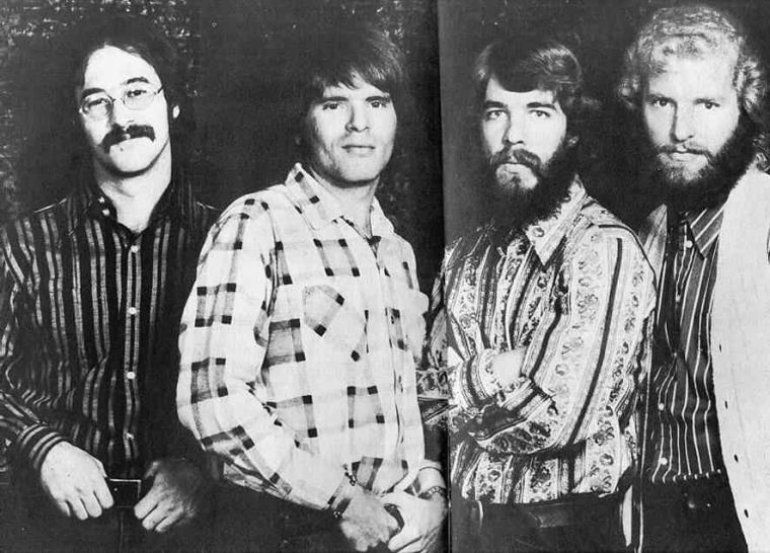
“Bad Moon Rising” is the rare Creedence Clearwater Revival classic that smiles while it warns—an apocalyptic song dressed in a jukebox melody, where dread comes dancing in on a bright, irresistible rhythm.
Released on April 16, 1969 as the lead single from Green River, “Bad Moon Rising” became one of Creedence Clearwater Revival’s defining records almost at once. In the United States it climbed to No. 2 on the Billboard Hot 100, where Billboard shows it peaking on June 28, 1969, and in Britain it went even higher, reaching No. 1 on the UK Singles Chart for three weeks that September. It was also certified as CCR’s second gold single, which tells us something essential right away: this was not a song that grew into legend only after the fact. It was a major hit from the beginning, a record that entered popular life quickly and never really left it.
As for the wording “Remastered 1985,” it is best understood not as a separate composition or a distinct new-era recording, but as a later remastered catalog presentation of the same 1969 master, commonly attached in digital services to Chronicle: 20 Greatest Hits. That compilation itself first appeared in 1976, but 1985 CD and later catalog editions helped establish the remaster labeling that many listeners now see in streaming libraries. So the heart of the song remains entirely rooted in 1969; the “1985” tag belongs to its reissue history, not to the moment of creation.
The story behind the song is one of those wonderful contradictions that only a songwriter like John Fogerty could make sound natural. Fogerty drew inspiration from the ominous storm-and-doom atmosphere of the 1941 film The Devil and Daniel Webster, and he also wrote it during a period of social unease in America, when the late 1960s seemed full of violence, unrest, and a creeping sense that trouble was gathering just beyond the horizon. Yet instead of writing a slow dirge or a thunderous protest, he gave that anxiety a brisk, almost cheerful rockabilly pulse. That contrast is the secret of the song’s enduring force. It sounds like a good time until one actually listens. Then the clouds roll in.
That is why “Bad Moon Rising” has always felt so uncanny. Lyrically, it is full of foreboding: bad weather, earthquakes, destruction, the sense that something terrible is approaching and cannot be stopped. But musically it moves with a lightness that feels almost mischievous. This is not accidental. The song’s brilliance lies in the tension between sound and meaning. Creedence Clearwater Revival make disaster feel catchy. They turn prophecy into something you can hum on the way home. And in doing so, they capture something very true about modern life: danger does not always announce itself with solemnity. Sometimes it comes with a bright hook, a clean guitar line, and a rhythm so friendly that the warning sneaks into the blood before the mind fully notices.
In emotional terms, “Bad Moon Rising” is not merely about catastrophe in the literal sense. Its deeper meaning is broader. It speaks to that old human feeling that the world has shifted slightly off balance—that intuition, hard to prove but impossible to silence, that hard times are coming. It is a song about dread before the event, about reading the signs in the sky and feeling one’s spirit tighten. This is why it has lasted so powerfully across generations and across situations far beyond 1969. The song never becomes trapped in one historical moment because its central emotion is permanent. Every age knows what it is to feel the weather changing.
Placed in the context of Green River, the song also shows just how extraordinary CCR were at their peak. This was a band that could fuse rockabilly, blues rock, swamp rock, and pop concision into something instantly recognizable. John Fogerty wrote with the plainspoken force of someone who understood that memorable songs are often built from simple words charged with genuine feeling. There is no excess in “Bad Moon Rising.” It wastes nothing. The melody is direct, the imagery sharp, the arrangement lean. Yet within that economy, the song opens a whole emotional landscape—one of storm light, public anxiety, and private unease.
And that is why the remastered version still lands so strongly today. Remastering can clarify the edges, brighten the instruments, and bring out the snap of the rhythm section, but it does not change what made the record immortal in the first place. What still matters is that strange old magic at the center of it: the way Creedence Clearwater Revival turned a warning into an anthem. The way John Fogerty wrote a song about ruin that somehow felt alive with motion. The way dread and delight keep brushing against one another in every chorus.
So “Bad Moon Rising (Remastered 1985)” should be heard as a later sonic presentation of one of CCR’s purest masterpieces: a 1969 single from Green River, a No. 2 hit in America, a No. 1 hit in Britain, and one of the great paradoxes in rock history. It is ominous without being heavy, popular without being shallow, and familiar without ever losing its edge. More than half a century later, it still sounds like a smile wearing a prophecy.