
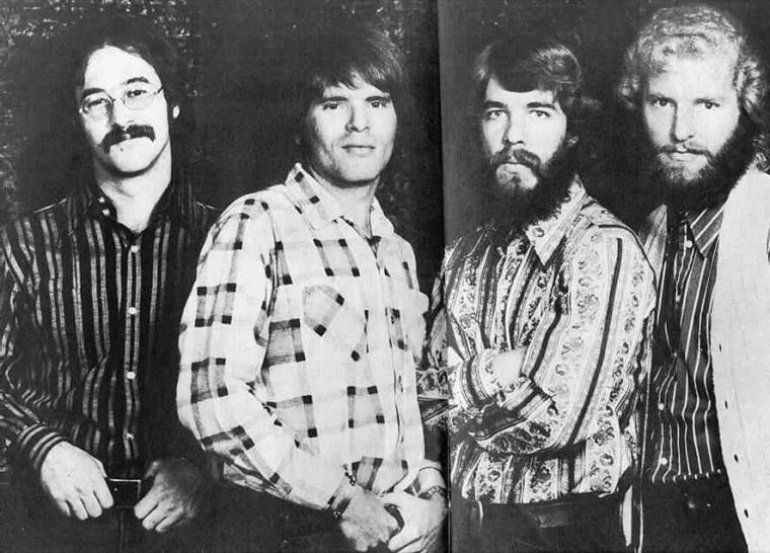
“Sail Away” feels like CCR’s last, quiet wave from the shoreline—an invitation to escape that already knows the tide is pulling the band apart.
“Sail Away” sits on a very particular page of the Creedence Clearwater Revival story: it’s one of the deep cuts on Mardi Gras, the group’s final studio album, released April 11, 1972. That date matters, because by then the CCR engine that had once sounded unstoppable was running on strained companionship. Tom Fogerty was gone, and what remained was a trio trying—sometimes stubbornly, sometimes resentfully—to keep the ship moving.
On Mardi Gras, the usual CCR rules were broken on purpose: instead of John Fogerty controlling nearly everything, the album was built as a forced “share,” with songs written, sung, and produced by each remaining member. That decision is the shadow behind “Sail Away.” This track is credited as a Stu Cook composition—written and sung by Cook, and (in accounts of the sessions) he is even said to have played lead guitar on it. And if that sounds like an unusual sentence to say about a Creedence record, it’s because it is. For years, CCR had been a band of shared muscle and largely singular authorship. Here, you’re hearing one of the moments when the “other” voices step forward—not as decoration, but as proof that the old hierarchy was cracking.
If you’re looking for the “ranking at release,” the clearest chart story belongs to the album rather than the track. Mardi Gras was still a commercial success, peaking at No. 12 on the Billboard 200 and earning a gold certification—listeners showed up, even if critics often didn’t. “Sail Away” itself wasn’t promoted as a major A-side single; it lived where album tracks live: in the deeper rooms, waiting for those who let the record keep spinning after the familiar titles. (Discographies and release listings place “Sail Away” right there in the middle of the LP’s back half, with a duration commonly listed around 2:25.)
So what is the song doing emotionally? Even without the lyric sheet in front of you, the title tells the truth: escape—not the glamorous kind, but the kind you fantasize about when reality has become too loud. A sailor, a captain, the sea: these are classic symbols of leaving without having to explain. In the CCR universe, “leaving” is often a physical act—rivers, roads, storms, the sense of motion as survival. But on “Sail Away,” that motion feels different. It doesn’t swagger. It drifts. It feels like someone trying to convince himself that starting over is still possible, even while the past is packed into every suitcase.
And the backstory makes that ache sharper. Mardi Gras was recorded amid personal and creative tensions, and the band would disband only months after the album’s release. With that knowledge, “Sail Away” can sound less like a carefree travel postcard and more like a private coping mechanism: If I can’t fix what’s happening here, maybe I can dream of somewhere else. It’s the old human bargain—when the heart can’t repair a room, it starts imagining a horizon.
Critically, “Sail Away” has often been singled out as one of the album’s more controversial moments, sometimes described as difficult compared to CCR’s classic run—an uncomfortable reminder that not every farewell arrives polished and heroic. Yet there’s a strange dignity in that discomfort. Because this isn’t a band at its most mythic; it’s a band at its most human. Great groups don’t always end with a perfect closing line. Sometimes they end mid-thought, with the feeling of unfinished conversations still hanging in the air.
That’s why “Sail Away” lingers for listeners who return to it with years behind them. It isn’t there to compete with CCR’s monuments. It’s there to reveal a softer truth: even the strongest engines eventually reach a point where the road feels too heavy, and the mind begins to look toward water—toward distance, toward silence, toward the merciful idea that the next day might begin somewhere else.